
How I Went From Being A Disturbed To A Deep Sleeper
My science-backed night routine
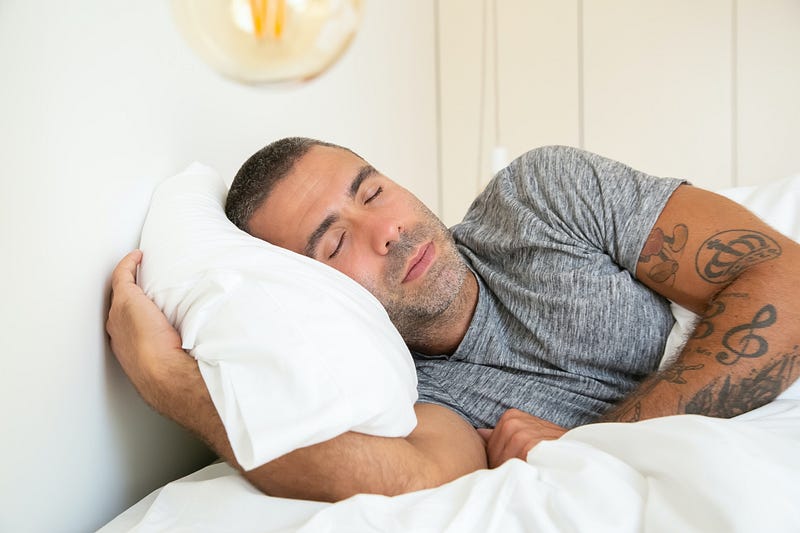
I’ve had sleep issues all my life.
I couldn't sleep for longer than 7 hours no matter how tired I was.
After years of being chronically sleep-deprived, I can’t put into words how much of a relief it is to get 8+ hours of deep, restful sleep every night.
Steal this night routine for a rejuvenating night of sleep.
T — 6 hours: stop all caffeine
The Journal of Clinical Sleep Medicine says that any caffeine ingested less than 6 hours before bedtime can be significantly disruptive to your sleep.
I love a good cup of joe to get over the afternoon dip in energy.
Unfortunately, there’s literally nothing worse for your sleep than caffeine late in the day.
It can be especially tempting to have a little pick-me-up for those of us who exercise in the evenings.
But I’d rather have a sub-optimal workout than a night of bad sleep.
T — 5 hours: warm lights only
You can kiss good sleep goodbye if you stare at a bright screen until bedtime.
Warm lights like yellow and cool colors signal to your brain that the day is over and it’s time to wind down.
The Sleep Foundation says that:
Low illuminance helps with relaxation and getting into the right mindset for sleep.
I turn on warm lights in my room to switch off my brain.
T — 4 hours: light evening cardio
You sleep better when you’re tired.
Our bodies have a funny way of resting deeply when they know we need it.
It sounds like common sense but many of us forget this simple fact.
We’re so caught up in the intellectual work that our jobs and responsibilities bring us that we forget to do physical work.
Neuroscientist Andrew Huberman says that cardio workouts in the evening tire out your cardiovascular system — in a good way.
The Stanford professor points out that engaging in intense weight-training sessions in the evening can destroy your sleep.
It’s not just about exercise, it’s also about the context.
You then have to ask yourself what’s happening around that workout. So are you going into a brightly lit gym at 11 o’clock at night and blasting music, drinking three espressos, or an energy drink before you go? You’re gonna be awake — you’re gonna have a hard time going to sleep. It’s not just the workout — It’s the context around the workout.
Personally, my sleep has dramatically improved since I started playing sports or going on long walks in the evenings.
T — 3 hours: an early dinner
I don’t like being a grandpa and having dinner at 6 pm.
But it’s something that I have to do for my sleep.
Eating 3 hours before bed is the sweet spot because any earlier would lead to a hunger pang at bedtime — a recipe for late-night snacking which messes with your sleep.
Eating any later can deter your sleep too. Your body needs time and energy to digest food. It can’t shut down and go into rest mode if it’s still digesting your dinner.
Eating a carb-rich meal 3 hours before bedtime also makes my intermittent fasting practice much easier by keeping me full for longer.
I fast for a minimum of 13 hours every day, you can read about it here.
T — 2 hours: wind down mode
Shahab Haghayegh, like me, always had trouble sleeping.
The graduate student couldn’t fall asleep until the wee hours of the morning and awoke with less than 4 hours of sleep every day.
Fed up with this tiresome schedule, he decided to try one last thing: a warm shower before bed.
It changed everything for him.
So much so that he not only started sleeping 8 hours a night but also went on to do a systematic review of the effectiveness of this practice along with his colleagues.
Warm showers help you bring your body’s core temperature down — something that’s essential to get a good night’s rest.
Try this wind-down routine today:
- Finish work a maximum of 2 hours before bedtime
- Have a warm shower after dinner
- Cool your room down to create a conducive environment for sleep
Another game-changer for me was setting the air-conditioner to 18–22 degrees Celcius every night.
A widely popular study found that the temperature you sleep in can significantly determine the quality of it.
It might seem like a small thing but it makes a huge difference.
T — 1 hour: supplements
I posted this night routine of mine on LinkedIn earlier this week.
A couple of people gave me flak for using supplements like Melatonin and Ambien.
They were of the opinion that since the body produces Melatonin naturally, nobody should take supplements for it.
That’s like saying whey protein is bad because our bodies can produce protein.
I take a combination of the aforementioned supplements because they help me fall asleep easily and more importantly — stay asleep for 8+ hours.
Supplements are nothing to be scared of. They’ve become increasingly well-researched and widely prescribed today. Millions of us who have trouble sleeping use it.
I’m not a Doctor so I’m not asking you to take anything, I’m only sharing that taking sleep supplements has completely transformed the quality of my sleep.
Consult your physician and you do you.