
How I Went From a B Student to an A Student In Law School
Being prepared > being smart

About nine months ago, I wrote about how I’d been studying for law school the wrong way. My thesis was essentially that I studied ineffectively because I focused too much on doing the readings and not enough on doing practice problems. I essentially said overfocusing on the reading was a waste of time, and that it didn’t matter if you embarrassed yourself when cold-called by the professor.
I regret to admit that I was wrong.
That semester, I got two B’s and an A-. This was just average for my law school. I could have tried harder throughout. I knew I was capable of more, despite the fact that I am an evening student and I work a full-time job while being in law school. I was tired of making excuses for myself and just wanted to do better and see results.
And so I had to try to find a new strategy. It’s not good etiquette among your law school peers to share or talk about grades, for the most part. I once sent my wife a screenshot of my grades and she put it on my Instagram story. I started to panic to see if any of my classmates were following her. The rationale is how is someone who didn’t do so well in a course supposed to feel if you’re bragging about your good grades, or vice versa?
But if my growth as a law student can help other students, and even one aspiring or current law student, then I’m very happy to have helped someone, much like I always send my classmates my notes when they ask.
I started to be more proactive, participate more, be prepared for every class, and do the readings. This ended up working well. In my summer classes and fall classes this year, I went from a B student to an A student. And in the fall of 2023, I carried on that trend. I scored the highest grade in my Contracts class and secured the only A+ in the class, and I did this in doctrinal classes that are graded on a curve, where only a minority of students in class get A’s.
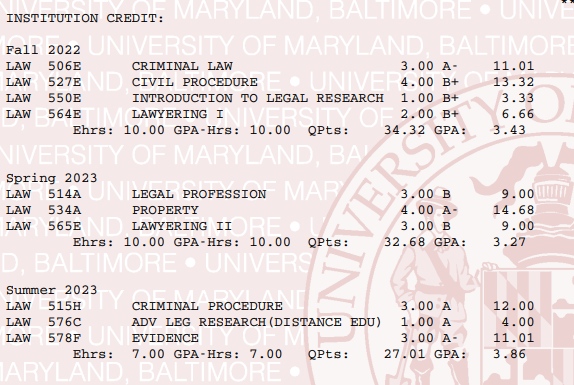
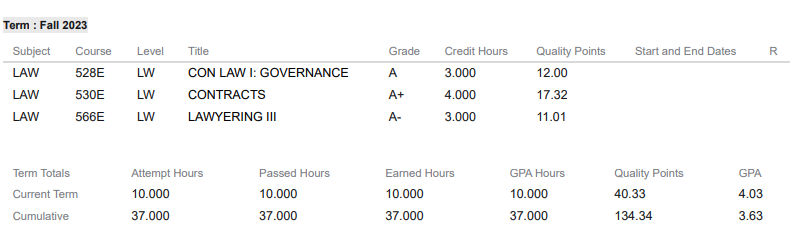
Different things work for different people. But these are the strategies that worked well for me and lessons I learned of things that did or didn’t work well, through trial and error. I hope I can keep up this academic performance, as I didn’t know law school well my first year, but I feel like I know law school a lot better now. But here that may work well for other law students.
You are as good as your outline
If you are new to law school, you should know a lot of law schools have open book exams. Law professors will rarely allow students to scan the Internet, but they do often allow an outline. In law school, an outline is a document of organized notes you’re allowed to compose for the exam.
The fact that open book exams are so common despite the bar exam being closed book (and requiring an intense amount of memorization was a bit head-scratching to me, but the rationale, I guess, is that in most of your work, you will have access to legal research and reference materials).
There are a lot of super smart people who have super short outlines. They may have two to four page outlines and still ace the test. I thought I could be one of these people. I thought I could rely on a photographic memory and superhuman recall. I thought I could rely on just stepping up when it was crunch time. I tried to rely on this recall that had served me well in other situations.
But I was wrong. I had to admit I wasn’t the smartest guy in the room, or at least wasn’t as smart as I thought I was. There are a ton of classmates more intelligent than me and better able to recall from memory what exactly happened in X or Y case.
The only thing within my locus of control was how well-prepared I could be for final exams. If you know anything about law school, you would know that final exams are the vast majority of grades in doctrinal and major classes like criminal law, civil procedure, and constitutional law. Maybe 10% of your grade is how much you participated in the class.
But starting in the summer of 2023, I started to have 40+ page outlines for the exam. My criminal procedure outline ran 100 pages. These outlines would include every single bullet of slides the professor put up if they used slides. They would also include a summary of every single case we read during the semester. I needed to know what the professor said were the essential facts, ruling, and holding.
I think it’s very important to note that whatever the professor said was gospel. In law school, one thing I still hold to be true is that the law is not the law — the law is what the professor says the law is. I know people who don’t always go to class and just do reading or look at study guides or commercial study guides (Quimbee is the most common one among my peers).
But the essential parts of knowing what the professor said are that only certain topics are mentioned on the final and that the professor emphasizes certain parts of cases or topics. Not knowing what to focus on can lead to studying the wrong things, studying topics not covered in class, and not knowing what the professor said is important. If they said it in writing, on a Powerpoint slide, then it was especially important as gospel.
I also started outlining the first day of class. My notes were, essentially, my outline. On the test, we were not allowed to copy and paste into the exam software. But we were often able to CTRL+F and find various holdings of cases or whatnot in the outline.
Not only would I have a good outline, but I would get comfortable with the outline. Even if it ran from 40 pages to 100 pages, I would read through it several times. This helped me know what issue I could find a certain case, and I would rearrange and restructure when one case fell more within a certain topic than another. However, reading through my outlines also showed me what topics I was strong with and didn’t need to study as much and what topics I was weaker on.
My new rule for law school is that you are as good as your outline. I no longer rely on having my best day with the best sleep, rest, and mental acuity. Instead, I rely on the best preparation through my outline throughout the semester, and the outline would be my semester-long project to be as thorough as possible on the day of the exam.
Know the cases
It took formative assessment quizzes in my criminal procedure class to make me realize that knowing the facts of cases was often free points. Very often, professors tested whether you did the reading and came to class.
They wouldn’t say “What happened in Marbury v. Madison?” super explicitly, but they would often reiterate the exact same fact pattern of a case and then change the names of the parties involved. If you read the case and knew the outcome, you could automatically recall the answer. Even better, if the answer was in your outline, you could also look for the answer in your outline and leave no point in that question or issue spotter up to chance.
I realized the extent to which almost every professor does this. Professors are very busy people. They often do not have a ton of time to conjure completely original fact patterns. I would look at the fact patterns of practice questions and quiz questions and think “huh, these facts sound awfully similar to what happened in Kyllo v. United States,” for example.
Professors say you don’t have to cite any cases on the exam, and there are tons of terrific law school exams that don’t mention any cases. But if you can use rulings of cases for your application and say “like the Supreme Court ruled in McCulloch v. Maryland, this law would be constitutional because…”, your answers would be a lot stronger.
This isn’t to say I went completely in the weeds and read all 20–30 pages of every case. If I was on call and had to present the case to the class, I certainly would. But I did rely on Quimbee and other commercial study guides to brief the case, then copy down into my notes what the essential holding and essential facts were. If the professor added other essential facts and holdings in the lecture, I would alter the mini brief that I had in my outline.
So I was wrong when I said “you can do better without reading the cases.” The rationale was that not every fact of the case and not every sentence was the most important thing in the world. If there was no online case brief or Quimbee entry for the case, I needed to learn how to find these central facts and holdings with no study guide aid. “Don’t read the cases” might work well for others, but it was wrong for me — so definitely at least know the central facts and the holding of the cases.
Practice essay questions and practice exams
At a certain point, maybe three weeks before the final, reading cases should no longer be the priority. Answering practice exams and questions is often just as important. You may have a good study group to study with, but this past semester and over the summer, I was largely on my own.
It’s important to note how the final exam will be structured so you can focus your studying a bit. It’s really easy to fall into the trap of just answering tons of multiple-choice practice questions. After all, they’re low cognitive lift, easier, and you don’t have to write anything. You also practice the skills of process of elimination and making the best guess possible.
However, it’s more likely than not your essays will account for a significantly higher portion of the grade. The most common type of question on a law school exam is an issue spotter. The issue spotter is a type of question where you are given a set of facts and asked to relate the facts to the law you learned in the course. For example, you could be asked “can Joe sue Jill?” and be given a ton of facts in constitutional law about what Jill did to Joe. You would have to identify the issue as standing and then apply the test for standing to see whether it applies in this case.
It’s better to practice these issue spotters. You wouldn’t have to write whole essays, but I would just read the practice questions from professors or essay practice questions on Quimbee. I would often have to read the five-paragraph, dense prompt several times, and then start outlining what the issue was, how to apply the test (if there was one), and what a case we learned in class said about this particular issue. Professors want you to write these answers, often, in IRAC format (Issue, Rule, Application, Conclusion), so I would often structure my essay answers like I would the answers in my legal writing class.
However, if the professor gives practice questions from old exams, these questions are far more helpful than practice questions on any study guide. This is particularly true if the professor gives model answers, as well. A professor’s model answers that they themselves wrote are not a license to copy the professor’s style, but it is an exemplar of what they expect and what they will or will not give full credit on an exam for.
Some professors don’t do multiple choice and only do essays, and those are the exams I’ve done better on. Essay questions are a chance to show what you know, throw everything against the wall and see what sticks. The challenge with multiple choice is, well, you either know it or you don’t or you get the question right or you don’t. You can be tricked or make a mental mistake very easily. It’s not uncommon for professors to say “the multiple choice section is where students lose the most points,” and that has been true of me in every class.
The good thing about study guides like Quimbee is they often give a rationale for every answer and how you should approach the question. The pitfall of study guides is that you can end up reviewing a lot of material you didn’t cover in the class and that won’t be on the final exam if you aren’t clear on what exactly was and was not covered in class.
Doing practice questions after each unit can also help you substantially in understanding the unit. I would only do practice questions at the end of the semester, but it’s likely better to do a few quizzes and questions for individual questions and units on a site like Quimbee or Barbri to check your knowledge and ensure you understand.
Being prepared > being smart
When I first started law school, I often felt like I had no clue what was going on in the class until the last two or so weeks of the class. Often, I would be learning the whole course two or three days before the final. I thought this was how everyone operated. It made sense — I didn’t know how to study, didn’t know the system of law school, and really just didn’t know what I was doing.
I thought I could rely on intuition, sharpness on the day, and a great gut instinct to succeed despite not having the time to do the best preparation for my job. And it’s not like I did poorly — I was an average to an above-average student.
I thought that was the way to do it — that I had to go with the flow, trust my gut, and things would work out. However, I trusted and knew my capabilities of being far more than just an above-average student. But I couldn’t do it by being the smartest guy in the room. I couldn’t do it by having the best memory or recall of all the very intelligent peers around me.
I had to change my approach and change my thinking if I wanted to do better. I couldn’t just rely only on superhuman performance under pressure or a “killer instinct” anymore — I needed more.
I went from a B to an A student by learning the law school system, and above all, being prepared.
I was no longer learning the whole course two to three weeks before the final exam, but hit benchmarks and kept up with my professor the entire course. I no longer had bare-bones outlines that required a huge mental load of recall, but beefy outlines I was comfortable with that gave me every reference point I needed.
Instead of relying on my ability and instincts, I relied on a new system. I relied on my system to be able to keep up and have my bases covered as much as possible. By relying on a better system, I no longer had to rely on behemoth, 10-hour study sessions the day before the exam.
Law school’s difficulty is often the sheer amount of information you need to know for the test and how to apply certain doctrines, but it’s often not like the concepts themselves are difficult.
I should have learned this lesson sooner, but being smart, naturally talented, and performing well under pressure is overrated.
Being prepared is much less stressful and much more effective.


