
How I Used “Discount Testing” To Increase Revenue By 6X
Discounts can be magic — but you’ve got to test them.
Over the last decade, I’ve worked as a marketing manager for different startups. Despite their differences, most of my clients had one thing in common: they spent up to 60% of their marketing budget on discounts.
And that’s the problem — most companies do not change their discount strategy despite this high spending.
They pick a popular discount type in the market and stick to it, hoping the same discount will get customers to use their service for a long time.
The truth is the business impact of any discount fades away if you do not have fresh alternatives.
Imagine hosting a weekly dinner party. If you keep serving the same yummy dish, your guests might find the experience less exciting over time.
That’s why you must constantly change your discount strategy to grow your business. Otherwise, the revenue does not increase after the discount’s honeymoon phase ends.
That was my challenge at my job in a ride-sharing company.
The Challenge
We were doing well in the first three months. We were sending customers one popular type of discount in the newsletters: $6 off the next ride with a promotion code.
We were confident that this offer would work. All competitors were offering the same discount type to their customers in newsletters.
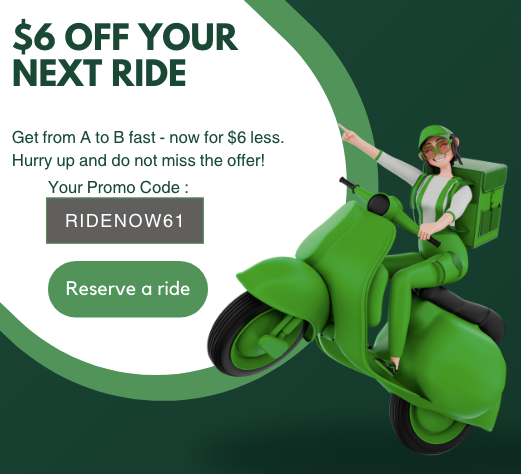
We spent a lot of money on these newsletter campaigns. But the revenue stopped growing after three months.
I even sent the same newsletters more frequently because of the panic mode in the company.
It did not work. Email open rates started to decrease. The revenue remained stagnant.
We could not keep our customers for the long haul despite the discount.
It was exactly like serving only the most delicious dish to all the guests. We expected all our customers to like our offer after giving one dish a discount over and over.
And, of course, this did not work. We couldn’t keep our customers interested in our service.
It was time to change the course and find discounts that fit our customers’ needs better.
The 3-Phase Discount Strategy
The best practice, the “$6 discount,” worked for some time.
Customers were used to this direct cash discount in shared mobility. So it made our service attractive to customers at first.
After some time, the discount lost its appeal. It was neither exclusive nor unique anymore.
But how could you have a discount that works in the long run?
The answer is you can’t. You can’t have a one-magic discount that works forever. Instead, you need a discount strategy that evolves based on customer expectations.
The only way to craft that strategy is to test different discounts to grow revenue.
So, I planned a discount strategy in three phases for long-term growth.
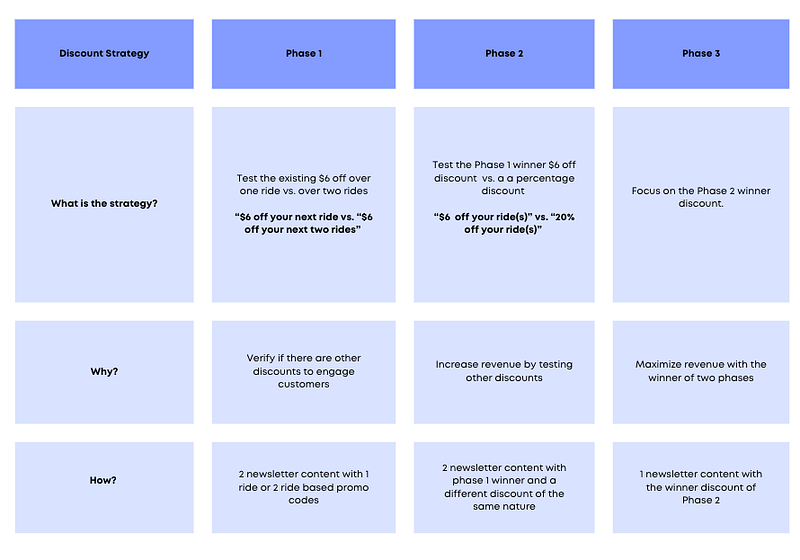
- Phase 1: Test the existing $6 off over one vs. two rides.
“$6 off your next ride vs.“$6 off your next two rides.”
- Phase 2: Test the Phase 1 winner vs. a different discount of the exact nature, like a percentage discount.
“$6 off your ride(s)” vs.“20% off your ride(s).”
- Phase 3: Use the ultimate winner of two phases.
Here, the idea is to find the best discount to grow revenue with an iterative approach.
The starting point was the discount that we know worked for some time — a $6 discount.
In Phase 1, the idea was to test the same discount over one vs. two rides to motivate customers to ride more. The total reward is the same, but the discount pattern is different.
In Phase 2, the plan was to find the best discount type after establishing the best discount pattern.
In the final phase of Phase 3, we focus on the best discount to maximize revenue growth.
Phase 1: Test the existing discount in different patterns
This phase is all about finding a pattern that works better.
So, I tested the best practice discount type in two different patterns: $6 off for one ride and $6 off for two rides.
The idea was to motivate customers to take more rides by changing the discount perception. Customers may find a $3 discount spread over two rides more valuable even if the total reward is the same $6.
So, I had two newsletters, one with the same old $6 discount for one ride and the new one with a $6 discount for two rides.
Half of the customers received the $6 off for one ride, and the other half received the $6 off for two rides content. Apart from the discount pattern, nothing else changed in the newsletters.

Guess which discount won this round: $6 off valid for two rides.
Customers perceived it as more valuable when it was valid for more rides. It did not matter that they got a $3 discount per ride instead of a $6 discount.
They had more rides and brought more revenue than before.
The next step was to see if we could increase revenue using a different discount type that was valid for two rides.
Phase 2: Test Phase 1 winner of $6 discount with a percentage discount
Customers liked it better when a discount was valid over two rides.
So, we needed to test a different discount of the same principle.
As a result, I planned two discount content: a $6 discount valid for two rides and a 20% discount valid for two rides. Half of the customers received the first discount, and the other half received the second discount.
So, we had 2 two newsletters with different discount types: “$6 off your ride(s)” vs. “20% off your ride(s)”


What happened to the results?
20% discount was the clear winner compared to the $6 off.
We found a new discount type that has the potential to grow the revenue even more.
It is time to focus on this best-performing gem to maximize the revenue.
Phase 3: Focus on Phase 1 and 2 winner
We saw that customers liked the discount more when it was a percentage discount and was valid for two rides.
After Phase 2, it was time to maximize the revenue by focusing on this percentage discount.
So we sent the newsletter with the winner discount to all customers.
This concluded our discount strategy in a year.
Now, let’s talk numbers.
The Result
Let’s see how revenue changed in six months.
- $6 off over two rides doubled revenue compared to the initial monthly revenue.
- 20% off over two rides tripled compared to the initial monthly revenue.
- 20% off over two rides grew the revenue 6X compared to the initial monthly revenue.
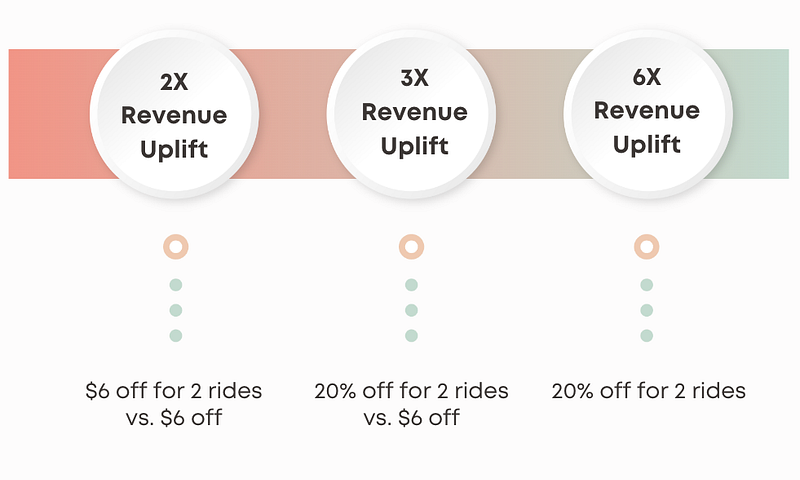
By testing discounts systematically, I could grow the revenue by 6X in a year.
This is what I could do with one discount strategy in three steps. The more you test, the more you can increase revenue in the long run.
Key Takeaways
- Do not stick with one discount type. Just because it worked before does not mean it will grow revenue in the long run.
- Test the existing discount by changing the pattern. Identify when customers respond better to your offers.
- After identifying the pattern, test the same pattern with a different discount. There may be more potential for revenue increase.
- Focus on the winner discount after two rounds of testing. This discount would maximize your revenue for some time.
- Keep testing by adding new discount types. Remember, not one evergreen discount type will work for your business.
Ready to take your growth to the next level? Follow me on Substack or connect with me on Linkedin for more.
Want more marketing tips and tricks? Subscribe to the Better Marketing newsletter The Marketing Memo here.


