
How I Use a Journal to Improve Productivity, Embrace my Creativity, and Stay Happy
A simple, yet effective guide to journal your way into becoming the best version of yourself

I have been journaling almost every day for the past 15 years. As a teenager, I used to treat my journal as a personal diary — only writing about the incidents that happened during the day and how they made me feel. With time, I included newer prompts that morphed the journaling experience into more of a structured approach toward looking at the contents of my life.
As journaling was already helping me understand myself on a deeper level, I decided to do some research on practices that can enhance my old habit to make it more productive and fun. I discovered three amazing uses of a journal that prompted me to write in one regularly. The new prompts that I introduced have helped me convert my journal into a tool for self-awareness and growth. They had several benefits for my mental health, the most significant being:
- Journaling helped me take forward the lessons from the worst moments of my life and develop insights for a better future.
- It gave me a deeper clarity of my goals and intentions, which in turn kept me grounded and helped me plan ahead more effectively.
- It helped nurture my creativity and played a significant role in how I managed to consistently come up with and publish valuable content.
What Is Journaling?
To include journaling in your routine and use it as an effective tool to guide you on the path to becoming the best version of yourself, it is important to first understand what is journaling. As a paper by Rog Hiemsta suggests,
“Journaling is a means for recording personal thoughts, daily experiences, and evolving insights. The process often evokes conversations with self, another person, or even an imagined other person. Add the advantage available in most journaling formats of being able to review or reread earlier reflections and a progressive clarification of insights is possible.”
A journal is not the same as a diary. According to a study by the National Council of Teachers of English, in a diary or log, we usually write what it is that we have done, in a linear, chronological, day-by-day fashion. In a journal, we write the contents of our life both in a forward and a backward way; we work within the present, and thus, look at the past in order to better understand the future. As a report by WAC Clearinghouse establishes, journal writing works because every time a person writes an entry, instruction is individualized; the act of silent writing, even for five minutes, generates ideas, observations, emotions.
How Should You Do It?
Once we have established that journal writing is effective, the next step is deciding where you want to do it. I have always used paper to write my thoughts and emotions down. In recent times, the use of digital journaling has been on the rise. This comes down to a personal preference. However, research suggests that individuals who write information down remember it better than those who type it out on a laptop.
When is the best time to journal?
Ideally, you are free to write in a journal whenever you wish. I prefer to do it at night right before going to bed because this helps me reflect back on the happenings of the day and analyse the lessons I learned. As this study by Harvard Medical School establishes, writing down important things right before you go to sleep might also help you analyse and retain that information better.
In this post, I want to address the three prompts that I used to turn my journal into a tool for self-improvement and a means of finding contentment and lasting happiness. I would also like to outline my current journaling routines and discuss the results that I achieved in the hopes that it would be helpful for anyone looking to explore journaling as an avenue for personal development.
1. Staying Happy
When a bad incident clouds the end of the day, we tend to go to bed in a foul mood. Objectively speaking, it is impossible for a day to be all bad. No matter how dark the clouds on your horizon, they will have a silver lining.
This is where a journal comes in. Writing about the reflections on incidents that negatively impacted my mood helps me reflect critically on what lessons I can learn. The resulting outcomes give me clarity and help me find meaning in my suffering. It also helps me detach emotion from the incident and develop a critical judgment I am hopeful will lead to valuable life lessons.
There are two ways you can achieve this:
Getting something positive out of each day
This is one of the best uses to put your journal to, especially before going to bed each night. I started this unconventional routine of writing the most positive things that happened to me on that day despite the sadness. This wasn’t easy. It took real work. But with time, I developed this ability to look for the best in the most hopeless situations.
Here is how you can get into this routine:
- Write at least one positive thing that happened to you during the day.
- It can be something significant but don’t hesitate to mention seemingly trivial details that made you smile — like that stray puppy on the sidewalk that wanted to play with you.
Sure, some days will be harder than others. But, stick to this habit, and no matter how flimsy the thread of positivity is, at least you will never go to sleep grumpy. It is rightly said that there is something positive in each day. Writing it out will help us develop enough insight to look for it.
Learning to be thankful
Gratitude journaling is something that can help you see the best in everything. According to a post by Positive Psychology, a regular practice of gratitude journaling can lead to a higher quality of life with reduced depressive symptoms, improved sleep, reduced impatience, and better decision-making skills.
I don’t write a gratitude journal each day, but I try to write a page after at least a week. This helps me put the past seven days in perspective and look ahead with more hope and patience.
Here is how you can get into this routine:
- Think of the worst thing that happened in the last week. Then, try to write down 10 reasons why you are grateful for that.
- These reasons can include something good that happened to you as a direct consequence of the negative event or some valuable lessons you learned because of it.
- As you add more points, take some time to read through each of them. Most of the time, this will help you look at it in a less subjective manner and figure out a way to derive a lesson you can carry forward. Feel free to write them out as well.
The goal is not to aggressively look for positivity everywhere. The goal is to not let negative events have the power to influence our mood throughout the week.
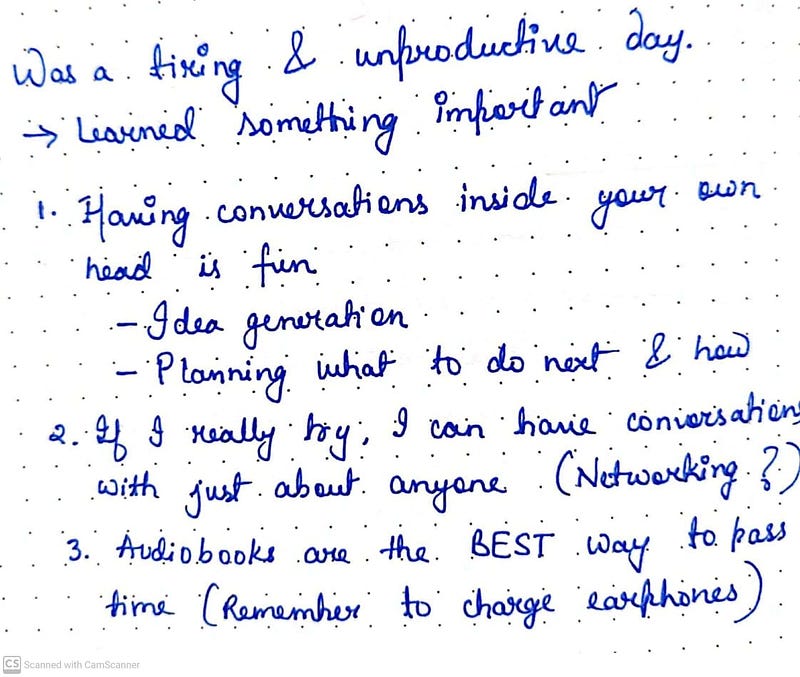
Looking for the silver lining for each dark cloud in your journal will help you notice the positive aspects you otherwise might have overlooked.
2. Maximising Productivity
I have found that a journal can be an excellent tool to keep track of my goals and make sure that I don’t lose sight of the things I intend to accomplish in a given time frame. Here are the ways you can use your journal to boost your productivity:
As a planner
- At the beginning of each new month, list down the goals you hope to accomplish by the end of the month.
- Below each goal, write ideas on how you can turn those dreams to reality.
- An important point to remember here is: know your limits. Don’t bite off more than you can chew. Settle on a realistic approach that will help you tackle your goals, and set deadlines you can stick to.
Aside from monthly goals, you can also make time-sensitive plans. If your journal has dates, you can mark on the due date as a reminder. If not, you can make your own annotations with red ink so the deadlines pop out at you whenever you leaf through the pages.
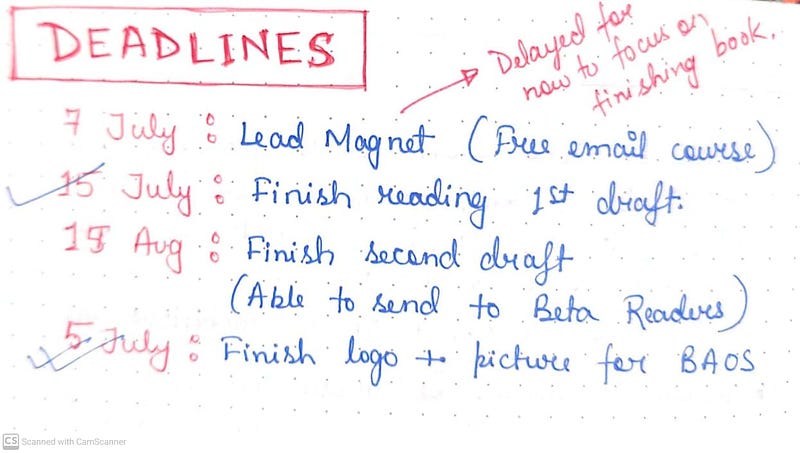
Make to-do lists
A planner can help you keep track of long-term goals, whereas to-do lists can help you crush your daily goals.
- Before you go to sleep, make a list of all the tasks you hope you accomplish the next day.
- Draw little checkboxes next to each item. Speaking from experience, crossing off each one as you sail through the next day will fill you with confidence and positivity.
When you wake up the next morning, a quick read through your journal page will fill you with a clear sense of purpose. As an additional measure, you can also time-block your day and set tasks according to the energy levels and mood you will have for each hour. Such an intimate level of self-awareness will only bolster your confidence and not let you get into the false sense of accomplishment one might feel when they can’t remember what else they have left to finish.
Identify what’s holding you back
An unexpected benefit of making to-do lists and planners is that no matter how hard you try, you will never be able to complete all the tasks you set for yourself. I call this a benefit because instead of beating yourself up over how unproductive you are, you can use this opportunity to reflect on what exactly prevented you from doing what you set out for.
- When you can’t complete an item on your to-do list, put a cross on the checkbox next to it and write a reason why you couldn’t complete that particular task.
- When the month is over, look through your unfinished tasks and try to identify a pattern: Is there a particular category of tasks you often fail to complete? Are there any limiting self-beliefs or excuses you make to yourself that is stopping you from being your productive best? Are you setting unrealistic goals for yourself?
- Based on the data you collect over a few months, identify the necessary sacrifices you need to make to reach where you want to be. Journaling helped me realise that I was spending way too much time socialising with people. While this was necessary to network with my new neighbours, I tried to limit this time to a maximum of two hours each day.
- If you have been spending longer than necessary on a certain unproductive task, find a way to outsource it.
3. Embrace Your Creativity
In his book “Choose Yourself!,” author and entrepreneur, James Altucher, introduces the concept of an Idea Machine. According to him, a person can spend weeks and months at the gym, training the muscles on their body until they become strong. In the same way, there is an “idea muscle” in our brain and it needs constant work so it can become strong and generate amazing ideas on a daily basis. The “brain workout” Altucher suggests is writing 10 ideas each day. The point is not to come up with amazing ideas that can be executed. Rather, the point is to force your idea muscle to work hard and come up with 10 ideas each day.
This sounds simple, but when put to practise, it proves to be impossibly hard. I started writing 10 new ideas each day since May 2020. Over time, this evolved into writing 10 ideas for articles or plot points for my stories. This wasn’t a conscious decision, but since I am a writer, most of the ideas I had veered around my writing. I took this as a sign from the universe and stuck to writing ideas for 10 possible blog posts or subplots in my novel. As you can see from the attached image, most of the ideas aren’t any good. However, it took me lots of time to think them up and I grateful for the exercise they gave to the idea muscle in my brain.
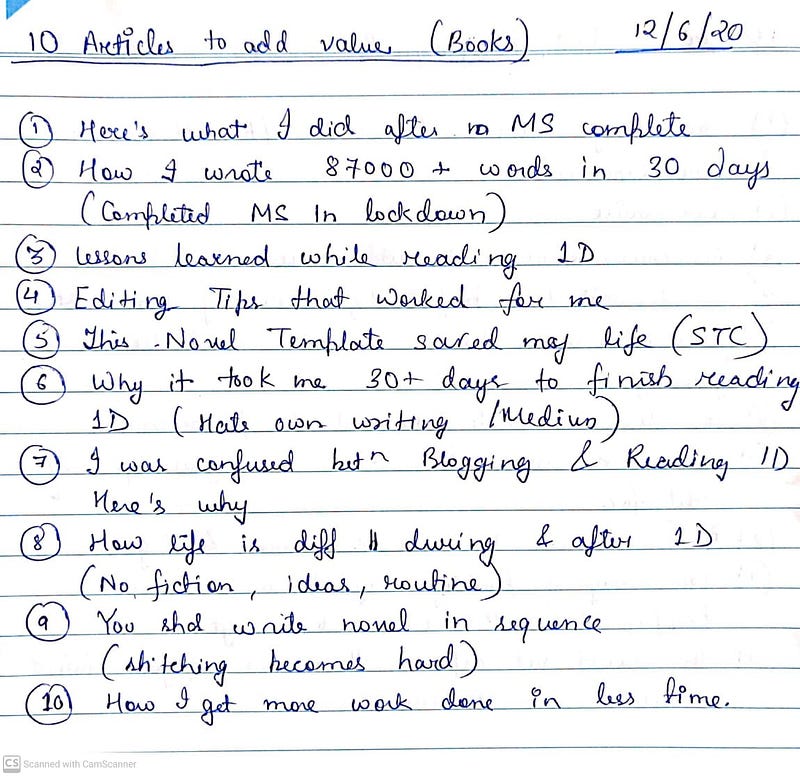
Here is how you can get into this routine:
- Fix a time of the day for idea journaling. I do it at night — the same time as my regular journaling. However, I have heard a few of my friends had good results when they did their idea journaling first thing in the morning.
- Start with a fresh page and write down 10 ideas.
- Don’t worry about whether the ideas are good or if you will ever be able to execute them. Focus on just writing 10 ideas.
- Keep doing this every single day without fail. On days you don’t have access to a pen or paper, use your phone, but don’t break the habit.
In the first few days, I struggled hard to think of 10 ideas. I used to sit for several minutes staring at a blank page, unable to come up with another word. But, I trusted Altucher and didn’t give up. Today, I fill up page after page with ideas, and most of these branch out into sister ideas and sub-ideas, usually taking up the form of full-fledged plans and life goals. I won’t go as far as to say that I have become an Idea Machine, but my ideas have steadily gotten better with time. This journaling prompt has helped me embrace my creativity and I am sure it will play a significant role in helping you boost yours too.
Wrapping Up
Daily journaling has broadened the scope of my understanding of life and provided me with a tool to help me become a better version of myself. I firmly believe that each of us has a beautiful story to tell. The best way we can learn more about ourselves is by writing that story on paper. Even as writers, most of the work we come up with is for the public eye. Journal writing is different. This is something we do only for ourselves without any intention of writing to “please” another person. With this realization, a journal becomes a powerful tool for both self-awareness and development.
Summing up, here are the three ways you can prompt yourself to journal daily:
- As a way to look for the silver lining, those moments of happiness in each day. You can extend this to gratitude journaling as well.
- As a planner and to-do list to boost your productivity. You can also have a monthly wrap-up where you go through the activities you managed to accomplish in the previous month and identify what held you back. This can give you valuable insights into what you need to give up and what tasks you can outsource.
- As a creativity journal to write 10 ideas each day. This will exercise your idea muscle and help you become an Idea Machine so you can come up with amazing ideas on a regular basis.


