
How I Survived a 19th Century War
I learned to ride a horse during combat!
I was lucky.
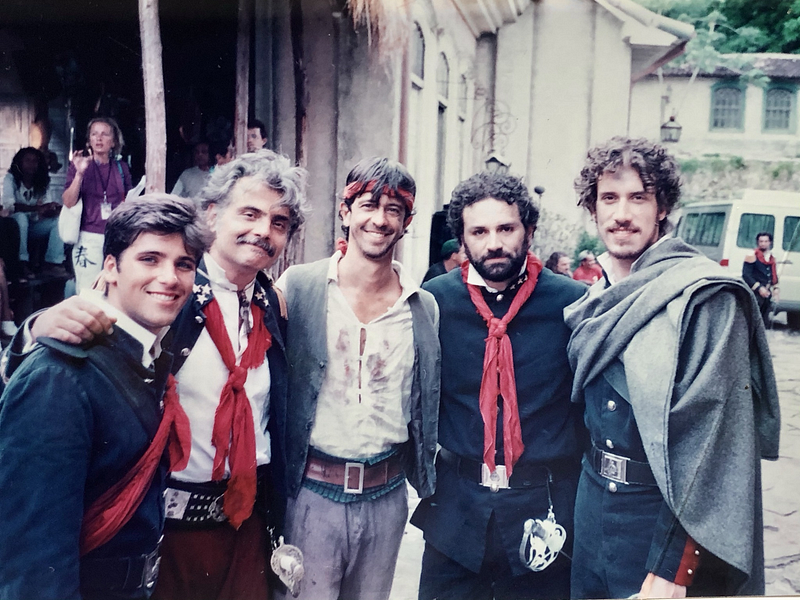
My first television role was in the miniseries “Seven Women,” set in the Ragamuffin War between 1835 and 1845. My role was that of an Italian revolutionary brought to Rio Grande do Sul by Giuseppe Garibaldi. Almost all of my scenes involved battles.
I was, at the time, thirty-two years old. My graduation at the Teatro-Escola Célia Helena had taken place less than a year ago, and my second professional play had stopped a few months ago. I was hired on a Thursday, and my first taping would take place on Saturday.
I no longer expected to be called. My audition took place more than half a year ago, and I see in the newspapers that the tapings had been going on for months. When I got the call then, it was a revolution in my life. Out of the blue, I had to move to Rio de Janeiro, live in a strange city, surrounded by strangers, and start a peculiar profession — I was a theater actor, but I had never worked on television.
However, I had an ace up my sleeve to face a 19th-century war: fencing.
Since my early years in drama school, I had fallen in love with the sport. I started training with the Brazilian Fencing Team’s coach, and I got to be among the ten best saber players in the country — which was not a big deal since there were less than fifty saber players in the Brazilian ranking. I took some theatrical fencing classes with my coach — we only use three of the attack and defense positions today, but there are nine, and all of them are used in actual combat — and I was confident that, at least in this respect, I would do well.
My big problem was the horses.
I had never ridden before. And I had no idea what the experience would be like. I was sure that, at some point, it would fall. My biggest fear, then, was to happen to me what happened to Christopher Reeve. No, it wouldn’t have been worth doing a miniseries on TV Globo — the most prominent Brazilian television network — at the expense of my ability to walk…
But I was hoping that, at some point, someone would train me.
I arrived in Rio de Janeiro feeling that I would have to run a lot to reach the other actors. Everyone was riding horses and fighting for some time; I was the rookie. I was apprehensive.
Until I realized that I was one of the best prepared.
Tapings are grandiose events in which hundreds of people are involved. Battle tapings, then, are even worse. THOUSANDS of people are on them. We even had six hundred extras in some battles. It is necessary to transport, feed, dress, and guide these people. And these are people who never took acting classes, who had no idea of the weight of a saber in their hands, who never fired a gun or saw an explosion up close.
There was, then, an army of people to prepare the extras. It was a miracle that we didn’t have people getting out of those battles in ambulances every day…
And with the actors, it was not that different.
Although we have more professionals to help us, the camera was always aimed at us. So our work had to be impeccable. And the problem is that some of us were not cut out for that kind of battle.
I had my difficulties. My horse laughed at me every time I approached; it did not obey me at all. But, when the director shouted “action,” the horse understood! And he was a good actor! As I just needed to pretend that I was bossing him, it ended up going well. I didn’t fall once.
Now others of us were not so lucky…
One of my troop colleagues, for example, fell during our equestrian training. He didn’t get hurt, actually. Days later, however, when we were taping a shipwreck, one of the waves knocked him down and dragged him over the deck several times, causing him to collide with all kinds of objects, including us, actors. That day he left the taping at an ambulance.
Another actor, this one in the leading roles, managed to be worse than me in equestrian. And, as he was a major player, this became a problem. He fell several times during the tapings and seemed unable to stay on top of the horse. What was the solution? They gave a role to the horses’ owner — who was also our trainer — who always made him stand by the falling actor. So when the actor started to fall, the trainer, who was already around, pulled him back into the saddle. It worked, the actor didn’t lose again!
What about fencing?
One of the actors failed to understand that the saber we used was fake and therefore was not as tough as a real one. And, for some reason, he thought he really had to kill each of his opponents. This actor, alone, broke more than twenty saber blades. There were so many that, at the miniseries’ end, we had to tape using extras’ sabers, which were coarse, but much more resistant.
In the end… We all learned to ride a horse, shoot with muskets and cannons, survive in the chaos that is a battle, and defend ourselves using a saber…
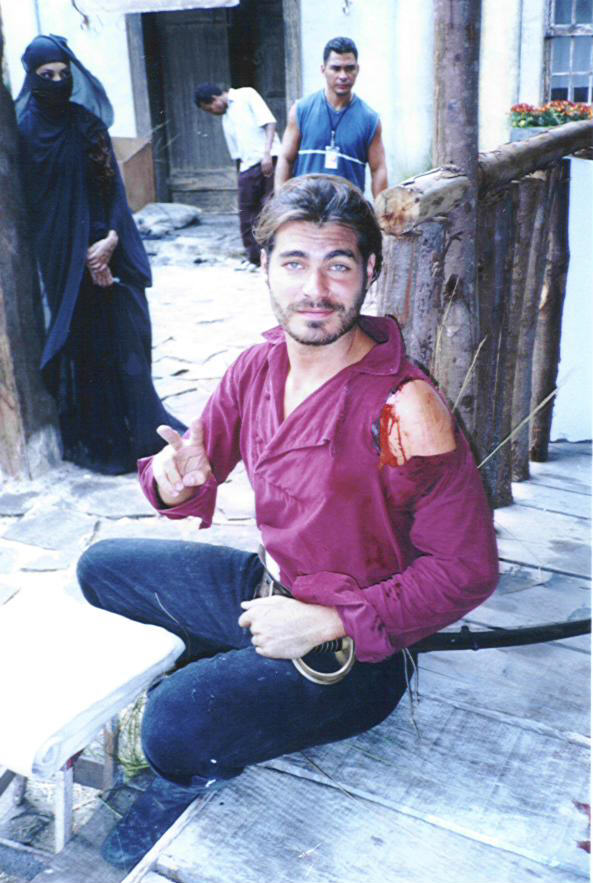
And almost no one was hurt in the process!