
How I Solved My Night Owl Dilemma To Achieve Profound Gym Consistency, Energy, and Sleep
It’s advice I wish I had known from the start.
It’s true.
Audacious early birds who work out when the sun rises see better health outcomes.
I used to look at these people like they’d lost their marbles.
I was the guy with a sudden burst of energy like I’d been tasered between 10 p.m. and 1:30 a.m.
When I finally managed to hit the sack, it felt like I was on the hard shoulder of a motorway. It would then take a swat team and 13 snooze alarms to get me out of bed the following day.
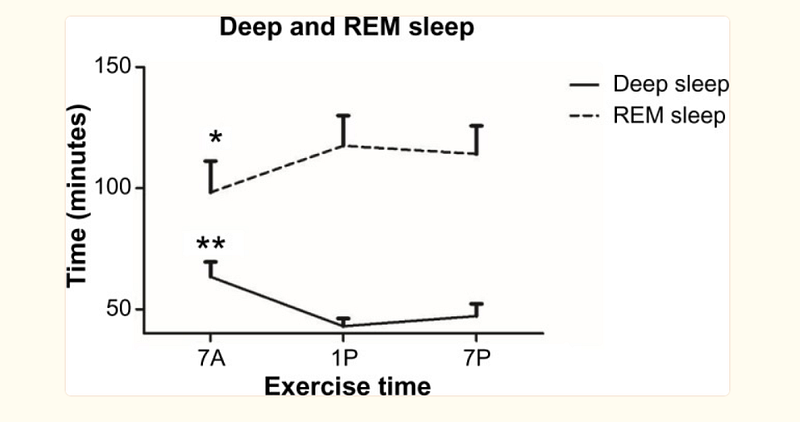
One research study took 20 people with high blood pressure and got them working out for 30 minutes at 7 a.m., 1 p.m. and 7 p.m.
The group who worked out at 7 a.m. had lower blood pressure at night, fell asleep quicker, had a deeper sleep and clocked up more REM sleep (Rapid Eye Movement), which research has shown is the most crucial stage in overall sleep quality.
So it’s no surprise these dopamine-fueled morning addicts feel like they’ve had a shot in the arm first thing, energised, ready to tackle the day.
This wasn’t me — I used the relentless grind of my career as an excuse.
The never-ending cycle of commuting to work, getting back late, and not having the energy or willpower to drive to the gym and work out on a cold winter evening felt like my kryptonite.
I’d stay up late watching mind-numbing trash on T.V. and repeat the cycle of inconsistency like Groundhog Day on repeat.
It’s a loop I broke free from, and so can you.
Let’s dive in.
Authors Remark: I’m not a certified health and fitness expert — But as you can see, fitness, self-research, and using myself as a case study is my passion and the information contained in this article is all based on my personal experience, self-taught knowledge and deep research.
Unlock your sleep potential and supercharge your gym performance with this essential tool.
Winters here in the U.K. can be rough.
I often had to be up in the dark, go to work, and leave for home in the dark, which was soul-destroying, even for night owls.
Something significant changed. We had a global pandemic, which, being a single male living alone, gave me anxiety on a level I’d never experienced before.
It was a blessing in disguise because it set off a chain reaction, helping me lose 33+ pounds (proof and guide here)
Because I accidentally set the wheels in motion to improve my energy levels by getting out of the office during lunchtimes, which during my 10-year career in the corporate world was only something I did sporadically.
I’d go for a stroll to relieve some of the stress induced by being couped up indoors, in my car and at my office desk, which had plastic shields to separate me from the other staff. Yuck.
What started as a 30–45-minute walk at lunch turned into going for walks before work.
Famous neuroscientist and podcaster Andrew Huberman says you should go outside in the first 15 minutes of waking up because the research shows you’ll have more energy and wakefulness during the day and better sleep at night.
The impact is humungous.
Andrew Huberman — Source
“Sunlight viewing is not some woo biology thing. It’s grounded in the core of our physiology. There are literally hundreds, if not thousands of quality peer-reviewed papers showing that light viewing early in the day is the most powerful stimulus for wakefulness throughout the day, and it has a powerful, positive impact on your ability to fall and stay asleep at night. So this is really the foundational power tool for ensuring a great night’s sleep and for feeling more awake during the day.”

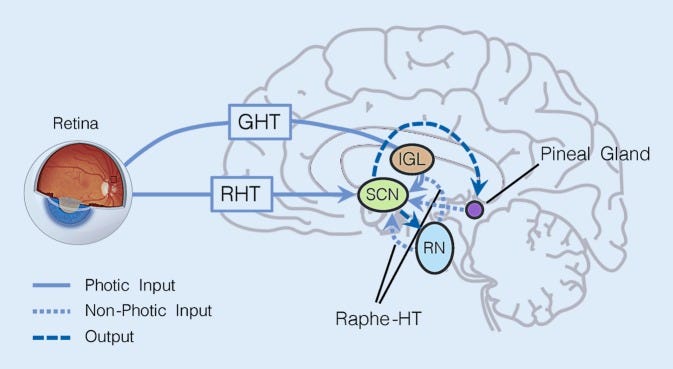
One study says the most important thing that sets our internal clock is the light in our surroundings. Our eyes take in this light and send signals to our internal body clock, telling it what time it is.
Research shows light in our eyes sends signals to a gland in our brain called the pineal gland, which makes a hormone called melatonin. Melatonin helps us sleep better.
Huberman says you need at least 5 minutes of sunshine on a clear day, 10 minutes on a cloudy day and 20 to 30 minutes on an overcast and rainy day.
Trying to get sunshine through your office window or car windshield doesn’t count, and it doesn’t work.
I did my morning walks without realising it was an ‘actual thing’. But the first noticeable difference was that it reduced my post-lunch and early afternoon slumps.
And then, after a couple of weeks, I started to feel less grogginess in the morning and more sleepiness in the evening.
At the time, I didn’t associate that first boost in energy with my morning walks, but I do now because it’s as obvious as a slap in the face.
One research study found early morning sunshine increased evening sleepiness and reduced sleep onset latency, i.e. The amount of time it takes for a person to fall asleep after getting into bed and attempting to sleep.
It also increased “next-morning alertness”, which explains why I didn’t feel like a zombie playing Whac-A-Mole with my alarm clock.
Once you have the extra energy, point it as effectively as possible.
Huberman says, “You’re less motivated to exercise because you value the reward more than the pursuit”.
My morning walking and that first bit of sunshine resulted in better sleep and more energy.
It was like a shot in the arm and a boost of momentum.
I started to set the wheels in motion by going for walks, once in the morning, once at lunch at work and then when I got home after work.
Walking after work turned into 5km runs around my local area. Running was not something I initially found fun, but it was a great way to clear my head, and that’s where my mindset started to change.
I wasn’t running to lose weight. I was running because of the pursuit of the feeling it gave me.
Now, I’m not saying you should get yourself some anxiety lol. I’m saying pursue things with a purpose and do it for the sake of the process, not the reward you’ll receive at the end.
It’s the most sustainable way.
Research shows you’ll only make the things you want harder to achieve if you attach a reward to an activity. It’s negatively impacting your consistency.
E.g. If I go for this run, I’ll lose 350 calories.
Find an activity you love doing, make it something you look forward to, and remove any associated reward. Instead, try and get pleasure from the pain of the process like I did with my running.
Huberman echos a similar view that attaching rewards makes exercising consistently hard and creates a significant barrier because we link dopamine to the reward.
Andrew Huberman — Source
“Celebrating the win more than the pursuit actually sets you up for failure in the future, and so this gets us right into something called “dopamine reward prediction error”.
The reward prediction error is basically, if you expect something to be really great and then it’s not quite that great, your dopamine baseline lowers.
That means you not only felt as if you lost because it wasn’t as much a celebration as you thought it would be but that you’re starting from a lower place, meaning you’re less motivated.”
Final Thoughts.
They’re two very contrasting ideas.
The first is a strategy to bleed into your lifestyle if you need help getting up in the morning.
Early morning sunshine gives you wakefulness during the day and helps you sleep at night.
You’ll have fewer slumps during the day and more significant sleep results, plus added energy with more chance of you consistently working out.
Once you have the extra energy, point it as effectively as possible.
If you channel it toward something with an associated reward, realise long term that you are making it harder for yourself.
Changing my mindset to enjoying the process of the pain and not the so-called “reward” has significantly impacted my levels of consistency.
I wanted to share these ideas.
I hope they help you immeasurably.
Stay updated on my latest articles! Join our 2,000+ strong community — it’s free, and you can unsubscribe anytime. Sign up now!