
How I self-learn Japanese
and my best resources for that
About
The purpose of this article is threefold. It first relates my own experience towards Japanese self-learning, one of my greatest achievements so far. It also shares helpful tips and resources for current self-learners. Lastly it goes beyond language learning considerations and anyone intersted in self-development will find it worth the read.
Motivation
I am an adult European citizen, who grew up in France, always studied and worked in Europe, and who will probably continue to do so for a long time, if not my entire career. So why learn Japanese? Like anyone, I need strong good reasons to achieve what I perceive as a big challenge and a long journey forward. And despite what many book covers pretend, learning a new language so different from your native one is definitively a long term goal. It took me a long time to come up with a simple way to answer this question:
I learn Japanese because I want to deeply understand Japanese culture and interact with Japanese people. I learn Japanese because it’s a challenge for me in multiple ways: memory, interaction with others, resilience, language learning, etc. I learn Japanese because achieving language proficiency would make me feel immensely proud.
This motivation finds its source in my childhood and teen age, where I first perceived Japan as a miraculous place where anime and manga are better than anywhere else in the world, where food is the best in the world (equally with France, pardon my chauvinism), and where both respect for ancient culture and most advanced high tech world peacefully coexist. If you want to learn more about this feeling regarding Japan, I recommend the travel diary from pechedediamant.com, whose articles perfectly reflect my thinking.
How
Except if you are naturally gifted and skilled for language learning, Japanese is somehow scary, especially if you learn it on your own. I must admit I tried many different approches before finding my way. To give a few examples:
- I studied Japanese in classroom for two years during my studies: this ended up being super inefficient due to too much heterogeneity across students (level and motivation-wise). From that, I nevertheless learnt the very basics, i.e. hiragana (ひらがな) + katakana (カタカナ), as well as a few survival phrases.
- I purchased all kinds of Japanese learning materials: dictionary, vocabulary books, grammar books: hereagain, no effective return. I mostly struggled to find sentences adapted to my level and my wishes: simple sentences written in real Japanese (no romanji), going beyond traditional ‘introduce yourself’ and ‘where is the bank?’ kind of lessons. In a nutshell, grammar examples were not using the vocabulary I knew, and both vocabulary pronunciation and meaning were impossible to memorise in the long term.
- I also tried the listening approach, using free podcasts: apparently too advanced for a beginner like me.
The picture looks bad but I definitively learnt from these attempts: Japanese grammar is rather easy, and my failure resided in my lack of vocabulary, reading skills, and ultimately listening skills. I thus made more homework to find the best resources given my weaknesses, and I decided to start my journey of learning Japanese the hard way (but the solid one!).
Resources that work for me
Now that you know which process I’ve been through, I can confidently introduce you to my best friends as a Japanese self-learner. My opinion is that one cannot build great skyscrapers without strong foundations and solid building blocks. My strategy is thus to:
- Acquire solid building blocks, i.e. a lot of vocabulary (meaning + pronunciation).
If you do not know Wanikani yet, this site was my mindset changer and I definitively recommend it. On this platform you can learn ~2 000 kanji and ~6 000 words in just a few years, leveraging mnemotechnics and Spaced Repetition System. Basically, kanji are made of radicals, and words are made of kanji. Learning them in a coherent manner makes your learning curve exponential over time!
Let me illustrate with a very simple example: 火山
- 火 (pronounced か (ka)), stands for fire. It’s a basic kanji, fairly easy to memorize. For the reading, you might want to remember the following story: when we think fire, we ought to think of something on fire. What is it on fire? It’s obviously your very own car (か)!
- 山 (pronounced さん (san)), stands for mountain. Hereagain, simple kanji easy to memorize (looks like a montain, isn’t it?). You already know its pronunciation if you know Mount Fuji is often called Fujisan as well.
- Then guess what 火山, the fire mountain, means? Volcano! And guess how to pronounce it? かざん (kazan)! Isn’t it a powerful technique to learn vocabulary in an exponential manner?
As I write this post, I’ve been using Wanikani for almost a year (just activated the lifetime subscription), and recently completed level 13 (out of 60), which corresponds to ~270 radicals, ~430 kanji and ~1 250 words. Each element comes with illustrative examples and descriptions, like the similar kanji analysis.
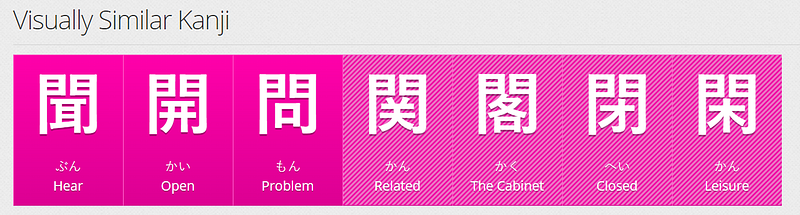
In addition I also use this plugin which tracks your progress versus JLPT requirements, versus most common Japanese words and even versus most famous Japanese websites. As an example, level 13 makes you understand more than 60% of Japanese Wikipedia!
- Acquire strong foundations, i.e. good grammar knowledge.
Learning vocabulary is great, but you also need to practice a bit of grammar to cement words all together. I personally use TextFugu, a Japanese online book for self-learners. Main advantages are that it is very pedagogical, combines text with sounds and video whenever relevant, and that contents improve over time (benefits of online books versus paper). Hereagain I opted for the lifetime subscription. Note that TextFugu will soon be replaced by EtoEto (currently in very alpha version).
- Practice reading using appropriate resources (meaning real Japanese sources).
Once you have injested a decent amount of grammar and vocabulary, you can put your knowledge into practice to break any simple Japanese written contents. As a routine, I am trying to visit NHK news web easy once a week, and read new articles. Not easy for me yet, but I can detect the begining of a improvement, as topics being discussed and basic sentences are more and more easy to capture. Yeah!
- Practice writing
Quite scarying in the beginning, writing is also a great way to fix your grammar learning, make mistakes, correct in an iterative approach, and gain confidence. I recently joined lang-8, a sort of free social network dedicated to language learners: help others by reviewing their posts in your native language, the community will then help you in return by correcting your first Japanese written attempts. Quite a win-win deal, isn’t it?
- Practice listening.
I’m not there yet. My first attempts as beginner made me conclude that I needed more practice prior to listen to real Japanese discussions, debates etc. I still lack a bit of vocabulary (I’m confident I will overcome it soon) and Japanese speaking pace is too fast for my untrained ears. As a transition period and prior to search for podcasts of real interest to me, I opted for news in slow Japanese.
- Practice speaking.
Speaking is for sure the ultimate objective. Anyone having completed all previous steps should have no reason to fear this final difficulty. However, speaking implies interactions with Japanese people, and I do not take for granted that we all have Japanese friends, family or acquaintances willing to kindly dedicate time to make us speak.
Although this situation is a challenge, there are several ways to overcome it — thank you the Internet!
- You want to learn Japanese? What about doing it in a friendly manner with people sharing the same interest and objectives in your neighborhood?
- Option 1. does not work for you? What about finding online Japanese teachers? Or maybe Japanese people interested in learning your language? I’m sure it’s the ideal way to capstone all big efforts and so far achievements into a great opportunity to gain confidence in your speaking maturity and also maybe to make new friends!

Join the movement!
As shown between the lines throughout this article, there are plenty of great contents and materials that can help you achieve your biggest goals. Actually, global shift towards digital and social network ecosystems makes it easier than before. My personal feeling is that self-development and self-learning are part of the most important growing topics worldwide (see the boom of Coursera, EdX, LinkedIn Learning and similar platforms…). As a direct consequence, communities of passionates from all areas are growing, so why not join the movement as well?
Conclusion
I hope this summary of my journey towards Japanese learning was an interesting and helpful reading. Of course, there are numerous other valuable resources, and I strongly recommend you to have a look at tofugu to discover them. I wish you all success if you are engaged in similar challenges!
I’m happy to receive feedback of any kind so please comment if you have advise, or should you want to complement with other tools and resources which better worked for you!
どうもありがとうございました!
If you are looking for language partners to improve your foreign language skills you can find it at swaplanguage.com.


