
How I Revise My Novel In Three Simple Steps
The first draft of anything is shit. Ernest Hemingway said that. Not little old me.
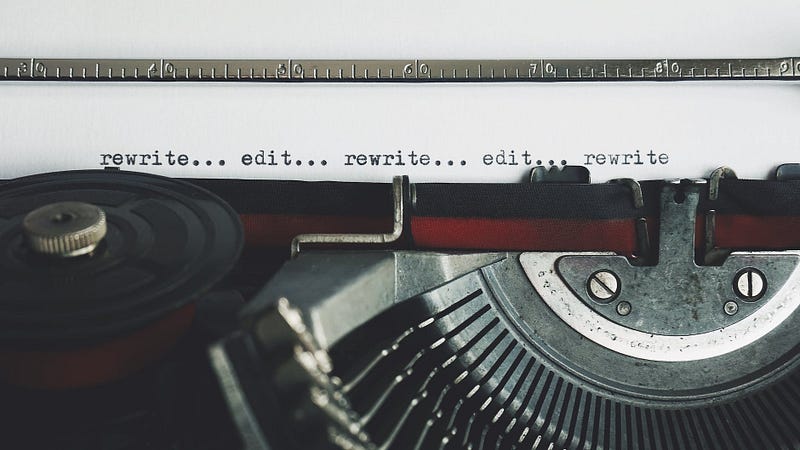
Finishing your first draft is the first stage of writing a book. The real work begins at the revision stage. As Hemingway said, writing is rewriting.
Revision is a cumbersome process that has the potential to make any writer lose their mind. This is especially the case if you have a lengthy novel with over seventy thousand words.
But like most complex things, revision shouldn’t be a soul-sucking process if you break it into small manageable tasks. To keep me sane, I break down the revision process into three steps, and I work on one step at a time.
Before I dive into these steps, however, I’ll like to remind you to let your manuscript rest for a while once you finish your first draft. Don’t start revising the book as soon as it’s done.
I recommend at least two weeks away from your novel. I even forbid you from thinking about anything remotely related to your story. I take at least a month’s break away from my first draft to give me a fresh perspective. That way, it’s easier to find the mistakes.
You don’t have to stop writing while letting your story breathe. Use that time to work on something else. Write a short story, a novella, or perhaps another novel. Hell, you can even hibernate.
Just stay away from that damn first draft.
My three steps in revising my novel
While each step is equally important, I start from the most complex to the least complex. These steps are:
1. Filling plot holes
2. Polishing the prose
3. Proofreading
Step #1: Filling plot holes
Plot holes are the first things I look at during revision. After working on a novel for several months, it’s normal for inconsistencies to creep in along the way.
These inconsistencies, called plot holes, pull readers out of the immersive flow of the story because they go against the logic you’ve established.
Plot holes can be small, like mistakenly referring to a character by a different name, say from John to Jake. They can also be so big they completely alter the story. For example, when your character, Jake, visits his supposedly dead mother on Christmas.
Plot holes appear in our stories for many reasons. But I think the main reason is forgetfulness. After fifty pages, we forget that Jake’s mother died when he was five, on page two. He falls in love, and he can’t stop gushing about how his girlfriend will love his mother’s cooking when they visit on Christmas.
Three chapters later, his name becomes Jason.
It’s okay if these things happen in the first draft. But for them to appear in the final draft of your manuscript is catastrophic.
I tackle plot holes first because I believe they are the most likely to disrupt the flow of the story as well as the most difficult to revise. It’s only after I fill plot holes that I concentrate on other things like grammar and spelling. Readers may forgive you for a few spelling errors here and there, but not so much when plot holes are involved.
As a reader, I can’t stand plot holes. The bigger they are, the angrier they make me. To me, it feels like the writer thinks I’m too stupid to figure out the inconsistency. Before long, I just throw the book away (metaphorically, of course — the damn book is on my phone).
I put that same energy into fixing my own plot holes.
I admit, though, that the longer the story, the harder it becomes to keep track of all the inconsistencies.
Fortunately, I have a simple system that makes things a lot easier and more efficient. The system is in three phases:
Phase #1: Read through your outline
I’m a plotter.
This means before I write even a word of my story, I plot out everything meticulously. It starts from basic things like the names of my characters to far more complex things like the way the Mountain People celebrate their Red Moon festival on the winter solstice.
I document every single detail in my outline which can be over thirty thousand words. Of course, things may change in the story and my ideas may take a different direction. But I always update my outline.
And so before I start revising the draft, I first go through my outline to remind myself of what my story is really supposed to be about. Since it takes me months to finish a draft, and another several weeks to let it breathe, it’s possible that I’ll forget about a lot of key things in the story.
Going through my outline refreshes my memory about everything.
Phase #2: Read through the draft
Once I finish reading the outline, I start reading through my first draft critically. Here, I don’t look at grammar or spelling. Instead, I look at the story itself, to see how the scenes weave into each other, and to identify all the inconsistencies.
I usually don’t make any changes in this phase unless the plot holes are rather simple, like a change in name or hair color.
For the most part, however, I simply read through and make comments (a feature in WPS and Microsoft Word) on the sentences that need fixing. For example, while reading through a scene, I’ll realize that a character who didn’t leave the house with his dog, suddenly has his dog with him at the supermarket. Upon noticing something like that, I highlight the discrepancy in the comment box.
My comment may look something like this:
Okay, where the hell did the dog come from? Did he forget to bring his dog along, or has the dog been with him the whole time? Fix this shit.
Phase #3: Fixing the inconsistencies
Using the notes in the comment box as a guide, I make all the necessary changes. I may do massive rewrites if the inconsistencies are that profound.
This can take an incredible amount of time and energy. However, once I finish rewriting all the plot holes, I officially consider my manuscript to be a second draft.
Of course, though the second draft still needs a lot of work, it’s far better than the first.
In order words, the second draft of anything is a little less shitty. You can quote me on that.
Step #2: Polishing the prose
After fixing all the plot holes, I now direct my attention to the way I use words in my story.
This step is important because while writing the first draft, I don’t care about how words sound at all. Hell, I usually don’t even bother to ask if I’m using the right word. All I’m interested in is telling the story until the very end.
It doesn’t matter if I keep using the words condemn and commend interchangeably. Nine times out of ten, the sentences in my draft read like a toddler attempting to recite a poem they wrote themselves.
Yeah. It’s that bad.
On the few occasions when I’m in the zone, I do manage to string out some earth-shattering sentences that can probably give a lexophile an orgasm. Most of the time, however, even while in the zone, I manage to churn out a hot pile of trash.
The draft is full of unnecessary repetition, an unholy amount of adverbs, passive voice, bad grammar, lots of malapropism, and so many ridiculous mistakes.
Well, I did start by saying that the first draft of anything is shit, didn’t I?
Fortunately, Step 2 is for fixing all these errors. I unleash my inner editor — the perfectionist — to painstakingly polish the prose.
In my experience, this takes the greatest amount of time and can span over several months even.
My inner editor analyses every single sentence — and I mean that literally — with the eyes of an eagle.
I make sure that I cut out all unnecessary words or whole paragraphs that add no value to the story.
I rewrite migraine-inducing sentences for easier comprehension.
I write in the active voice.
I remove redundant words.
I use strong verbs rather than adverbs.
I use a thesaurus to replace overused words, and I make sure that the word is a perfect fit for the sentence.
And of course, I correct grammar and spelling.
Basically, I try as much as possible to make the book readable. By the time I’m done polishing the prose, it indeed becomes a lot better than before. With that, I officially dub the manuscript a third draft.
Step #3: Proofreading
While my third draft, has no plot holes (as far as I know), and I’ve done my best to correct every grammatical error and spelling mistake I can find, I know there are still mistakes lurking everywhere.
Ironically, these errors creep in while polishing the prose. I use the last step of revision, proofreading, to fish out all these little mistakes and tidy up the manuscript.
Of course, I have learned from experience that no matter how many times I read through a manuscript, some errors still manage to escape me. It’s human after all.
To solve this problem, I use Grammarly and ProWritingAid to proofread my manuscript.
These are both invaluable writing tools that do more than just correct your spelling mistakes and grammar. I don’t only use them for editing my novels, but also for all other kinds of writing including this blog post.
With these tools, no error escapes my eye.
Once I’m done proofreading, I now have a fourth draft which I’m very proud of. But mind you, I dare not call it a final draft — the work isn’t done yet. There are other things to consider such as getting feedback from beta readers and a professional editor.
Those things, however, are beyond the scope of this blog post.
Now what?
If you’re not sure how to go about the whole revision thing, you can try using my process and see if it works for you. Perhaps, you already have your own process. That’s okay, all writers are different, after all.
What’s important is that you revise your novel. In fact, be an obsessive editor of your own work.
I hope this is helpful. Don’t hesitate to leave your thoughts in the comments.
I wish you all the best in your revision journey.
Thanks for reading.
Originally published at https://torshietorto.com on December 9, 2022.


