
WRITING
How I Rescue Dying Articles for High-Paying Clients
My systematic process for improving my writing

$2,500 has been deposited into my account.
Two days later, my face was in my hands, groaning, “How am I going to get through this?”
In front of me, was an alphabet soup of words, a literary iceberg en route for a tech CEO.
All I had to do was write 1500ish words. And here I was floundering like a beached tuna.
Client: “I want this article to be a hit.”
Me: “Sure! No problem!”
A hurricane forms in my stomach.
My livelihood depends on delivering. I’m in a one-strike business.
One Week Later
Clients don’t typically fire you in the traditional sense — they just stop replying. Ghosting is the industry norm in freelancing, the omen you live in fear of. A non-reply is your ominous meeting invite from human resources.
I held my finger over the send button several times before backing off and rethinking the article. Finally, I sent it. Then, in my typical neurotic fashion, I paced up and down the hallway, hoping he would like it.
I resolved to stop stressing over it. Needing a distraction, I jumped in my car and left for the gym. I was halfway there when my Bluetooth lit up. It was him. I picked up the phone and, within a few moments, breathed a sigh of relief. He’d loved the piece.
The article, like others, had once been garbage and a source of existential despair.
“I’m out of ideas.”
“This article is horrible.”
Polishing a piece can be confusing, frustrating, misguided, and futile if done incorrectly.
The magic is in the method. If you are systematic, you can turn any sinker into a strong piece that makes money, wins clients, and earns followers.
Here’s the sequential process I use to satisfy top tier clients.
My Checklist
Feel free to steal it.
Intro
- Keep the introduction short: 2–3 paragraphs, 200 words max.
- Open strong with a good hook. Seize their attention.
- Get to the meat quickly. Include personal examples when applicable.
- End of introduction: includes either curiosity or tension that needs to be resolved.
Body
- Does it read fast? Solution: Say more with less. Contract words.
- Lots of active voice? (Passive: The football was caught by Mike. Active: Mike caught the football.)
- Did you kill the lull in the middle? Solution: analogies, deleting excess verbiage, metaphors, quotes
- Alternating sentence length? A good blend of short and long sentences
- No redundancies? Ask yourself: Have I already said this? Or implied this was true?
- Did I avoid being too generic and general? Solution: add descriptions, adjectives, and analysis with your thoughts sprinkled alongside key details.
- Am I being too predictable?
Conclusion
- Will the reader come away feeling satisfied? Put a bow tie on it. No questions left unaddressed.
- Key takeaways? Include your own analysis and perspective on it.
Printable version (save as an image):
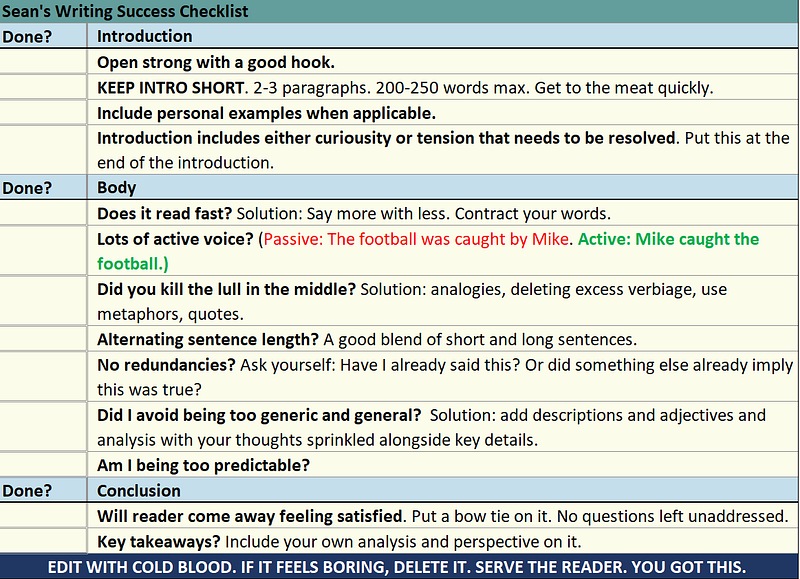
I have a laminated version of this near my desk. I typically go down this, while looking at my article and looking for evidence to the contrary.
This process breathes life into an otherwise dying piece.
One Last Thing
Study your subject as much as possible before writing.
For ghostwriting: I always interview or have my clients send me a long recorded monologue. I often say, “Don’t worry about oversharing. I want you to overexplain and shamelessly share every detail from this and we can edit it fully later.”
For articles: I typically pair learning with another activity. I listen to lectures or videos while I exercise, clean the house, or walk. This brings a deeper understanding for clearer delivery.
“If you can’t explain it to a 6-year-old, you don’t understand it well.” — Albert Einstein
Do not start freewriting about the topic first. That locks you in a sub-optimal direction. It robs you of a better intro and keeps you from starting with the right assumptions.
Use the above checklist, or create your own version. When a sentence or paragraph doesn’t pass the above tests, just edit it until it does, or delete it and write something else. You’ll see huge improvements and it’ll improve your editorial eye.
Treat every article like you are publishing for a high-end client. Worst case scenario, it doesn’t perform well, and you still become a better writer.
Subscribe to my newsletter for humor, history, and life lessons.