
How I Rank Articles on Google as a Beginner Blogger
My exact step-by-step approach to content marketing

In the last six months, I wrote an article about Saturday Night Live (SNL) which is now in the top ten search results on Google. Currently, it’s #3.
The article is called How to Become a Writer for SNL [The Insanely Complete Guide]. I am really proud of it. In my humble opinion, it’s the most relevant and helpful article on the topic.
After doing tons of research about how to rank articles on the first page of Google, I narrowed my approach down to five steps. If I can do it, so can you.
I am not well-known. I don’t have a huge existing audience. I don’t spend money on online ads to drive traffic to my website. I consider myself a scrappy freelance writer who uses content marketing to grow organic traffic.
Based on my experience and research, I believe anyone can use these same “tricks” to rank higher on Google, get more traffic, and make more money — even as a beginner blogger.
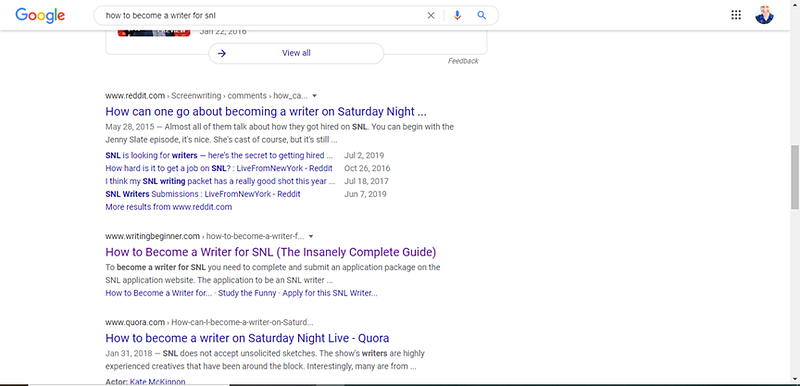
Here’s a screenshot from the first page of search results (my website is www.WritingBeginner.com):
1. Find Phrases That Easily Rank on Google
The first step I took to get my SNL article on the first page of Google was to track down a good keyword.
In my experience, the best keywords have:
- High monthly traffic volume.
- Low competition.
High volume means more people search for the topic each month. The higher the search volume, the better. Low competition means there are not many (or any) good articles written about the topic. The lower the competition, the better.
I’m generalizing for clarity, but that’s all you really need to know to find good keywords to rank higher on Google.
To find my SNL topic, I logged onto Ahrefs, a paid keyword search tool. It’s expensive, but it works. However, you don’t need a paid tool to find good keywords.
Using the keyword explorer tool on Ahrefs, I typed “writer” into the search bar and hit enter. Ahrefs spit out thousands of possible keyword ideas. I narrowed the results down to low competition keywords under a competition score of ten.
The lower the competition score, the easier it is to rank higher on Google.
After scrolling through a few pages of potential keywords, I hit the jackpot with the phrase, “How to Become a Writer for SNL.” As you can see from the screenshot below, this phrase has a keyword difficulty score of “1”.
That means it is super easy to rank for on Google.
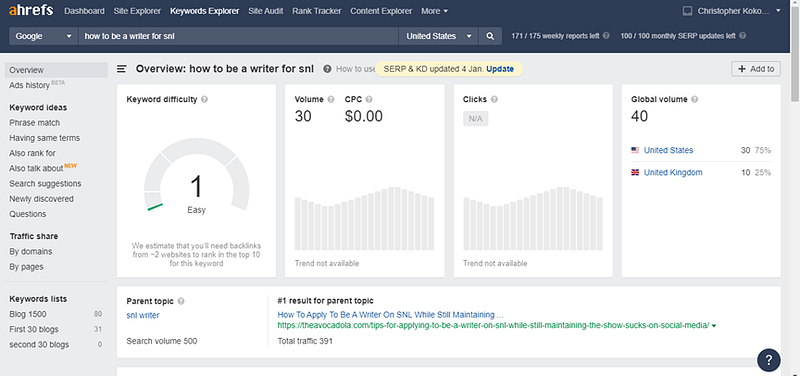
No, this phrase doesn’t send massive amounts of traffic to my website each month. But the compound effect of the traffic from all of my articles grows daily.
Finding low competition keywords is the first step toward taking over the top Google rankings. And, over time, that can mean money in your pocket.
2. Steal the Ranking Strategy of Nike, Amazon, and Travelocity
All the biggest companies in the world use ranking strategies that you can “steal” or borrow for your own content. One massive strategy is called SEO, or search engine optimization.
Once I learned the basics of SEO, my articles started to rank higher on Google.
You can really lose yourself down the rabbit hole of information online about SEO. It’s a complex subject, but let me try to make it simple for you:
- Place your keyword phrase at the beginning of your title. My keyword phrase was “How to Become a Writer for SNL” so I titled my article, “How to Become a Writer for SNL [The Insanely Complete Guide]”.
- Mention your keyword phrase in the first 100 words of your article. Try to fit it in naturally.
- Mention your keyword phrase a few more times in your article. Shoot for a keyword density of between 1–1.5% of the total number of words in your content. Most importantly, make the mentions organic and not forced.
- Use your keyword in at least one subheading.
- Use the phrase in the alt text of an image.
- Place your keyword in your article meta description (this is the short description of articles you see when you search for topics on Google).
There’s definitely more to SEO than what I’ve written. But these are the basic SEO strategies I used to get my SNL article ranked on the first-page search results of Google.
3. Write the Longest Article on the Subject
As soon as I found my SNL keyword phrase, I immediately scoped out the competition. There’s no reason to write an article that I know won’t rank.
Thankfully, the top ten results at the time were short articles with little relevance to the topic.
In fact, the top article for the search result (to this day) is actually a satirical piece about writing for SNL. Don’t get me wrong, it’s absolutely hilarious. But someone searching for “how to become a writer for SNL” is probably looking for practical steps, not comedy.
One of the ways I judge competition is by the length of competing articles.
Here’s how I do it:
- I Google the search phrase.
- I click on the top result to open up the article.
- I hit Shift + A to select all of the text in an article.
- I copy the text.
- I paste the text into a free online word counter.
- The word counter spits out the word count.
- I write down the word count.
- I repeat the first seven steps for all of the top ten results.
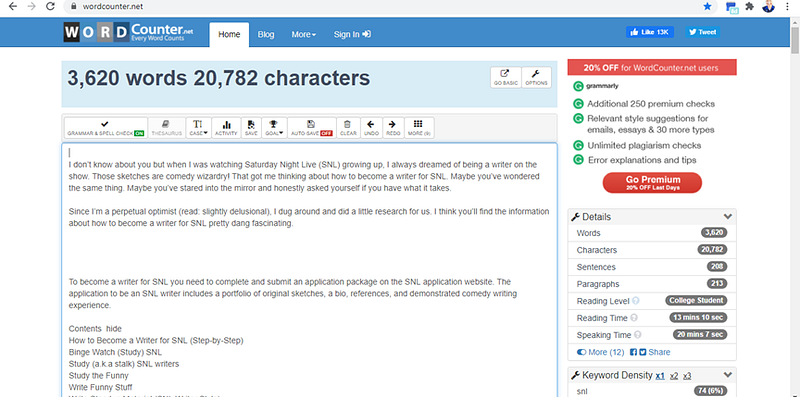
When I completed this process for my SNL search phrase, it became clear that I could beat the competition with a high value 2,000 + word article. Not one to ride the edge of ranking, I wrote an article that is currently 3,620 words long.
I don’t want to just beat the competition. I want to crush them.
4. Write the Best Article on the Subject
Besides length, I wanted to also write the best article on how to become an SNL writer.
To me, “best” means that my article is:
- The most relevant to the search phrase.
- The most detailed.
- The most unique (I don’t say what everyone else is saying).
- The most helpful.
When I wrote my article, I did tons of research. I scoured the internet, found relevant images, cited sources, linked to helpful resources, and gave detailed instructions.
I didn’t hold anything back or save anything for later.
5. Keep Updating Your Article
The final step I took to rank my article on Google was to continuously update it. As soon as I saw my article raising in the rankings (by looking at my data on Ahrefs), I immediately added another 500 words to it.
I didn’t add just any 500 words. I added 500 more words of value.
I found a way to make a great article even better. I added fresh images, even more tips, and linked to new resources. I added more variations of my keyword phrase.
Following this same approach, I have updated a dozen or so other articles on my website. Nearly all of my articles are moving up in rankings. I just saw today that my article, How to Become a Fortune Cookie Writer is now also in the top ten search results.
Final Thoughts
All you need to do to rank your articles high in search results on Google is to follow these five tips:
- Find high-volume, low competition keyword phrases.
- Apply basic SEO to your article.
- Write the longest article on the topic.
- Write the most valuable article on the topic.
- Keep updating your article with better content and SEO.
I continue to use this same system to push articles up the rankings on Google. The most important step is the first one: find good keyword phrases. If you write good articles on topics people are searching for, you will succeed.
No doubt about it.