
How I Quit Smoking On Psilocybin
Renewing neural pathways.
First came the realization. Then, the decision. And last, the suffering.
But by the end, I was renewed.
The glowing sun began to set over a green-brown plain. A small herd of cattle meandered nearby, grazing. The flamingos, so near before, had moved on.
I held my partner close as we sat atop the roof of the 4x4 we’d borrowed from our host, the farmer. It had been a long, beautiful afternoon near the side of a shallow pan. We’d spent it tripping on 2 grams of Psilocybin.
I learned a lot on that trip — three months later and I still feel its impact. I’ve shared the lessons in self-care that landed hammer-like while I was up. And I described how those realizations followed from an ‘enlarged’ awareness.
In that state, it seemed clear that the brain, in its electrical functioning, gave rise to an awareness — which I call my ‘self’. It was also plain that a healthier brain projected a larger awareness. And with awareness enlarged, I’d see the long-term results of my actions instead of living short-term. I’d see which actions led to better outcomes and which to worse. In a nutshell, I’d be wiser. And, I believe, happier.
It was through this that I saw clearly what smoking was doing to me.
The Realization
Robert Wasson echoed a metaphor for self-reflection during a psilocybin trip that fits:
- Imagine your life as a piece of magnetic tape, playing on a tape recorder. As the reels turn, your life plays out.
- When you ingest psilocybin, you press pause, remove the tape, and hold it up to the light to examine.
- From this viewpoint, you gain insights about the way the tape is playing — and ways in which it could play out better.
- Armed with these insights and with new decisions made, you re-insert the tape and press Play once again.
You don’t see into the future, of course. But you look at your life from the outside in, from a wider, wiser perspective. With that wisdom, you see the ‘big-picture’. You understand where your habits are taking you, long-term.
It was that wisdom that let me break my smoking habit.
The memory remains vivid. I was sloshing about in the water, self-reflecting, and discussing those reflections with my partner.
It hit me suddenly, like a broadcast from the subconscious. Speaking as I thought, I said to my partner, “Oh, that smoking habit I have. It’s damaging. I’ve got to stop”.
Sure, I could say that anytime. But here, I felt it. I could see the damage it was doing — to my health, focus, and mind. More than anything else, I could see how it drained my power.
I was a slave to smoking. Instead of my actions being self-directed, they were chained to a cycle of addiction. To relieve anxiety, I’d smoke. That relief would lead to more anxiety after the relief faded, which could be cured only with another smoke. It was a self-reinforcing spiral that siphoned off my willpower in service of a substance.
This created urgency. My willpower was too vital to renounce to addiction. I recently learned its importance, for everyone, from Jim Collins. He and his team, in Good to Great: Why Some Companies Make the Leap… and Others Don’t, found that the best companies are led by leaders with personal humility and indomitable will.
Will — personal power — allows you to accomplish great things. Without it, for example, you’d never have the stamina to become a Top Writer on Medium. Will can be strengthened over time. But it’s corrupted by addiction.
This is what I saw. It wasn’t about smoking, but addiction. It was about will. If I was going to do anything meaningful in this life, I had to strengthen it. I had to free it from addictions so that it could strengthen.
I had to act.
The Decision
At that moment, I made the decision to quit smoking. And I wasn’t going to do a slow burn. I was going to cut it clean. No more, from that moment on.
I felt empowered. But I didn’t feel liberated yet. That’s because this decision — to quit — was only Step 1. There was a Step 2. And Step 2 was painful.
The Suffering
Step 1 was a rational decision. I understood the damage that smoking did. I could see the consequences of continuing. I knew things would get better once I quit. But I wasn’t ready for the challenge of doing the quitting. I didn’t know it yet, but I’d have to rewire my programming — renew neural pathways — and curb my emotional dependence. That was Step 2, and it was going to be hard.
The pain started when the sun began to set. The cattle, grazing nearby before, had moved on. We packed up our picnic and prepared to head back to the warmth of our farmhouse. As we did, I thought about what we’d do that evening. And as I imagined that, I couldn’t help but picture myself enjoying a cigarette as I sat by the fire and watched the starry night.
It was an enticing image. I wanted that cigarette. It would feel good. I craved it. But, just moments before, I’d decided to quit. That imagined cigarette wasn’t available to me. And that made me want it more.
Involuntarily, I started bargaining with myself. I’d quit from tomorrow morning, a voice said. I’d wean off the habit. But that would be like breaking a promise to myself, another replied. What did my realization mean, if I delayed acting on it until it felt convenient?
Then, I noticed something. These voices, debating in my head, were not me. They bubbled out of anterior emotions and were just reflections of what I was feeling. It was the emotion — that dopamine-fuelled desire for a cigarette — that came first. The thoughts — that rationalized postponing my decision to quit smoking — came second. I needed to look through the thoughts and deal with the feelings.
I remembered that this was about will. I had decided to quit. And if I was serious about it, I had to go cold turkey right then and there. If I didn’t, my decision would be meaningless and my will weakened.
I decided to embrace the pain. I turned away from my desire, accepting that there’d be no cigarette for me that evening. My vision for the evening splintered and faded away.
That act — of letting go — felt deep. It was emotionally painful. I cried. But after I let go, for real, the pain began to fade. And a new feeling replaced it.
The Renewal
We got back to the farmhouse. We unpacked, washed up, and made dinner. After, we had a drink with the farmer and his family. We sat near a warm hearth and chatted. As the evening wore on, my pain faded away, giving way to something new.
Liberation.
I noticed it as we headed back to our house. I sensed it as we stared at the cosmos on the way. And I knew it as we settled into bed. I was free.
That sense of freedom stayed with me as I resumed my life. I had shaken off the dependence that chained me to the next cigarette. I could flow from one experience to the next without a smoke interval in between.
Here’s the part that’s baffling. The cravings were gone. And I had no withdrawals. It was easy not to smoke.
Reflections
Don’t get me wrong, it wasn’t a clean-cut miracle cure. I still have a few triggers — social occasions, beers, hanging out with smokers. And sometimes I’ll even have a smoke.
But the nature of my desire to smoke, when I do want to, is fundamentally different now. Unlike after past attempts to quit, I don’t constantly fight off cravings. I didn’t need tons of discipline to resist them. Because there just wasn’t any desire to smoke. I didn’t want it.
It was like the pain I went through when I quit on psilocybin had contained within itself all the future pain of resisting cravings. It was like I’d reprogrammed myself during the trip, and my neural pathways were reconfigured now.
In the Netflix series, The Mind Explained, Vox described a metaphor that explains what might have been going on in my brain when I went through Step 2. The metaphor comes from Robin Carhart-Harris, and goes like this:
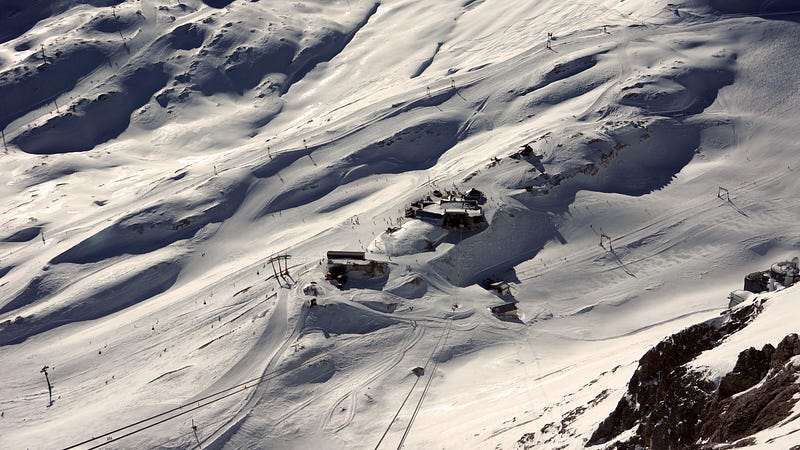
Think of the mind as a ski slope. Every ski slope develops grooves as more and more people make their way down the hill. As those grooves deepen over time, it becomes harder to ski around them.
Like a ski slope, our minds develop patterns as we navigate the world. These patterns harden as you get older. After a while, you stop realizing how conditioned you’ve become — you’re just responding to stimuli in predictable ways. Eventually, your brain becomes what Michael Pollan has aptly called an “uncertainty-reducing machine,” obsessed with securing the ego and locked in uncontrollable loops that reinforce self-destructive habits.
Taking psychedelics is like shaking the snow globe. It disrupts these patterns and explodes cognitive barriers.
This might be why I felt no cravings. And it might be why participants, in study after study, succeed in quitting smoking using psychedelics. The neural pathways that produce the cravings get snowed in. New pathways can be forged.
Last Words
Naval Ravikant says, “suffering is a window to truth”.
Through suffering on psilocybin, smokers might see the truth from which they hide. That they are chained to smoking. Their chains are neural pathways, forged deep into the ski-slope of the mind.
When they take psilocybin, those pathways are snowed in. It brings renewal. New, healthier habits can form in the fresh snow.