

How I Plan to Start Loving Failures
A missed deadline, an imperfect presentation, a moment when things didn’t go as planned — ohh yeah, baby, those are the learning opportunities I’m looking for!
The primary component of anxiety is the fear of uncertainty which is the feeling of not being sure what will happen in the future [1] where events may result in either success or failure. If we started embracing failures, we could decrease the fear of uncertainty and, consequently, reduce anxiety.
Where I come from, mistakes and failures are viewed rather negatively, and people are hesitant to share them with others for fear of being judged. This strongly reflects how parents teach their children to avoid mistakes at all costs, which, at some point, can lead to anxiety and low self confidence.
I decided to put an end to this and begin embracing setbacks. Firstly, let’s briefly understand how our brain works when we negatively respond to failure compared to when we celebrate failure.
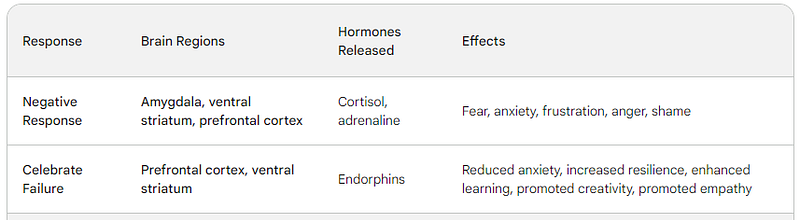
Reduced anxiety, increased resilience, enhanced learning, promoted creativity and promoted empathy sound like a winning lottery ticket.
So, now I want to figure out how I can start loving failures!
This story is inspired by my desire to overcome anxiety and is supported by information from the book The Winner Effect: The Neuroscience of Success and Failure.
1. Reframe Failure as Feedback
Sit down and list all the possible positives that failure might bring.
“If I fail the exam, I’ll know which topics I should focus on.”
“If the project fails, I will gain lessons learned for the next project.”
“If my actions start a conflict, I’ll get to know a person better.”
“If I don’t meet a deadline, I will find out what I could have done differently.”
Change the narrative around failure by reframing it as feedback. Instead of seeing it as a reflection of your abilities, consider it valuable information that can guide your future efforts. This shift in perspective helps detach personal worth from the outcome of a specific endeavor.
Listing as many advantages of a mistake as possible engages a key part of our brain, the prefrontal cortex. The prefrontal cortex is involved in weighing the pros and cons of a situation, making informed choices, and modulating emotional responses through its connections with other brain regions, including the amygdala [2]. Recognizing the advantages of failure should prevent the prefrontal cortex from signaling the amygdala to initiate a fear response.
2. Challenge Fear of Judgment
Sit down and consider what others might think if you fail. Evaluate whether it is truly as bad as you perceive it to be.
“If I fail the exam, my girlfriend might think that I’m stupid, but she knows how hard I studied for it and understands the difficulty of the exam. She won’t love me less.”
“If the project fails, my manager might think that I’m not qualified for this job, but she remembers all my successful projects and sees how much time I spent to plan this one.”
Psychology recognizes the fear of judgment as a common barrier to embracing failure. Challenge the belief that others will perceive you negatively due to setbacks. Remember that vulnerability and authenticity can foster deeper connections and understanding.
Don’t forget to observe how people react to your mistakes. Do they truly perceive you negatively?
Go further, intentionally make small mistakes to prove to yourself that your fears have no basis.
3. Document Lessons Learned
When faced with failure, document on what went wrong, what you can learn from the situation, and how you can apply those lessons in the future.
“I spent too much time thinking about that calculation-type question and didn’t manage to answer others. In fact, there was only one such question. Instead, I should…And now I know what topics are covered in the exam.”
“The project failed due to poor communication. Half of the stakeholders didn’t read emails and missed their tasks. To prevent this in the future, I will schedule regular meetings to provide updates and monitor progress.”
It’s a crucial part of the process, otherwise, our brain might not recognize that Step 1, “Reframe Failure as Feedback,” was effective. We learned a lot from our mistake or failure, and this aligns with what we listed in Step 1. We should document the evidence of the advantages of failure. This also includes gathering constructive feedback from others.
4. Select the Right Surroundings
Engage with people who celebrate failure, view mistakes as opportunities for growth, and have experienced the same failures that you may encounter.
We are returning to where we started. If your surroundings hold a negative perception of failures, it will influence you and your own perception. Surrounding yourself with people who encourage a positive view of failure and value learning and growth is crucial.
5. Celebrate Failure
Get a bottle of Champaign, tell your friends, post on Instagram and open your heart to the tremendous insight you will get from that failure!
Challenge societal norms by openly sharing your failures and the lessons you’ve gained. Research on social norms suggests that individuals who challenge prevailing attitudes contribute to shifting societal perceptions. Celebrating failure publicly not only normalizes it but also inspires others to embrace their own setbacks.
Embracing failures requires a shift in perspective and a willingness to see setbacks not as roadblocks, but as stepping stones toward personal and professional development. Each failure, each stumble, offers a unique opportunity to learn, adapt, and ultimately thrive. It’s in these moments of vulnerability and uncertainty that we discover our resilience and capacity for growth. Rather than fearing failure, I choose to view it as a guide, pointing me in the direction of improvement and self-discovery. As I navigate this intricate path of embracing failures, I am confident that the lessons learned will sculpt a stronger, more resilient version of myself, poised for success in the face of any challenge.


