How I Overcame Imposter Syndrome After Joining Gojek
Working at a place where perfection isn’t sought after and failures are essential.
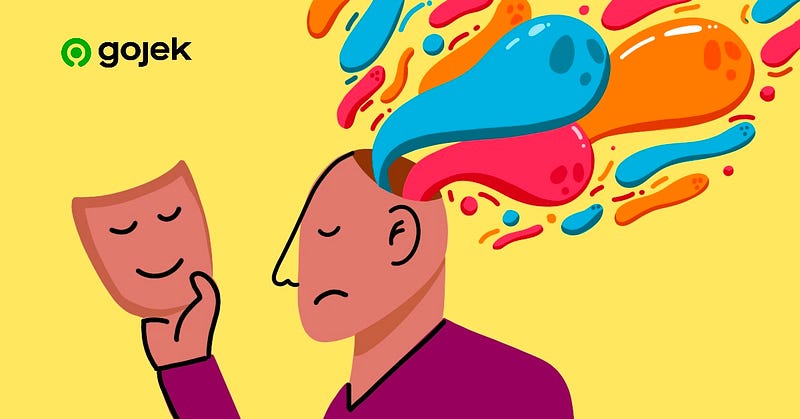
“Am I good enough? Maybe I just lucked out.”
“Ah, this isn’t perfect, I need to give my 100% ALWAYS.”
“I should’ve been smart enough to know everything about this, looks like everyone around me does.”
These are signs of a person experiencing Imposter Syndrome, and this is the story of how I overcame it after joining Gojek’s Design team.
Not-so-fun fact: The International Journal of Behavioural Science says approximately 70% of people experience Impostor Syndrome at some point in their lives. 🤯
Working with pioneers 👑
Before joining Gojek, I’d been working as a UI/UX designer for a year. This field of work is quite new in Indonesia and working with industry stalwarts at an early stage is rewarding, but it can be intimidating too. I learnt I’d be working with Borrys Hasian, Head of Design Ops, and Tri Nugraha, Product Design Lead — who are among the first designers who pioneered UI/UX Design in Indonesia. They built the community, introduce us to the field, and create content that helps me and all of us to learn more about design.
And that’s when the dose of Imposter Syndrome kicked in.
I kept thinking: “Did they make a mistake while hiring me?”, “Will I be able to live up to the expectations?”
But hey, I thought I’d give this a try. So, I put a smile on and started working as an Interaction Designer at Gojek.
And then… (no spoilers here) the feeling came back. 😟
100+ designers working on various facets of 20+ products in the #SuperApp. It was overwhelming.
I remember feeling this surge of raw energy as I first entered the Gojek office. Groups of people working around a cluster of desks, wearing their Gojek t-shirts, whiteboards full of sticky notes. It seemed like everyone had it all figured out… except me. 😫
It was a rush of pressure back then being suddenly dropped in this environment.
At first, hesitation 🤔
During my first month here, I hesitated to ask questions when I still had doubts. I didn’t challenge my coworkers’ opinions or designs as I felt like they knew so much more than I did. I even felt that negotiations and confrontations were hard because I cared too much about being liked.
Growing up in a traditional Asian family, failures and being vulnerable were seen as things that needed to be hidden from the public. In this rapidly moving industry, I struggled for a couple of months with self-doubt and Imposter Syndrome. It wasn’t until recently I finally found a sense of belonging.
Then, gradual enlightenment 🧘♂️
I started reaching out to people, talked with my coworkers, my managers and seniors, and opened up about my insecurity. I learned that Imposter Syndrome is quite common among designers. Even the best designers I know in Gojek experienced this at some point.
No one was born talented and automatically good at design. It takes practice and experience.
Senior designers encouraged me and told it’s okay to make mistakes and it was in the core process of product design. We need to learn from our past failures so we can iterate our design and improve our products.
Knowing my teammates always have my back makes me feel that Gojek has done a great job of nurturing this safe space for people to make mistakes and receive constructive feedback to improve.
Now, I see a challenge as an opportunity, rather than a setback. Each time I encounter a problem I don’t know how to solve, it is a chance to lift myself from where I currently stand.
The three lessons 💡
Here are the three things I learnt from experiencing Impostor Syndrome:
- Acknowledge the feeling itself As Sun Tzu said, know thy enemy. The first thing you need to do is to acknowledge that you have Impostor Syndrome (It’s okay to not be okay!) Uncomfortable thoughts or anxious feelings might still be there, but don’t treat it as a setback, but as a normal response when we face new challenges or move out of our comfort zones. When you start feeling this way, try to move forward and overcome said challenges.
- I’m an eternal student It’s fine if you don’t know what you don’t know. We always need to learn just like a student. I try not to let my ego or pride stop me from achieving my goal. I’m not embarrassed to ask for help, I admit my mistake and I grow from it. Having this mindset has helped me connect and learn from new people and also explore areas I haven’t learned as I am driven by the sheer curiosity about the problem I’m trying to solve.
- I need to accept external validation It was quite difficult for me to accept it when people praised me. You know how that conversation usually goes, right? Them: “Your design is really good” Me (anxiously): “Oh really? It was nothing special” This was my default response to ensure I didn’t sound too arrogant. But, now I realise, when my design is good, it IS actually GOOD! I learnt this at Gojek.
Love thyself and thy design 🥰
I recently started accepting my wins and celebrating it. So, when the team praises and thanks me for my design explorations for the project, I say said “Oh thank you!” instead of my usual “Oh, it was nothing special.”
I learned to appreciate myself and take the compliment because I did give my metaphorical blood, sweat, and tears 피 땀 눈물 (BTS fan? Me too 😉) while working on that design!
If some of you experiencing Imposter Syndrome are thinking now I’ve gotten my life all figured out… The answer is no. 😂 Insecurities may never fully disappear, but it starts getting easier to handle them once you believe in yourself more and work towards your goal.
PS: I still struggled with mild insecurity writing this article. 😅

Click here for more stories from the vault. 💚


