
How I Make $2,000 Each Month by Answering Simple Yes or No Questions
The big money secret is context

I make $2,000 or more per month by answering simple yes or no questions on my portfolio of websites.
Many bloggers overlook these questions because they seem too small, too inconsequential, and too obvious. But that’s what makes them so lucrative for me.
In this article, I’ll share my complete process for making thousands of dollars every month by answering stupid simple questions.
Hint: The big money secret is context.
How I Make $2,000 Answering Yes or No Questions
Let me start by explaining exactly how I make money by answering these simple questions.
What I do is search for simple questions in my niche that other bloggers have not answered online. Then I write an article to answer the question.
After the article ranks on Google (and ages over 6–12 months), I earn commissions from display ads and affiliate marketing on my websites. Over the course of a year (and beyond), I’ll make up to $2,000 or more per month from these articles.
The more articles I write, the more money I make.
As long as I keep the articles fresh and competitive, they will continue to make money forever.
No big surprises there. I’ve written about making money in a similar way before. But I’ve never outlined exactly how I write the articles for these types of topics.
That brings us to the next section…
How I Choose Yes or No Questions To Answer
I try to keep my strategies as simple as possible.
I choose yes or no questions based on the niche of my website, seed words related to my niche, Google autosuggest, estimated search volume, and competition.
Showing a few examples is probably the best way to explain my system.
Example #1: Gardening
For this example, let’s say that my niche is gardening. I’ll go over to Google and enter a seed keyword into the search bar.
We’ll use “garden rake” for our seed word. You can use any word or phrase related to your niche.
I plug “garden rake” into Google search. Then I add a question modifier in front of or behind the seed word. It looks like “Is Garden rake,” “Are garden rakes,” or “Can garden rakes.”
You use any seed word related to your niche and any question modifier (is, are, can, do, will, has, etc.).
Then you look to see what Google autosuggest for the rest of the phrase, sentence, or question. When I just did this, Google gave me several options. That is very typical for my keyword/topic research process.
Here are a few of the Google autosuggestions:
- Are Garden Rakes Worth It
- Do Garden Rakes Work
- Can I Use a Garden Rake on Carpet
- Do I Need a Garden Rake
The common thread of these questions is their simplicity. You can literally just answer them with a “Yes” or a “No.”
The next step is crucial: I run a Google search for each phrase to check the competition. If no other blogger has answered this specific, direct question, then I will likely write an article about it on my website.
However, if another high-authority website has written a long article directly answering the question, then I will forget that question and move on to another one.
You can check the authority in two ways:
- Is the website known and recognized in your niche?
- Use tools like MozBar or the free version of Ahrefs
I like it when the authority of a website is less than the authority of my website and the length of the article is less than 600 words. Even better if there is no other article that specifically answers the question.
It’s important to always check the competition before writing an article.
Otherwise, you might end up writing an article that never has a chance of ranking high in search. That lowers your potential earnings.
Before I show you how I write 1,000 to 2,000-word articles in response to a simple yes or no question, let’s look at one more example.
Example #2: Pets
I want to select a completely different niche for this second example.
If you’re like me, I learn the most from diverse examples with concrete details. In this example, we’ll use “cat toys” as the seed keyword.
We plug that keyword into the Google search bar with question modifiers.
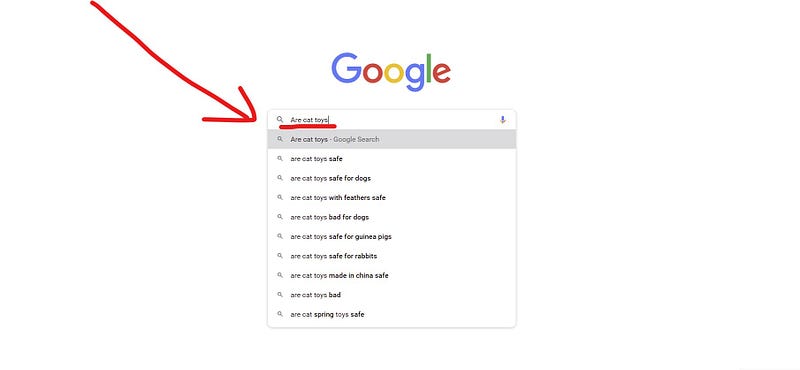
As you can see, here is what we might get:
- Are cat toys safe for dogs
- Are cat toys safe for guinea pigs
- Are cat toys safe for rabbits
- Are cat toys made in china safe
Just like with the gardening niche, I’ll Google search each of these questions to check the competition. If no other blogging websites directly answer this question, then I’ll write an article about it.
If forums like Quora or Reddit show up at the top of the search, that usually means I can still write a high-ranking article (usually #1 in Google search).
How To Write 1,000 to 2,000-Word Articles for Simple Yes or No Questions
Anyone with the right keyword search methodology (like the one I just demonstrated) can find good topics.
But how in the heck do you write a full article when a simple “Yes” or “No” would suffice?
Here is the gist of the strategy: context.
Most yes or no questions depend on the context of the question. For example, when I checked the competition for the question, “Are Cat Toys Safe for Dogs?” I found a very short (under 500-word) article answering the question.
That usually means that I can rank an article in the #1 spot for this question with a more comprehensive (but still relevant) article with 1,000 or so words.
The only way I know how to extend the article that long is to play around with context.
Here’s what I do:
- I open up a new document (Word, Google Docs, my favorite AI writer — not an affiliate link).
- I place the main keyword phrase/question as the title. In this case, “Are Cat Toys Safe for Dogs?”
- Then I brainstorm all of the different possible contexts for this question. I write down all of the ideas (even if I will delete, add, or combine them later).
- I run another Google search for the keyword and look at the People Also Ask and People Also Search For sections (Usually on the first page of Google search results).
- I put the keyword question into free tools such as AnswerSocrates and SearchResponse.io. If I use a paid tool, like Ahrefs, I’ll run a keyword through that tool as well.
- I’ll plug the keyword phrase into the Google search bar and start adding other related words to see what Google suggests.
I might Google search for “Are Cat Toys Safe for Dogs in” or “Are Cat Toys Safe for Dogs before”.
After brainstorming and running the keyword through my tools, I’ll put together an outline for the article. This becomes the framework for writing a 1,000+ word article to a simple question.
Here is a possible outline:
Title: Are Cat Toys Safe for Dogs?
Subheadings:
Are Cat Toys Safe for Small Dogs?
Are Cat Toys Safe for Big Dogs?
Are Cat Toys Safe for Old Dogs?
Are Cat Toys Safe for Sick Dogs?
Are Interactive Cat Toys Safe for Dogs?
Are Cat Toys Safe For Dogs Left Alone?
Are Chewy Cat Toys Safe for Dogs?
Are Petco Cat Toys Safe for Dogs?
Are Electronic Cat Toys Safe for Dogs?
Are Catnip Toys Safe for Dogs?
What Happens If My Dog Eats a Catnip Toy?
As you can see, I could go on a long time with this article. All I need to do is write 100–300 words under each subheading to get my 1,000 to 2,000-word article.
Context Ideas for Writing Longer Articles
I almost always want to write articles that are at least 1,000 words. I often shoot for 1,500-word articles just to scare off any potential competition from other bloggers.
By “scare off” I mean they will look for easier topics and low-hanging fruit rankings.
Coming up with context ideas is not always straightforward.
Here are a bunch of contexts I run my topic through:
- Old/Young
- Big/Small
- Expensive/Cheap
- Seasons (Spring, Summer, Fall, Winter)
- Type
- Brand
- Edition (5th Edition, 6th Edition)
- Uses (for gaming, for fishing, for school, for video editing, etc)
- Users (gamers, fishermen, parents, students, coders, dancers, pet owners, etc)
- Alone/Public
- Single/Group
- Simple/Complex
- Opposite
- Exceptions
- Features
- Locations
To demonstrate how this might work, here is a made-up example using the context framework for the silly yes or no question, “Do Snowmen Melt?”
- Do big snowmen melt?
- Do little snowmen melt?
- Do snowmen melt in winter?
- Do snowmen melt in Antarctica?
- Do snowmen always melt?
- Do snowmen families melt?
- Do snowmen with clothes melt?
- Do snowmen melt faster in Florida?
- Do snowmen ever not melt?
- Can you make a snowman melt slower? (and How?)
As you can see, not every context idea works for every topic. But a surprising amount of them do.
By running your topics through free and paid tools, then the context framework, you can easily write an article over 1,000 words.
What To Do If The Yes or No Question Is Too Small?
Despite this process, I still find yes or no questions that are simply too small for a complete 1,000+-word article.
What do you do then? Do you throw out the question?
No! Instead, you keep a running tally of these questions that you may be able to add to other articles. You never know when a small question can fit inside of another article — and push that article over the 1,000-word mark.
Over time, you might even notice a pattern or categorization of those tiny topic ideas.
If you discover a pattern or category, group those tiny questions into a single article.
4 Quick Things You Need To Know
Based on the questions I get from my other articles, I want to share four things here for clarity.
- I only use this full strategy on my portfolio of self-hosted websites. I don’t use this process on any other online platform where I publish articles.
- You can use the context framework section on almost any type of writing on any platform.
- I make money by publishing simple articles on my websites, ranking them high in Google search, and putting display ads on my websites (I’m with the Ezoic ad network right now). When visitors to my websites read and engage with my articles, I earn display ad commissions.
- I learned to write better articles and build profitable websites from the Passive Income Geek Blogging program (not an affiliate link).
Final Thoughts
The great thing about these articles is how easy they are to write.
I can usually write one in an hour or two (from blank page to published post). Sometimes one of the subheadings becomes another separate and complete article.
After you publish enough articles, check your analytics.
You’ll probably find that your article ranks for many of the subheadings. If you write an article specifically about a subheading (ex: Are Petco Cat Toys Safe for Dogs?), you can possibly rank high for that search term as well.
For more ways to make money from your writing, browse my “playlist” of write and make money articles (There are currently 91 articles and growing).


