
How I made $78,034 with one $97 online course
You can earn a full time living without selling high ticket programs.

I’ve been obsessed with online courses since I first heard about them in 2010.
My first introduction to the online course world was Udemy. It was the first platform that I can remember that let ordinary people share their knowledge online and get paid for it.
I created dozens of courses on Udemy back in the day.
Topics ranged from forming LLCs and other business legal issues to tutorials on how to record and edit audio files. I had finally found a platform to explore all of my passions and make some side income in the process.
I was in heaven.
But the problem with Udemy is that it’s not a platform for people who want to earn a substantial amount of revenue with their online courses.
Sure, there are some course creators there who have managed to attract tens of thousands of students and are doing quite well.
But most Udemy course creators are not able to earn a full-time income on the platform because Udemy routinely discounts courses by up to 90%. For example, courses priced at $100 often sell for a mere $10.99.
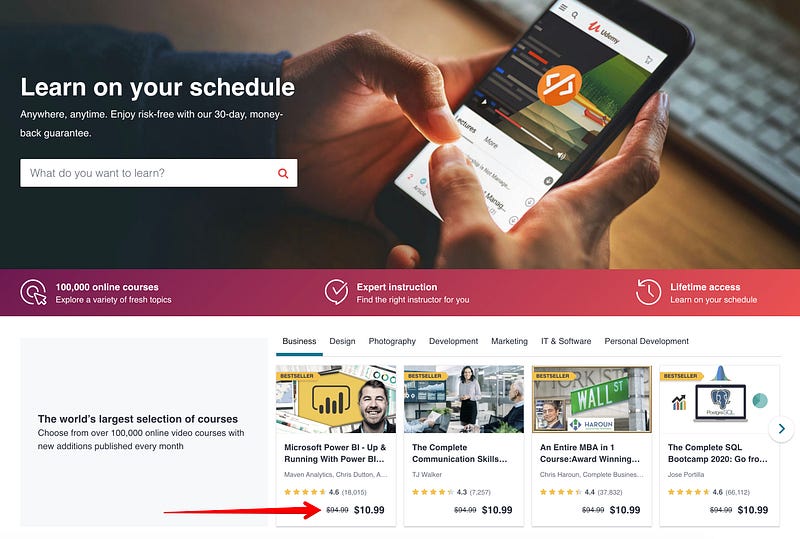
The only way to prevent Udemy from discounting your course is to opt-out of its promotional program. This means you will be responsible for doing all of your own marketing and advertising because Udemy will no longer promote your course for you.
That wouldn’t be so bad except for the fact that Udemy has strict rules on how and when you can communicate with your students.
For example, you are not allowed access to student email addresses. You can only promote your other Udemy courses to your students a limited number of times per month through Udemy’s internal messaging system. You are not allowed to promote other products and programs outside of Udemy.
Plus, a lot of people opt-out of receiving instructor emails, which limits the effectiveness of your marketing efforts on Udemy.
The moral of the story is that Udemy was built to cater to students by providing inexpensive education. It wasn’t created with the primary intention of helping online course instructors earn a full time living from their work.
Just to be clear, I don’t have a problem with the Udemy model. I think it serves a unique purpose in the marketplace, and it’s a great place to get started if you are interested in creating courses but don’t really know where to start. They make it really easy to upload your content.
But I found myself at an impasse.
In the year that I had been creating courses for Udemy, I had enrolled 26,943 students in both my free and paid classes but earned only $600.
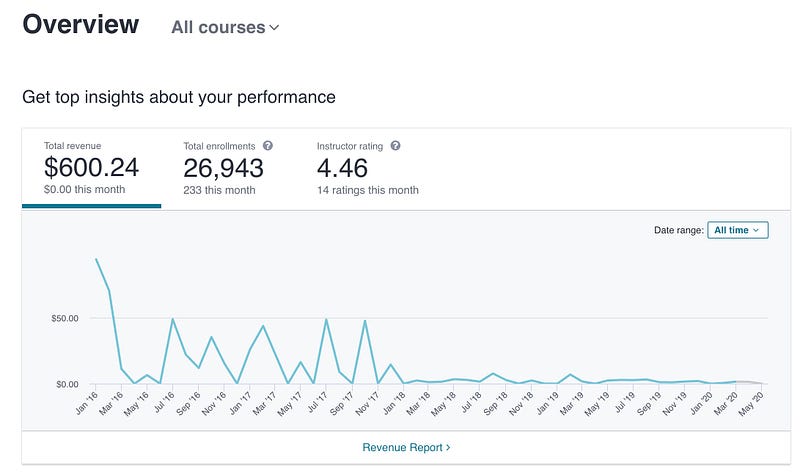
If I wanted to reach my goal of making the equivalent of a full-time income with my online courses, I had two choices:
1. I could make 9100 sales on Udemy per year at $10.99 a pop (an unlikely feat), or
2. I could move to a different platform where I could sell my courses at full price and have free access to communicate with my students directly.
I ended up taking one of my courses off of Udemy in December 2017 and put it on the Teachable platform (referral link.)
I priced the course at $97, which was the same price I listed it for on Udemy before they applied their 90% discount.
In December 2018 — which was my first month selling the course on Teachable — my revenue jumped to $6,218.
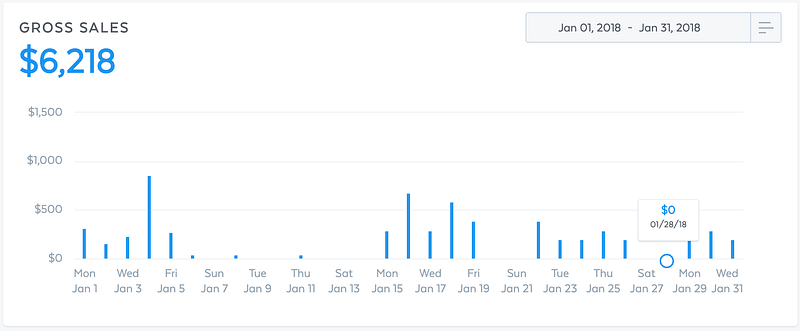
I had effectively gone from making a few bucks here and there to earning a full-time income in one month from the same program. This wasn’t a fluke. Throughout 2018, that one little $97 online course made me $78,034.
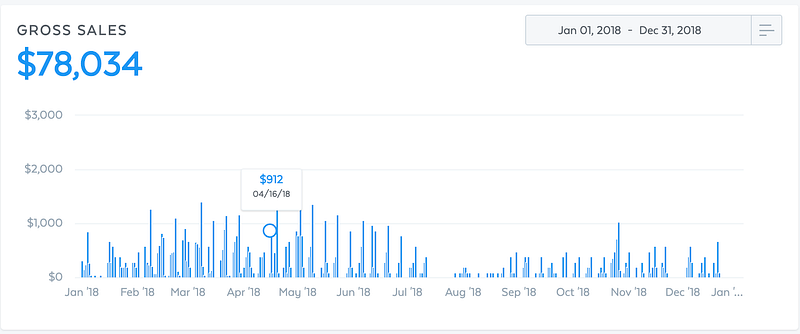
Now, this didn’t happen just because I moved my course from Udemy over to Teachable. My increase in earnings was a direct result of my marketing and advertising efforts.
Let’s talk about that.
The Marketing Strategy
I didn’t follow the traditional “build a big email list and then launch” formula because I didn’t have an email list at the time. Instead, I set up an evergreen sales system which consisted of:
- Google ads that ran to…
- An article on my website that answered a specific question I knew my target students were searching for, and
- An invitation to sign up for a free 5-Day Challenge at the end of the article.
I pre-recorded all of the videos and materials for my 5-Day challenge and uploaded them into Teachable. Teachable has a “drip” feature, which allows students to unlock a new lesson each day.
When someone signed up for the challenge, they would get one challenge video lesson dripped out to them each day over the five days. It worked surprisingly well.
All of this ran on autopilot.
At the end of the 5-day challenge, I made an offer to join my full course for $97.
I left the offer to enroll in the course open for five days following the free challenge.
I learned somewhere that putting a deadline on your course enrollment would increase sales, so I decided to test it out for myself, and it worked.
I had created a series of automated sales emails reminding subscribers about the deadline to enroll using ConvertKit (referral link.)
If someone did not enroll in the course within the five day enrollment period, they would be locked out of the sales page and redirected to a waitlist. I did this using a software program called Deadline Funnel (referral link.)
I let this automated system run for the entire duration of 2018.
At the end of the year, I had spent:
- $12,384 on Google ads
- $999 for a year of Teachable’s Pro plan.
- $300 for a year of ConvertKit (they also have a free option.)
- $360 for a year of Deadline Funnel.
My total expenses were $14,043.
My total revenue was $78,034.
My total profit was $63,991.
A Note About Paid Advertising
If the amount that I spent on Google ads scares you, please know that I didn’t start out spending $1000 per month on ads.
In the first month that I hosted my course on Teachable, I spent $150 on ads because I had a Google ad credit. You can request your own $150 Google Ad credit here.
I used the initial credit to test out my marketing materials. Once I saw that my process was resulting in sales, I started spending more of my own money on ads. At first, I would spend $5 to $10 per day. Eventually, I would just reinvest a percentage of my course sales each month back into advertising.
This way, I never lost money on ads. I was able to use them as leverage to grow my online course revenue gradually month after month.
Never Stop Experimenting
This process worked well for me, but I didn’t stop there. I’ve since tested out many different methods of selling online courses, from webinars to simple email sequences and everything in between.
I found that almost every strategy that I implemented and tested did work to some degree.
There is no “one magic way” to sell online courses. But some methods will work better for your particular course niche than others. So don’t be afraid to test things out.
Another objection that I hear often is that “Google ads are expensive.” My answer is that, yes, they can be expensive if you are bidding on keywords in a very competitive niche.
However, if you are teaching an online course in a more obscure niche or you do keyword research to find long-tail keywords that aren’t as competitive, Google ads can be quite reasonable. I get clicks for as little as $.08.
Also, Google ads are just one way to get traffic to your content. The only reason I got started with them because of the free ad credit. You could easily use Facebook ads, Instagram ads, SEO, YouTube, Pinterest, or other social media platforms to drive traffic to your content.
You just have to pick one and go with it.
The Takeaway
The point is, don’t get hung up on the details.
- Choose a method of getting traffic to your content. Whether that is paid ads, SEO, or social media, it doesn’t matter. Just pick one to start.
- Nurture your prospects with content. You could use a simple email sequence, a challenge, a video series, a webinar, a mini-course, or anything else your imagination comes up with.
- Then make an offer.
Get the Mini Post-Grad Survival Guide
A 5-day email course with amazing tips on budgeting, investing, and productivity for 20-somethings. Learn how to spend $40 per week on groceries, among other things, by signing up for free.


