
How I Learned To Deal With Change
By embracing the opportunity to make a difference.

If I could have dinner with any 5 people dead or alive, Marcus Buckingham would be one of the five. I think everything he does is pure leadership gold.
So when I found out that he was offering the StandOut Strengths Assessment for free during the pandemic, I took it right away.
As a talent professional, I love a good assessment almost as much as I love Buckingham’s work. 20 minutes later, I had my results.
The assessment measures “how well you match 9 Roles and reveals your primary Role and secondary Role.” The resulting report helps you “accelerate your performance by showing you actions you can take to capitalize on your comparative advantage.”
My primary Role? Pioneer. My secondary Role? Connector.
There were a few elements of the pioneer Role that resonated with me immediately:
- Whereas others are intimidated by the unfamiliar, you are intrigued by it.
- You are smarter and more perceptive when you’re doing something you’ve never done before.
- With ambiguity comes risk, and you welcome this.
Check, check, and check. Are you starting to see the theme here?
I am invigorated by exploring the unfamiliar. I love being thrown into a challenge I’ve never dealt with before and figuring it out. I embrace change. But I didn’t always feel this way.
As most assessments do, this one progressed from describing the benefits of your workstyle to describing the potential pitfalls of that style, especially when working with those who have a style very different from yours.
I knew what was coming because I had felt it in my gut when working alongside colleagues who were less comfortable with change or ambiguity.
- You are not threatened by change or uncertainty but, for many people, the opposite is true.
- Know that you will sometimes be a disruptive addition to the team.
- Be sure to bring more risk-averse people along with you.
I get it. Change is hard for a lot of people. But it doesn’t have to be.
What if you could re-frame the way you view change?
What if you could learn to embrace change, too?
Jason Clarke, founder of Minds at Work, gave one of my all-time favorite TEDx Talks on this topic, and it fundamentally re-framed how I think about change. I attribute my ability to embrace change to the points he makes within his talk.
Clarke rejects the belief that most people don’t like or want change and cites a few compelling examples of why he believes this.
“If this is true, we’ve got to tell the fashion industry right away. Because they are based entirely on the idea that people want to change their look. We’d better talk to the tourism industry as well because apparently, people don’t want to go to other places. All those people in gyms and those people that are trying to lose weight and people having cosmetic surgery or getting their hair done? We’ve got to tell them how much they hate change. People that have elections and people who have affairs? We’ve got to tell them, too!”
Great points, right?
He goes on to argue that what people actually dislike is fake, phony change. What people want, he says, is real genuine change.
“We know how the lack of change can get packaged up as something new, and we’re savvy to it.
Is it likely that we now suspect all change as being fake?
Real change sounds very much like fake change. It’s hard to pick the difference.”
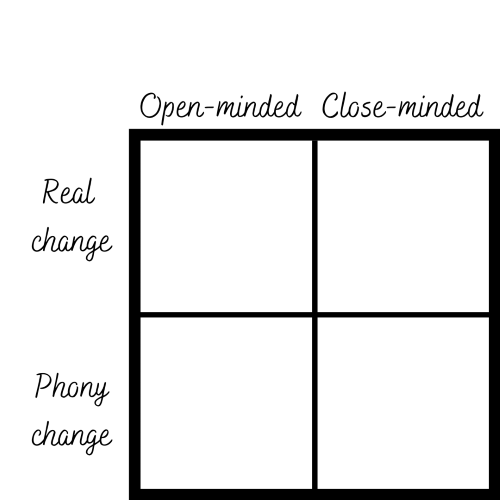
Clarke lays out two options we have when faced with change — we can be either open or close-minded.
Similarly, he lays out two options for the person offering the change — change can be either real or phony.
He lays this out in a decision matrix like the one below:
- If I have an open mind and am presented with a change that ends up being phony, then I will be majorly disappointed. That sucks, but I can handle it.
- If I have a closed mind when presented with the same phony change, then I can say, “I told you so.” But, what does that really do for me? Not much.
- But if my mind is open and the change is real then I have an opportunity to make a real difference! I think most people want to make a difference.
- And — worst-case scenario — what if my mind is closed but the change is real? That’s a missed opportunity. We’ll never know what we could have achieved by embracing that change.
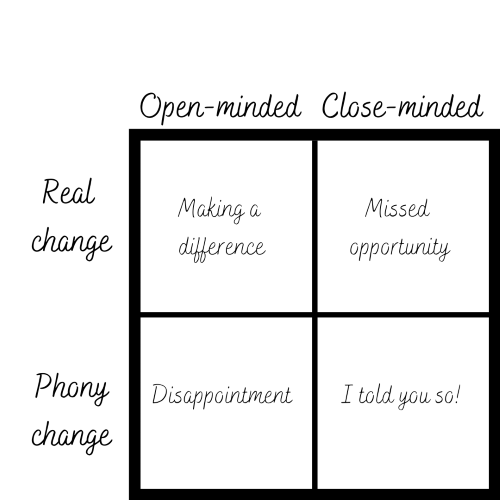
Clarke closes his talk by summarizing these options and saying,
“You have the choice to close your mind, to lose a rare opportunity to make a change for the right to say ‘I told you so.’
Or you could give this a fair chance, open your mind, and risk disappointment for the chance of making a difference.”
When you lay it out like that, isn’t the case for embracing change pretty straightforward? It is for a pioneer like me.
Not a member of Medium yet?
Join here to directly support my work and get access to every story on Medium. You can also subscribe to my free newsletter or connect with me on Linkedin.


