
How I Got Into Stanford From the Dreaded Waitlist
The 3 lessons I learned to apply to any academic and career journey.
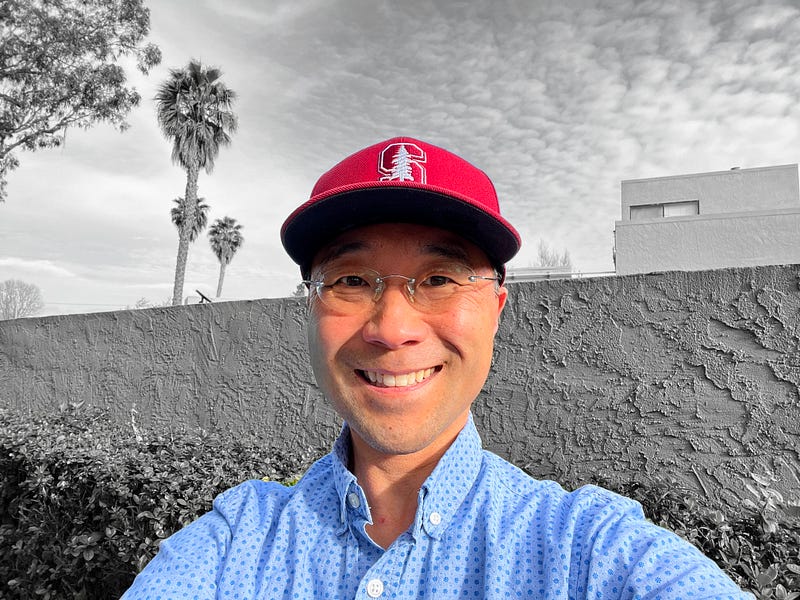
Stanford University was the dream school for me. It transformed my life.
I almost didn’t get in. I feel fortunate that a series of events helped me go from almost certain rejection on the waitlist to ultimately being admitted to Stanford with a fellowship grant that fully funded my education there.
Here’s what I learned from the process of getting into Stanford beyond random luck or serendipity.
I’m Grateful For My Parents
Firstly, my parents had immigrated to the United States with not much more than an 8th grade education, a suitcase, and us two toddlers.
Fortunately, my father had learned the skills of the trade in the craft of tailoring bespoke men’s suits from my grandfather who was a master tailor. Because tailoring was a needed job, but not a popular career in the US, my father had a job opportunity waiting for him in the US to start his family’s American dream. However, both my parents still aspired much more for us kids than to grow up to be another generation of tailors.
America beckoned us with its opportunities for more education and career options.
My parents were not able to help my brother and me with our schoolwork though. Without much education themselves, they needed to work extra long hours barely above minimum wage to make ends meet. However they did model work ethics, financial savings, and the importance of community networks while revering education for us kids.
As a result, I became the first in my family to finish high school and to go to college.
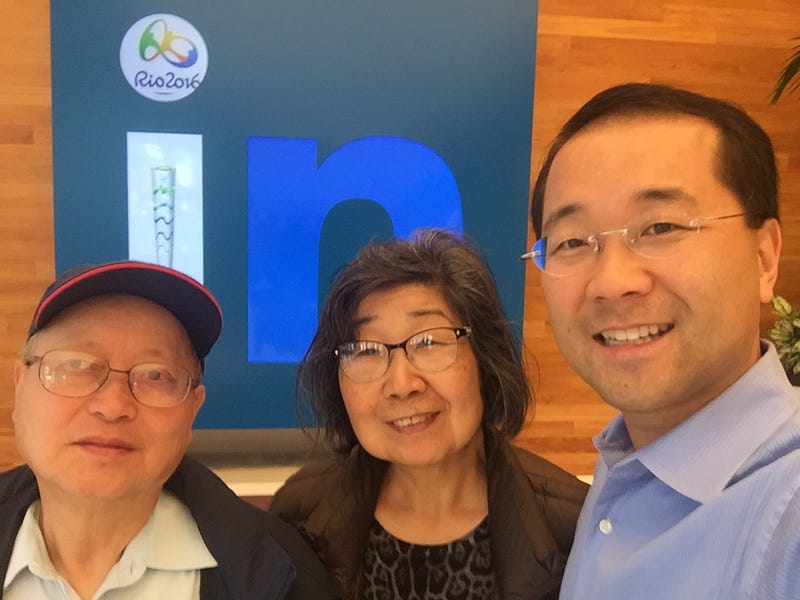
In the future, I’ll share more stories of my experience getting into UCLA and the lessons I learned there.
For today however, I’ll share about my journey to being admitted to the Stanford University graduate school.
Uncertain Economy and Uncertain Future
In my 4th year as a mechanical engineering undergraduate at UCLA, I could not decide whether to go to graduate school or to start full-time work.
The economy was shaky at the time. New college graduates were uncertain to be able to get a job.
I did what people often do when they could not decide: I pursued all the options without cutting out anything. While I still had to finish my senior year university classes and still leading the extracurricular ASME student chapter, I also needed to take the GRE exam, apply to graduate schools, apply to scholarships, attend job fairs, and interview for jobs all at the same time.
I definitely felt stretched and burnt out at the time.
The university did present me an option to stay for a 5th year to graduate with a combined Bachelors and Masters degree concurrently. A few of my classmates chose this option to stay in school during the recession. However, this option did not appeal to me, as my desire was towards building robotics plus gaining business skills, instead of doubling down on the mechanical engineering program at UCLA.
In the spring of the year, my classmates started hearing back from universities on whether they got accepted into graduate programs. I remember the tradition where some of the engineering students taped their rejection letters to the doors and walls of the engineering student lounge for people to see and commiserate together with.
I was bracing myself for the rejection letters too.
Pursuit of Engineering and Business Leadership Skills
It was during this time that one of my UCLA engineering classmates came up to ask me about the status of my graduate school application to Stanford. I remember my classmate Jack (not his real name) frequently asked people about their test scores and report card grades. Although he could potentially make some people feel uncomfortable, I still had a cordial relationship with Jack.
Jack had applied to the same graduate program at Stanford that I had.
It was the manufacturing systems engineering masters program. When I had read the description in the Stanford course catalog, it was very appealing to me as it was run by the mechanical engineering department and included classes for both mechatronics (another word for robotics) as well as business classes.
I knew that for my future career options, I could not stay technical, but also needed to expand with business skills.
I could not see myself as an MBA student though. An MBA degree was just too far away from my experience and self-confidence as an engineering major.
However, when I led the ASME student chapter as the club president, I got a taste of the importance of business and people skills. I remember that the regional leader for ASME came as a guest speaker to our club and told us that the 3 most important things for engineering leaders were:
- The calendar: your meetings and commitments
- The phone directory: your valuable list of contacts
- And the telephone: your ability to call and connect people
What he meant was that communicating with people, recruiting people to join you and partner with you, and scheduling things with people were very important, if not even more important, to the business of engineering than just technical skills. I heard similar advice from other engineering leaders too.
Hence, the manufacturing systems engineering program at Stanford that combined mechanical engineering (robotics and automation) and business leadership into a short 9-month program sounded like a dream program to me.
Luck or Networking? Or Both?
While randomly passing by each other at the engineering student lounge, Jack told me that he got accepted into this same Stanford masters program, and he asked me what was my status.
At the time, I had not heard back from Stanford yet. I did not get accepted and I did not get rejected. I just hadn’t heard anything back from the school at all.
Now, Jack was already accepted into Stanford. He was also invited to go that Saturday to attend an in-person event on campus for accepted students. For me, my heart deflated as I never got this invitation and didn’t get any acceptance letter.
However, as I didn’t explicitly get a rejection letter either, perhaps I still had a chance. Even a little bit of hope can motivate people for the best.
I told Jack that I hadn’t heard back from Stanford at all. He was clearly happy about his status, and offered me some very gracious words of hope for future opportunities.
As soon as Jack left the student lounge, I acted quickly to call Stanford University using the pay phone in the student lounge. I used my credit card to place the long-distance call. Never mind the cost — time to act was critical.
I called Stanford and managed to connect with the faculty head of the program that I had applied to. The Professor told me that my application status was that I was on the wait list. Although it was not an outright rejection, I still felt there was only a slim chance of getting admitted (acceptance rates into Stanford were less than 5%).
However, he invited me to attend that Saturday’s event for prospective accepted students anyway, despite my waitlist status. At least I still had some hope!
I went to the on-campus travel agent and booked my plane tickets for that weekend right away. As my parents lived in Northern California, not too far from Stanford University, it was easy for me to take a weekend trip up to the San Francisco Bay Area.
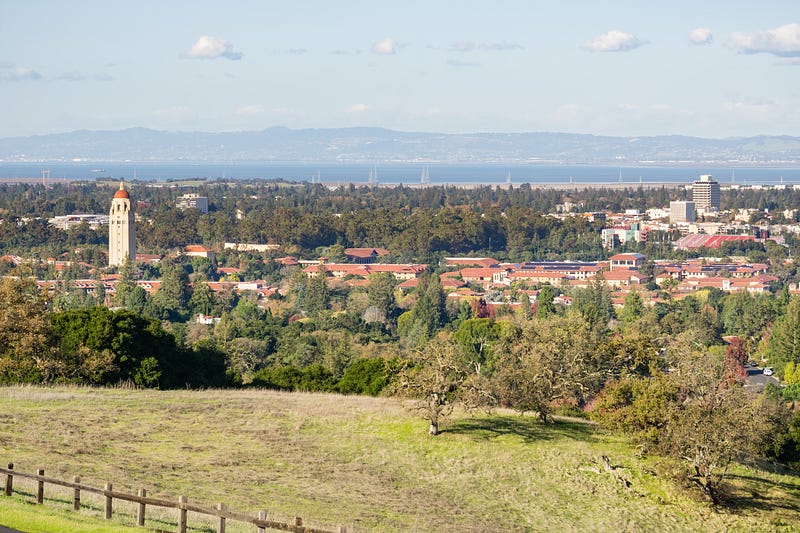
Feeling of Imposter Syndrome at Stanford
On that Saturday, I attended the event on the Stanford campus. It was my first time to visit Stanford University. I walked on the beautiful campus with the school entryway lined with palm trees. I saw many clean buildings with historical artwork.
With the world-renowned reputation for this prestigious institute of higher learning and research, I admit I felt a sense of imposter syndrome.
I remember sitting next to other students attending the event. All of them were accepted into this masters program. It wasn’t a super large turnout — perhaps 30 to 40 people. By my experience in a large public university like the University of California system, this group seemed tiny compared to the crowds that I was used to.
At the morning welcome and orientation, I ended up sitting next to my UCLA classmate Jack. He and I were the only ones there from UCLA.
Stanford presented an overview of all the various aspects of the manufacturing systems engineering program:
- The core classes included business classes like accounting and entrepreneurship and organizational behavior.
- The electives included supply chain management and mechatronics (which was the robotics class, or also known as the smart product development lab).
- At the event, the presenters talked about all the partnerships with companies, including high tech manufacturing companies from the Silicon Valley and beyond, who desired to hire engineering leaders.
This seemed like the dream school and dream program for me to go to!
However, I was not officially admitted. I was just merely sitting in the audience, eating the refreshments and mingling with the other students, all who were accepted into the program already like Jack.
One-on-One Meeting With the Professor
Later that Saturday, I had an appointment to speak privately to the department head right after lunch to discuss my application.
I met one-on-one with the Professor in his office. I sat in a chair next to the Professor’s desk, full of stacks of books and papers. I remember the Professor had a long gray beard, almost like Gandalf or Dumbledore or other wise wizard. The Professor was kindly and patient and gentle too.
As I met him, he reviewed my application status on his computer. He told me that I had all of the things that they were looking for in new students:
- The top GRE test scores.
- The top report card grades.
- The top letters of recommendations.
The only thing that I didn’t have was 2 years of work experience.
The Professor explained that they were modeling this engineering masters program similarly to an MBA program, where the ideal student profile was preferred to have at least 2 years of industry work experience. They felt that students with industry work experience were better able to find relevance in this program and also able to contribute more meaningfully to the class.
None of this was explicitly listed as prerequisites in the Stanford course catalog from what I remembered.
I gently asked him if I had the 2 years of work experience, would he be able to admit me into the program?
The Professor pondered my application a bit more. He said yes he would! He then offered me deferred admission into the program. He elaborated that if I go get 2 years of industry work experience, he would approve a spot for me in a future cohort of this program without needing to re-apply.
Wow! To me, it sounded too good to be true. I didn’t feel like I deserved it, and I just couldn’t believe that it was real.
Somewhat still skeptical of the deferred admission, I asked him if he would put it in writing.
He agreed!
He said I can get admission into Stanford whenever I’m ready for it with at least 2 years of work experience. I asked him what type of work experience was needed. He said any work experience.
Wow! Wow! Wow! It seemed so simple, yet I still could not believe it.
I thanked the Professor profusely, and went back to sit with the rest of the students at the event. I was ecstatic about getting the deferred admission. I still could not believe it until I got the custom-written letter in the mail a week later from the Professor on official Stanford University letterhead showing the decision to give me deferred admission, contingent on me getting 2 years of work experience.
I could not imagine anything like this happening at a big public university. At a smaller private school like Stanford, the decision-making process by faculty and staff seemed so much faster and simpler. Stanford had granted the Professor the ability to evaluate exceptions and handle special cases that would have been much harder to do with a big organization at another school with 30,000 students.
I felt like I won the lottery and was very grateful.
Get the Industry Work Experience
I returned to UCLA to finish the rest of my senior year. I finished all my class projects and other requirements for the undergraduate program. I graduated with “summa cum laude” honors and other departmental awards.
I had applied to jobs too. During this recession, I managed to get two job offers upon graduating. I accepted a job at Hughes Aircraft that waited for me until I graduated.
At the aerospace company, I was the engineer who programmed the robots used in manufacturing the electronics systems for the aerospace defense contractor. I ended up writing the software that used vision recognition systems to guide robots that built physical products in the aerospace company. The job was a fit for me since it combined my dream of working in aerospace with my love of computer programming and robotics and eventually AI.
In this high tech manufacturing company, I gained the relevant industry experience that was preferred for admissions to the Stanford manufacturing systems engineering program.
I still had a nagging fear that my deferred admission to Stanford was not real, despite getting it in writing. I feared that the Professor, or the department, or the university would change their mind, despite promising it in writing.
After a year and a half working at Hughes, I contacted Stanford again to make sure that the deferred admission offer was still good. The Professor said yes, he would still honor the offer. With that confirmation, I felt more confident about resigning from my job at Hughes so that I could return to school to get my masters degree.
It wasn’t until I got the official welcome packet from Stanford, with glossy brochures, that I was fully convinced that my admission to Stanford University was real.
On top of getting admitted into Stanford, I also got a letter from the Professor saying that I had received a fellowship grant from the department. It was a scholarship! The school would pay for all my tuition, on-campus apartment, and even a stipend that I could use for books and a computer.
My education at Stanford was fully funded, and I didn’t have to pay for anything out of pocket.
This manufacturing systems engineering program was a relatively small uncommon program, but important because local high tech companies wanted to develop and to hire engineering leaders. As a result, the program was well funded by industry and it shared this funding to sponsor a handful of students into the program. The program is no longer offered today though.
I’m grateful and am appreciative of the time that I had spent at Stanford and the people that I had met there. Coming from a poor immigrant family, the program transformed my life and career trajectories in multiple ways. The education was unforgettable and I plan to share my lessons with readers in the future to “pay it forward.”
The Takeaway Lessons
Here are the takeaway lessons from my story of getting into Stanford that can be applied to anyone’s academic or career journey:
1. Value Your Network
You can learn a lot from your network and community.
In my case, I found out about the Stanford event for accepted students only after talking to Jack in the engineering student lounge in random passing. Similarly, the careers of the ASME leader and my parents were all also helped by their community networks.
Value the people in your network, whoever they are.
- Learn more on networking: Relationships Matter, A Former LinkedIn Employee’s Views on Professional Networking
2. Value Personal Interactions
You can get unexpected opportunities by directly engaging with people.
In my case, after I called Stanford and talked to the Professor on the phone, I got invited to the private event for accepted students. After I had a private one-on-one meeting with the Professor, he was able to review my case, and made the immediate decision to turn my likely rejection into a conditional deferred admission. It was the best outcome that I could have hoped for in my limbo status.
Whether in school or in business, face-to-face personal interactions are very important to build trust for new opportunities.
- Learn more on personal interactions: Relate: interact with others
3. Value Small Organizations
Sometimes in the right small organization, you can get more opportunities than in big organizations.
In my case, I applied to a small lesser-known program at Stanford and was able to eventually get in. I’m not sure how I would have fared if I had applied to a bigger program like a traditional engineering or MBA program. The niche hybrid program that blended engineering and business classes was perfect for me as a generalist. In addition, since generalist leaders with both technical and business skills were in high demand, many businesses funded the program so that my entire education at Stanford was sponsored by the fellowship grant.
If you can find a small niche organization that fits you perfectly, it may be better than going to a big organization that you don’t fit in.
My father found his niche by learning to be a tailor. I found my niche by combining robotics engineering with business, which later turned into data science and AI.
- Learn more on combining engineering plus business skills: Jimmy’s Journey to Learn New Skills from Rockets to Data Science
Future Pivotal Transformations
My years at both UCLA and Stanford University prepared me for my career journey at Trimble and LinkedIn and beyond, as well as for much personal growth. I’m grateful I was able to apply the many lessons later in my life and to share them with others.
I’ve now transitioned my career towards coaching others. Just like how I learned from my experiences at Stanford, I’m now enabling people to combine their technical and business skills together to transform to more meaningful careers in the age of AI.
About Jimmy Wong
Jimmy Wong is a graduate of UCLA and Stanford University. He led LinkedIn teams for Data Science and AI for 12 years. He’s now a coach, writer, and speaker. Subscribe to his updates on LinkedIn and at AIjimmy.com.


