
How I Got 30,000 Views in My First Year on Medium
All the lessons I learned in 7 minutes
Before writing my first post, all I did was study successful posts — I ended up getting 20,000 views in my first month, so I wrote three more times and went past 30K…
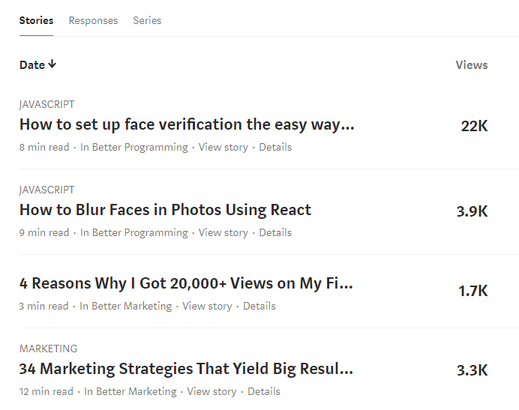
My experience ghostwriting in the past helped me notice an advantage all writers have but don’t value as much…
Successful writers are incentivized to reveal their strategies for free.
Earnings on Medium are based on membership reading time, so by default, there is a correlation between value and earnings. Therefore, my secret is actually simple — it’s copying those who are most recently successful.
Success leaves clues.
Figuring out success on your own makes it a journey instead of a process — you’ll never know how long the journey will take. A 3D object made in the 1970s best explains this…
The Rubix Cube
There are forty-three quintillion (43,252,003,274,489,856,000) positions the cube can have, and that means there are many ways to solve it — the quickest way it can be solved is in 20 steps.
Solve it alone and you’ll do much more than 20 steps, because you’ll make mistakes others have learned from.
Copying the success of others shortcuts the process.
Being successful is really being a successor — someone already set the benchmark for your idea of success and what it takes to get there.
This is why studying the journey of successful writers is helpful as you’ll see:
- Differences between their first and last post
- Niches they are successful in (judging by claps)
- Frequency of posts a month
- Their experimentation practices
- Publications they post under
My Secret Is My Bookmarked List

Before getting 30,000 views in four posts, there were bookmarked posts I enjoyed and studied deeply. I’ve listed them below and include what I found most useful.
“The Strategy I Used to Write My First $6,000 Story”, by Richie Crowley
This writer speaks about their success in a post called “The 9 Subscriptions To Take With You Into 2020”. The strategy was broken down extremely well and I believe he includes everything, which is why the post has over 5K claps. Now, I’ll explain what the writer attributes his success to.
Using other platforms
The writer perfectly laid out his marketing plan of maximizing social media to promote his post. He’d make connections on LinkedIn and ask if he could send them an email of his post to get their thoughts on it. On Instagram, he made inspirational posts and directed viewers to the link in his bio. Other platforms such as Twitter and Facebook were also used.
His subscriber list was also in effect as he sent out an email to over 1,000 people using MailChimp (free for your first 2,000 subscribers).
Window of opportunity
The post was published before 2020, which was necessary because the headline gave the reader a deadline to take advantage of the information. If the headline was published today and titled “The 9 Subscriptions You Should Use In 2020”, I’m sure it wouldn’t get the same results.
More detail = more money
The writer encourages you to make your post very in-depth so your earnings increase — it took his post 2,000 hours of reading time to get $6,000 in earnings. In the world of quality writing, quantity seems to make the difference.
My thoughts
The post highlights all the factors responsible for success on this platform. It’s no longer enough to write good quality and post under a publication, you have to do more — especially outside of Medium.
“How I Grew My Medium Earnings by 300%”, by Andy Chan
This ex-startup co-founder went from earning $450 to $1,500 in 30 days last year. In this post, there were three things that stood out to me as they influenced my perspective on Medium.
Monetizing a trend
He explained four actions you should take when you identify a trend: predict the lifespan, break it down, establish domain authority, and never miss an update. The trend must be in your industry or niche otherwise you’d have a difficult writing good content.
Understanding “evergreen” articles
These are posts that remain relevant over time. Trending articles grow exponentially, then slowly decline, while evergreen articles progressively increase in views and yet still capable of going viral. You can dictate your earnings by the number of evergreen articles you write by knowing the average earnings they get a month.
Optimization
Before posting on Medium, you can go into advanced settings and have a title and description purely for SEO. Medium has done most of the work for you by having a good page rank — all you do is figure out what the majority of people type into search engines to find the information to write about.
My thoughts
The post trains you to think differently about your approach to long-term writing on Medium, and I believe it comes from the writer’s startup background. Studying this post is worth doing if you’d like to understand the mindset of someone making trend-worthy posts.
“How I Got 3,500 Views in 10 Days on a Medium Article”, by Shawn Kong
This writer had a smart marketing approach which led him to get good results without any direct leverage (followers, curation, blog, etc).
Unclaimed friends
The writer strategically went into relevant Facebook groups to talk about the topic of his article. He’d also check the number of people in the community and its activity (posts a day) before deciding to join.
8 billion people on earth
Ten days after publishing, the article was shared twice in a Reddit community that has over 200K members and had over 2,000 people online at the time. The writer doesn’t know who shared it, but it’s certain they shared it because they saw it online somewhere. The share on Reddit added 3K views to the article and positioned it on the first page on Google.
My thoughts
His experience is confirmation that it’s never too late to promote your best post and that anyone starting on Medium can get results just by presenting an interesting conversation to communities outside the platform. This along with how breaks down his journey day by day is why I bookmarked it.
“A Transparent Look at My Writing Schedule That Produced 30M Views, as Inspiration for Your Own” by Tim Denning
This writer successfully recaptures your attention each sentence, as there is no redundant information in his writing. Line after line is pure value and this post explains how he achieves success through his lifestyle. Here is what I learned…
Think of writing like a day job
The writer commits to two days a week, starting from 9 a.m. and finishing at 5 p.m. He finds this helpful as it prevents task-switching. It’s easy for anyone to lose their train of thought when they try to focus on many things.
Separate your writing and editing
Two other days in the week is when the writer does only editing. This is helpful advice because editing sentence after sentence or even worse, word after word, will slow you down a lot.
Supporting others 24/7
The writer takes time to show appreciation for the work of others, in the form of claps. This is also a marketing strategy — people notice clappers and commentators, especially frequent ones.
My thoughts
Productivity increases when you separate writing, editing, and researching. It’s also necessary to schedule so you can make your writing activity more predictable — you’ll know how many articles you produce a week and you can then forecast to predict your earnings.
The 7 Tips To Take Away
(Tips 3 and 4 go together)
Tip 1: Have a marketing plan
If you don’t have one, you’re relying on coincidences to get results. Use what other people did as a reference, then add creativity if possible. There are two stages to making a successful post — creating and marketing.
I spoke about viral and legendary strategies in my list of 34 marketing strategies that work in 2020:
Tip 2: Write long
By writing long, you’re positioning yourself to earn more because it’s about membership reading time. Even if you get the same average reading time for a three-minute post, it’s likely readers will bookmark your post to continue later.
Tip 3: Think about Google
Have a customized title and description for search engines to increase your chances of being on the first page and getting more clicks. According to Backlinko.com, the #1 result in Google’s organic search results has an average CTR of 31.7%.
Tip 4: Use trends
It’s a guarantee you’re writing something people will be interested in. Remember to use a trend in your niche so you don’t experience writer’s block, or, even worse, publish content nobody enjoys.
Tip 5: Go narrow first
Have a niche. Commit to it for a month. If things are going great — continue. If not, find another niche. You should start writing about other topics and industries when you feel like you’ve maximized your niche.
Tip 6: Have realistic writing goals
Have them so there’s a finish line you can look forward to — it could be writing 1,000 words a day, or publishing three times a week. A month of accomplishing writing goals will provide the necessary data for you to graduate into making income-based writing goals.
Tip 7: Bookmark your favorite posts and study them every week
That’s how I got to where I am today on Medium.
Thanks for reading and use this post as a reminder to follow a blueprint to reach your goals.