
How I Get Dead Passive Clients to Engage & Talk During Product Workshops
Short Answer: Realistic human interactions.
Hosted a zero-engagement client workshop? Annoying and embarrassing, I know.
Does this sound familiar?
The day you prepared meticulously for is here.
You take the stage, greet the room, flash the slides, and start talking.
You have a big smile on your face. Everything went well. Except.
People have their heads down. They are busy with their phones.
You start throwing questions at them. All you need is one humble hand above the sea of heads to save you from stage embarrassment.
And then, you realize…
No one (actually) knew you asked them a question.
Is That You?
Before you reply, I will.
That’s me. I have been through this many, many times.
With time, I learned that passive content delivery in product workshops does not work.
This is the 100% surefire formula for a perfect afternoon nap in your product workshop.
Unconvinced? Try this.
- Use Ariel font 6 for the PowerPoint slides.
- Include complex diagrams to confuse, not clarify.
- Prepare a lectern, microphone, and a long history lesson in the introduction.
I guarantee one thing. You will hear the first snore in 10 minutes.
This is a predictable outcome. You know it will happen.
Question.
Have you tried changing the way you deliver the client workshops? Why not?
Case Studies Awaken the Dormant Mind
Slides and how-to guides don’t work. Immersive case studies do.
In fact, I find case studies the best method for content delivery and client engagement. It works beautifully for workshops starting at 8 in the morning, 1 in the afternoon (right after lunch), and 4 in the late afternoon, just before knock-off.
Here’s why.
- It comes with a business context — The problem statements are clear.
- It comes with defined objectives — You know your targets and deadlines.
- It comes with available and missing information — You get to make judgments.
In my experience — Clients love this.
It returns delegated decision-making powers to them. They become their own bosses. It is rare, but at least it is happening today. In your workshop.
Clients get to own the issues and solve the problems their way.
They start talking to you and within the room. They are free to collaborate and speak their minds.
It is no wonder the Harvard Business School’s case method is world-renowned. Clients, a cog in the corporate flywheel, become executives making million-dollar executive decisions within the case study.
They feel alive.
Even if it lasts only for 3 hours.
Build Interconnections in the Case Study
Let’s get to the juicy part.
How do we get our clients, even the most passive ones, to get off their seats and start talking to you or with others in the case study role play?
Simple.
Design the following in the set-up.
- An organization structure.
- An organization hierarchy.
- An organization-wide incentive-based responsibility (a.k.a. Key Performance Indicators).
The first point tells them where they are in the food web. The second tells them about the direct and indirect relationships around their teams. The last brings to light classic human workplace behavior.
This is a screenshot explaining the above.
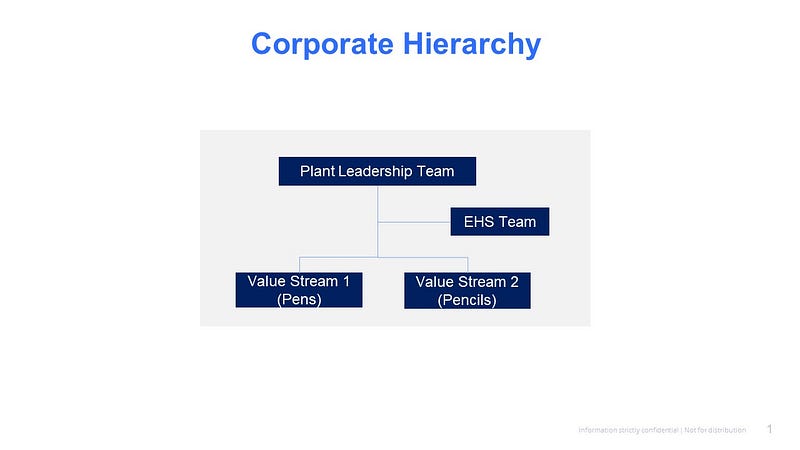
The closer you are to reality, the better. Here’s why.
- We understand what it means to deliver our work. Naturally.
- There are people outside of our teams who want us to do something for them.
- And then, there are Big Bosses who want everything done within the blink of an eye.
- Big Bosses are always trying to figure out where to get up-to-date information.
- Status updates meeting become a circus.
These frustrations are common to the Joes and Janes in the workplace. Even my intern does.
So, building them into your case study taps into their daily frustrations.
You know you hit them straight here (pointing to my heart) when they start saying things like This is real. I do face this problem. You are off to a great start.
Next, you want to place passive folks in leadership roles. They will be confronted by the need to communicate. They must. Otherwise, they will fail to manage their bosses and team members in the case studies.
Assign cross-functional positions to passive ones. Roles such as EHS team leads (Environment, Health / Hazard, Safety) are brilliant for this.
Such roles get the clam-like passive ones to open up. It happens in stages.
Passive, conscientious clients will be glued to their seats at first.
(Exactly how they behave in their day jobs)
They flip into ostrich mode, bury their heads at work, and try to get tasks on their laps completed.
And then, as they progress through the case study, the passive ones realize that,
- Alone, they are insufficient in a multi-layer, structured organization.
- They need to learn to use software to get their work done faster.
- They must speak up to connect and manage expectations.
Once that light-bulb moment goes on in their heads, you win. I know I do.
Because then my product (the software) fades into the background. It is no longer about pressing this or that button.
It becomes part of their daily work life.
And I become the consultant they come to for product support and future best practice(s) workshops.
It’s a win-win.
Parting Keynotes
I haven’t explained why I want passive clients to engage and talk in client workshops.
There are 3 main reasons.
- I want everyone in the client product to endorse my services and the software I’m selling.
- I want clients to come to talk to me to position my software as a solution for them.
- I want to identify all the decision-makers and budget holders.
I am sure it is the same for you.
Now, here is the thing.
You cannot achieve any or all of the above in a passive content delivery workshop. There is zero chance of extracting client intelligence when they are sound asleep.
Therefore, this is my proposal to you.
Use case studies. They work.
Your sales numbers will climb.
As a content contributor, I write my daily life observations and business exposure. Our life experience is the bedrock of our unique perspectives.