

How I Generate Thousands By Selling Poor Man’s Covered Calls!
The “Poor Man’s Covered Call” is an options strategy that utilizes both short and long options. This trade is not only customizable to match individualized trading styles but also significantly reduces risk.
After years of trading, I never fully grasped the substantial benefits of the Poor Man’s Covered Call (PMCC) until I decided to give it a try a few months ago.
Before I share my results, let me provide you with the essential details about this strategy.
Poor Man’s Covered Call (PMCC) Explained
This strategy involves selling a covered call while simultaneously buying an in-the-money call with a later expiration. Let’s break it down: the in-the-money call effectively acts as 100 shares synthetically. It is in the money and has very little extrinsic value, offering the buyer nearly the same exposure as owning shares but at a fraction of the price.
While nothing in this world is free, the catch is that the long call expires, providing less time for a correct directional move compared to purchasing shares. However, if you read until the end, you’ll understand why the risk is well justified by the potential reward.
The final part of the trade entails selling the covered call, which I consider the profitable side of the trade. This short call is covered by the long call, allowing me to make money if the price remains the same, goes up, or even experiences a slight decrease.
Advantages
· Limited Capital Requirement: Requires less capital compared to a traditional covered call, making it accessible for traders with smaller investment portfolios.
· Reduced Risk Exposure: Combines a long call option with a short call option, mitigating risk by limiting potential losses and providing a buffer against downward price movements.
· Customizable Strategy: Offers flexibility in adjusting strike prices and expiration dates, allowing traders to tailor the strategy to their risk tolerance and market outlook.
· Potential for Enhanced Returns: The strategy can generate additional income through the sale of short call options while maintaining a bullish position with the long call, potentially leading to higher returns.
Disadvantages
· Time Decay Impact: As with any options strategy, time decay can erode the value of the long call option, affecting the overall profitability of the trade.
· Market Direction Sensitivity: Success is heavily dependent on the underlying asset’s price movement, requiring a bullish or neutral market outlook for optimal performance.
· Complexity for Beginners: The strategy involves a combination of long and short options, which may be challenging for novice traders to fully grasp and implement effectively.
Quick Tip: You can put this trade on under one trade ticket but if you plan on trading the short and long call separately: beware that a naked call does require significantly more buying power, so keep this is mind if you plan on putting on or taking off this trade one leg at a time. In other words, if you take off the long call without taking off the short call in the same ticket, the short call will immediately require more buying power to be available.
Example
Let’s dive into an example, see below for the trade set up in my Tasty Trade account & if you want your very own brokerage account, use my affiliate link to sign up today!
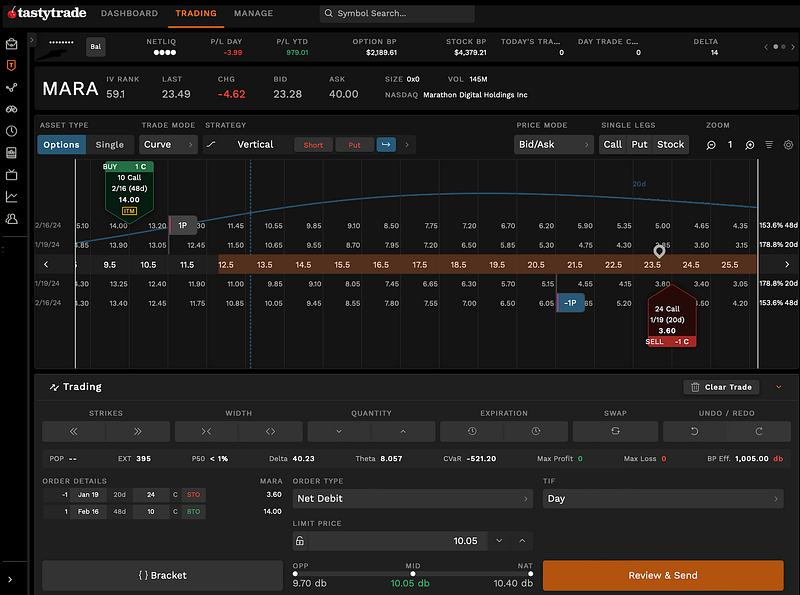
In this example, I am trading MARA, and at the time of this screenshot, it is priced at $23.49 per share. In the lower left, you’ll notice that I am selling the 24 Call for $3.60, expiring in 20 days, and buying the 10 Call for $14.00, expiring in 48 days.
The total required capital to initiate the trade is $10.05. It’s important to remember that everything with options is in multiples of 100, so $10.05 translates to $1005.
To determine my short call strike, I take the long call strike (10) and add what I paid for it ($14.00), which equals 24.00. Therefore, I sold the closest strike, the 24 strike.
Break Even Trading Price: $20.05
Max Profit: $360
Max Loss: $1,005
Courses of Action: Only 2 things can happen from here
If MARA remains above 24 in the next 20 days, I retain the $360 premium from the 24 short call and sell the long call for close to what I paid for it ($1,400), resulting in a satisfying $360 profit.
On the other hand, if MARA trades below 24, the short call at the 24 strike would expire worthless, leading to maximum profit. In this scenario, I can then sell another call against my long call since I still have an additional 28 days (48 days — 20 days) to capture the right direction for maximum profit.
PMCC Results
As evident from the screenshot, my account has gained $900 in 2023, with the majority of profits stemming from trading the PMCC strategy. Given that my account size is relatively modest at $5K and that I’ve only had this account for a few months, this success is particularly significant.
Similar to the example I shared, my primary trades have involved MARA, TQQQ, GDX, and SLV using the PMCC strategy, resulting in over $1,100 in profits this year. It’s worth noting that while I did incur losses trading other strategies, exclusively focusing on PMCC would have increased my account profit by $200.
Get 20% off by entering CHRISTIANPARK20 when checking out.
Final Thoughts

The PMCC strategy indeed presents a steep learning curve, but the potential rewards are substantial when it starts generating profits. I have already integrated it into one of my larger accounts and have experienced a promising start.
I trust that sharing this information has provided you with valuable insights into trading options. If you found this article helpful, please consider following me and expressing your appreciation by clapping. Your support is greatly appreciated!
Happy Trading!
Disclaimer: I am not a licensed financial advisor. All content is my opinion and is for entertainment purposes only. Please do your research to make the best financial decisions. This article contains affiliate links that may result in me gaining a profit from purchases.


