
How I Find Undervalued Stocks And Beat The Market
A walk through my process

Before the lock down last year, my focus for stock investing was low-cost index funds. I knew the market wasn’t always efficient, but I wasn’t sure how to take advantage of it when it wasn’t.
During the crash, I was prepared to buy with cash on the side. The problem was that the S&P 500 never got back down to what I thought was a reasonable level, then it quickly took off again. After that, I decided I needed to learn how to evaluate individual stocks.
If the market as a whole could stay overpriced, maybe I could find some stocks that were not.
I took advantage of my time at home to read “Security Analysis” by Benjamin Graham, Warren Buffet’s teacher, as well as several other books that helped me to understand the nature of the stock market and how to find and take advantage of undervalued companies. I quickly put my new learning to use and starting finding and buying companies that were selling at a discount, despite the level of the overall market.
The Data
To give you a glimpse of how powerful value investing is, I wanted to share my five largest holdings (not my 5 best) along with their results are as follows:
- Valero (VLO) purchased in Sept 2020 at $47.54 — current price is $80.40 (69% growth) plus it was purchased at an 8% dividend yield
- HollyFrontier (HFC) purchased in Sept 2020 at $21.46 — current price is $32.47 (51% growth) plus it was purchased at a 6.5% dividend yield
- Walgreen’s Boots Alliance (WBA) purchased in May 2020 at $37.41 — current price is $52.66 (41% growth) plus it was purchased at a 5% dividend yield
- BBVA Argentina (BBAR) purchased in Oct 2020 at $2.76 — current price is $3.37 (22% growth) with no dividend
- Westlake Chemical Partners (WLKP) purchased in Jan 2021 at $21.58 — current price is $27.11 (26% growth) plus it was purchased with an 8.8% dividend yield
These selections and more helped me to generate over $100,000 in equity growth since the beginning of last year at a 38% annualized return on an average account balance of $180,000. This beat the S&P 500 index by 7% annually over the same period assuming all purchases were made at the same time (generating an additional $18,000 in equity compared to just buying the index).
This wouldn’t have been possible if I hadn’t learned how to value companies and be confident enough in my analysis to buy their stocks at reduced prices, despite ongoing negative press about them.
Today I will walk through my process for screen stocks that warrant further research, which can help you to identify some winners of your own.
Screening Criteria
There are thousands of stocks for sale in the market. No one can be familiar with all of them, or even 10% of them well, so we have to find ways to filter them down to something we can work with.
Everyone has their own system, which may focus on sectors (technology vs. energy), company location (America vs. China), price (P/E), company size, or numerous other factors. As a value investor, I typically use bottom-up analysis without much regard for the sector, location, or company size.
I look for companies that are selling for significantly less than what they are worth, either based on their assets or their ability to generate earnings.
The following are the typical screening criteria that I use to find stocks for further analysis:
- price/earnings (P/E) — market price of the stock as a multiple of the net income for the past year
- price/book (P/B) — market price of the stock as a multiple of the shareholder equity (book value)
- price/cash (P/C) — market price of the stock as a multiple to the cash held
- price/free cash flow (P/FCF) — market price of the stock as a multiple to the free cash flow generated over the past year
- return on equity (ROE) — a measure of profitability that divides net income by shareholder equity
- return on invested capital (ROIC) — a measure of profitability that divides net income by total investment (debt + equity)
- current ratio — a measure of liquidity that divides the current assets by the current liabilities (“current” means within the next year)
- debt/equity (D/E) — a ratio that divides the total debt by the total shareholder equity to give an idea of how much leverage is used in the enterprise
There are others, such as dividend yield or price below a 200 day moving average, but the ones listed above are the main levers I pull when looking for securities that might be underpriced.
There are multiple screeners on the market. Some are free with limited functionality, others cost money. I typically start with a search on finviz.com, which is a good free screener (the ads are annoying, but you get what you pay for!).
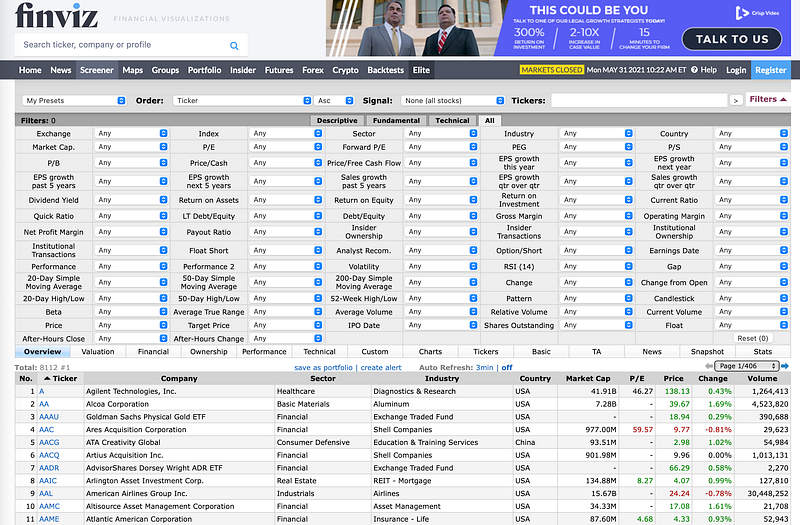
Below is a screenshot of the Finviz screener with all of the screening options (note the total of 8,112 stocks returns when using no filters):
Performing a Search
It is straightforward to manipulate the criteria that you want to use for your screen. For this example, I will focus on stocks selling at good prices compared to earnings and book value as well as having good returns, decent liquidity, and low debt.
- P/E < 15
- P/B < 2
- ROE > 10%
- current ratio > 1.5
- D/E < 0.5
The results of this screen are below:
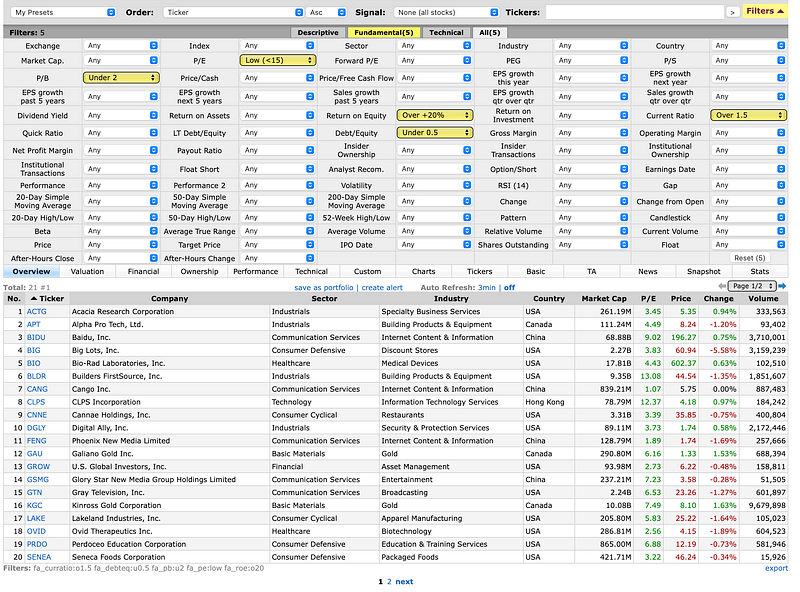
Now we have taken the list of 8,112 stocks down to 21, a much easier number to analyze. Finviz provides a fair amount of high-level info, including a stock chart and all the metrics that can be used to filter.
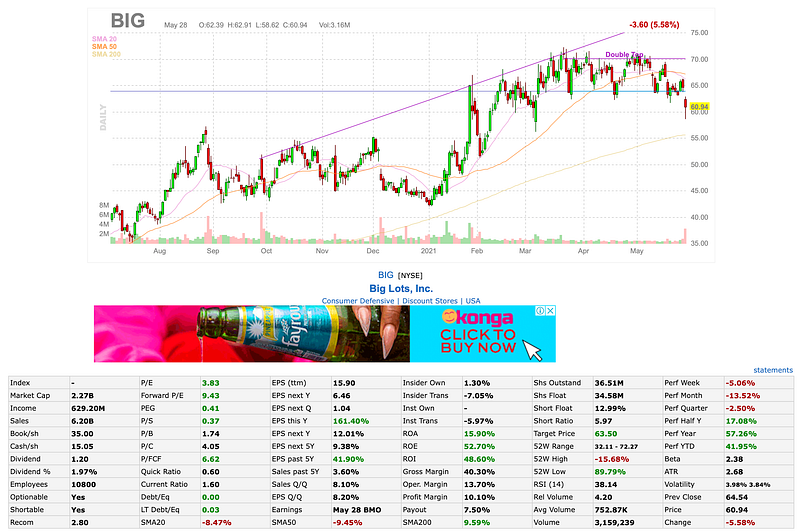
For example, if we want to look at. Big Lots (BIG) in more detail, we can click on BIG and get the following information:
Additional Screening
The process of determining the value of a company is quite a bit of work, so I prefer to run an additional screen from another website to check to see if the security might be selling at a discount. I used the earnings power value (EPV) calculation from gurufocus.com to apply an additional layer of screening.
Earnings power value is a way to evaluate the price of a stable business based on its historical earnings and its cost of capital.
See the related article in the resources section below for more detail on how to calculate this on your own. I’m looking for companies selling at around a 50% discount to their value, so I use this quick check to see the current stock price vs. the EPV calculation from Gurufocus.
Big Lots current stock price is $60.94, so I would be looking for an EPV of around twice that. However, according to Gurufocus, the EPV for BIG is $71.45. Note that when I fully analyze a stock, I always calculate my own EPV, along with other value estimates, but I use Gurufocus as a screener to see if something is worth the time and energy for further analysis.
In this case, although BIG is selling for less than the Gurufocus EPV, it is only selling for about 15% less (therefore providing a 15% margin of safety). Based on this, I would likely pass and continue my search for securities selling at a larger discount. However, it is up to you and how much time you have to evaluate companies. If you do your own calculation of EPV, you may find a larger margin of safety.
One company on the list, Phoenix New Media (FENG), is selling for $1.74 per share while the EPV is $3.90 per share. You wouldn’t buy the stock based only on this screen, but it may be worth the extra time involved to estimate its true value.
Security Analysis
Keep in mind the screening process above is only to give you a list of securities to examine in more detail. The screening process itself does not give me the value of a security. For that, I will need to do additional analysis.
I won’t go into detail here as I have written about it elsewhere (see resource section below), but some of the basic steps I use to analyze a stock.
- I pull the most recent annual report from the SEC (EDGAR) to read about the company, understand how they make money, the risks they face in their business, as well as their financial position. I will eliminate a company if I can’t understand their business model or I believe the business risks are too high.
- I use macrotrends.net to get a high-level overview of the income statement, balance sheet, cash flow statements, and key financial ratios for the previous 10 years.
- I enter this data into a spreadsheet template that I developed. The spreadsheet helps me to calculate several important valuations including: net current asset value (NCAV), asset value (AV), and earnings power value (EPV)
- I will choose the valuation I want to use based on the results. Then the spreadsheet will calculate how much the company is worth and the max price I should pay based on my designated margin of safety (MOS).
- If the security is selling near or below the max price based on my margin of safety (typically 50%), then I will add it to my watchlist for possible purchase.

Summary
There is a lot of info behind the process explained above that is beyond the scope of this article. You can learn more about the value investing principles required to find undervalued companies in the resource section below or by reading books and articles written by Benjamin Graham, Warren Buffett, Seth Klarman, Howard Marks, Bruch Greenwald, and other legendary value investors.
Once you understand the principles and temperament requirements for successful investing, then you can screen and value companies to your heart’s content. The example above is just one way to do it, but you can play around with the numbers, add or remove criteria, etc to give yourself additional companies to research. You are only limited by your own time and willingness to learn and apply those learnings to practice.
If you buy companies using a margin of safety, where the current price is significantly below the value of the business, then you will do well in investing.
This type of system, which helps you find and buy companies at a significant discount, is a great way to build wealth in the stock market. However, if you don’t have the time or energy to be this involved in screening and researching companies, then you should, by all means, stick to index funds. They are a great way to build wealth without having to do any work whatsoever.
But for the enterprising investor, you can use the strategy above to boost your returns by buying dollars for fifty cents. Even in a hot market like we have today, bargains are out there if you know where to look.
Good luck investing!
Click here to get your free sample of my new e-book: “The Insider’s Guide To Building Wealth”

Building Arks
After struggling to build wealth early in my career while following traditional financial advice, I set out on a path to learn about investing. Over a decade later, I’m financially secure and working towards full financial independence through real estate and the stock market. I have succeeded in building my financial ark to help me weather whatever storms may come.
I founded Building Arks to help busy professionals like you ignore mainstream advice and build real wealth.

If you would like to be notified by email every time I publish a new story, you can join my mailing list here.
Want to start earning extra income by writing on Medium? I earned over $6,000 my first year. Join here to become a member for only $5 per month. I will earn a portion of your subscription fee at no additional cost to you, and you will get unlimited access to thousands of articles from authors like me plus the ability to start your own writing business.
Here are some additional articles on investing and building wealth you may find useful:
I have no affiliation with any sites listed, nor do I make money from any partners or recommendations in my articles (except Medium). I am not a lawyer, accountant, or certified financial planner. All material is presented in good faith for informational purposes only based on my knowledge and experience. It is not intended to replace professional advice. You should always consult an expert before making any legal, tax, or financial decisions.


