
How I Fell in Love With Her
It was love at first write
I had known her all my life, yet we felt like strangers. I knew her passion for truth had been obstructed since youth, with voices not her own. They were void of value, antithetical to health, and perverse to the human spirit. They spoke only to the fear created in her by pressing down her body while taking hostage our mind.
At the age of seven, we went our separate ways. By we, I mean my mind, spirit, and body. The brain is complex and very capable of living three separate lives (or lies) at once.
Elders prayed over me to negotiate my release. But forgiveness of my debtor seemed only to suffocate me and exacerbate self-hate. I gave birth to inner demons that I was smart enough to disguise. Surely retarded on the inside, but I appeared externally wise.
I clung to books instead of people and traded religion research. I searched for truth instead of God and aspired to peace instead of profit. Then, one day, I fell in love with her. She — her — me; I fell in love with myself.
To fall in love with me I had to fall out of love with everything else. When trauma dictates our response to life we become so full of the world and empty of ourselves. Fear of failure and success, issues of abandonment and anxiety of intimacy co-exist. Your approach to life is topsy-turvy with survival as the goal.
When childhood passes you by or runs over you like a bulldozer, you die. No, there are two alternatives. You can stay a child forever or you can grow up extremely fast. Some survivors, like me, do all three. But, one day I fell in love with her.
I noticed her from the page writing promises in prose. Stanzas touching places her mind had never let her go. Turns out she was not dead at all, just a seed buried. I watched her bloom from a distance as she resurrected herself with rhythm and rhyme.
She turned to poetry because scholastic indoctrination was not enough to bring her back to her truest self. From the Sunday School class to the dissertation defense, what was reflected to her didn’t make complete sense. So, she kept searching, as sure as Christians keep churching.
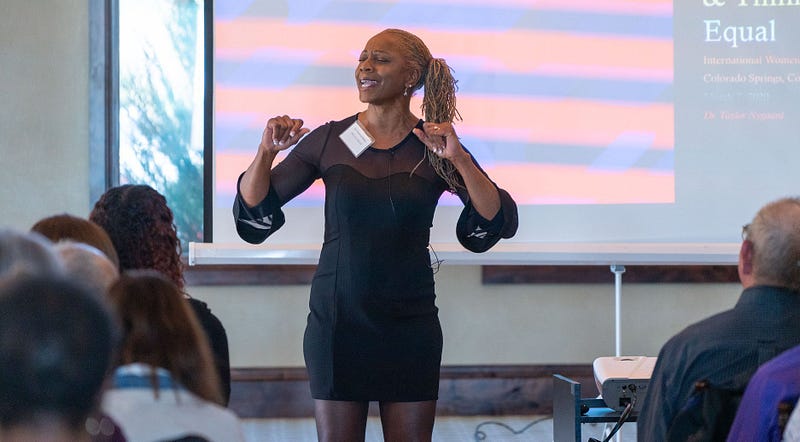
I followed her to the holy grail — the open mic. There, she-her-me, we learned to speak. The platform wasn’t a pulpit stingy with truth. It was a stage where we could become the truth, interrupt the status quo, nullify the norm, and reject the hypothesis of inferiority. She resurrected us to sainthood as I fell in love with her.
I became the “Rogue Scholar” with peer-reviewed sonnets of truth untold. I decided to risk it all to knock down a few walls to see how far truth would take me. From Rose to Rogue Scholar, I am no longer guided by fear. I ask the questions others don’t dare because inquiry is the righteous path to truth. Ministry of poetry took me back to my youth, where I fell in love with her.
Now I humble myself to the god of words, to bring to life what awaits to be heard. I hear her whispers in my ear and transcribe it to the page. It took 50 years for me to come of age. That’s OK because, along the way, I fell in love with her.