
How I Failed to Teach My Eight-Year-Old Son Empathy For His Friend
But something good happened after an incident at the park with his friend
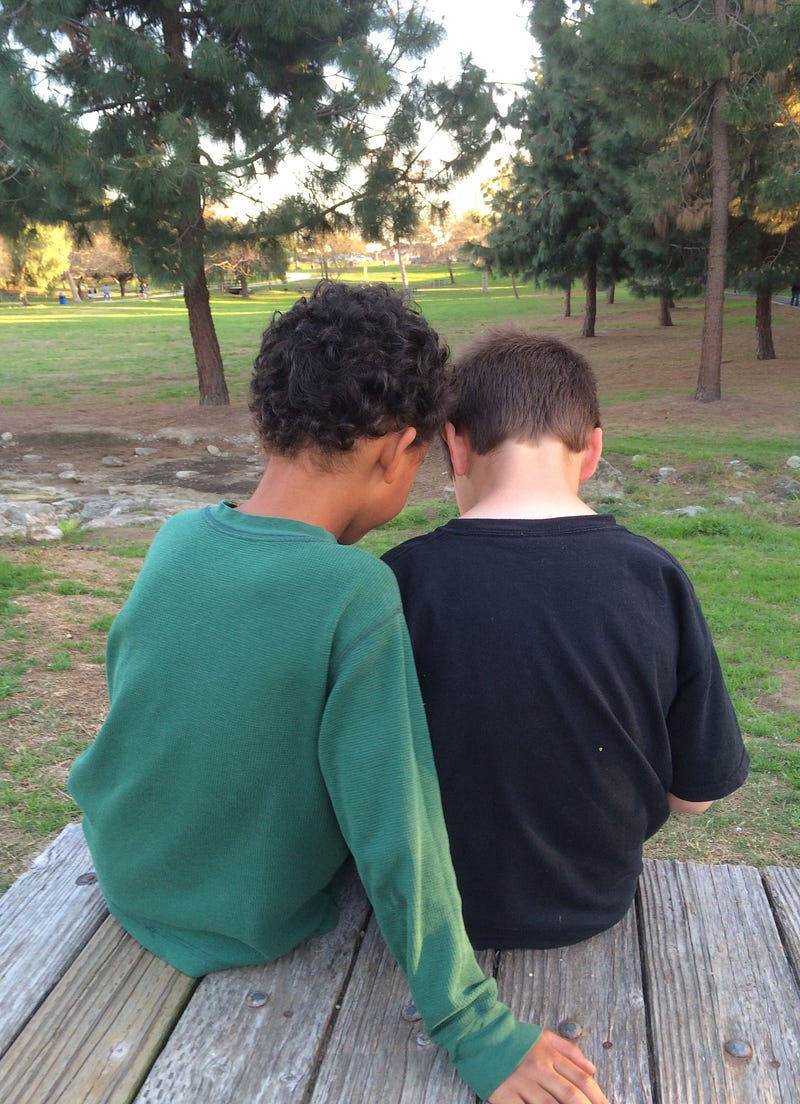
My son and I were walking to the park with his friend on a summer afternoon in mid-July. It was one of those lazy summer days where time seems to stand still and anything can happen and usually does.
His friend was pulling a red wagon with a cardboard box full of his toys, and the three of us were walking up a jogging path as Brad (not his real name) continued chattered on and on about the all of the toys inside his wagon.
“I have Buzz Lightyear, Sheriff Woody, Rex, Slinky Dog, and Mr. Potato Head from Toy Story,” Brad said as if taking an inventory. “I have Red, Chuck, Bomb and Terrance from The Angry Birds Movie. I have Captain America, Incredible Hulk, Iron Man, Thor, The Thing and Spider-Man.”
I let my mind wander at the top of a hill. We looked down at the playground, and then my son snatched the wagon handle, zigzagged down the winding path with his friend in hot pursuit, and I chuckled at this unexpected twist.
“Give me back my toys!” Brad shouted. “They’re mine!”
My son is eight and Brad seven, and one of the ways I measure his social development is by how long he can remain at the park without having an incident with his friend. My wife believes he tosses his friend’s toys into the pond because he gets jealous whenever Brad talks to me and I believe there would be less conflict between them if Brad shared his toys with my son.
“Toys for Sale! Toys for Sale!” my son bellowed when he reached the bottom of the hill as if he were a peanut vendor hawking salty snacks down the aisles at a ballgame. “Who wants to buy Sheriff Woody from Toy Story? Just $2.50.
“Batteries not included.”
I tried to explain to Brad that he was only pretending to sell his toys, but he didn’t believe me, and it became more difficult while my son kept shouting, “Toys for Sale! Toys for Sale! Come and get your Sheriff Woody. Just $2.50.”
“You can’t sell my toys!” Brad wailed. “They’re mine!”
It seemed like a good-natured, Tom Sawyer-like prank and I decided to let things play out. I want my son and his friend to resolve their own issues without me being a mediator every time there is a problem between them.
“Give me MY TOYS!” Brad screamed. “They’re MINE!”
The park was peaceful and quiet, virtually empty except for three older boys, ten or eleven, who looked on the cusp of middle school. They came over to see what all the screaming by Brad was about, lending credibility to the Toy Sale.
”Toys for Sale! Toys for Sale!” my son called out as they get closer smelling the possibility of potential customers. “Come and get your Sheriff Woody and Buzz Lightyear from Toy Story!”
One of the boys asked him, “Are you really selling Brad’s toys?”
He didn’t miss a beat and repeated his sales pitch.
“Toys for Sale! Toys for Sale!” he shouted. “Come and get Sheriff Woody and Buzz Lightyear from Toy Story!”
For a moment, I was amused. I laughed at the oddity of the scene. But then I looked at Brad and noticed he saw the prospect of his toys being pedaled as anything but amusing, and that he seemed on the precipice of boiling over.
Everything was a blur
Everything that happened next is a blur. Brad threw a rock. It missed my son, but he picked it up and slung it back at Brad, hitting him in the leg, and he jumped up and down screaming, “George (nor real name), I will NEVER EVER be your friend again!” while I got a nauseous feeling from the swirl of events.
“We’re going home” I told my son and felt a flood of emotions as we walked home, frustrated at him for not being able to remain at the park for longer than ten minutes without having an incident.
A flurry of thoughts rushed into my brain. Like when will my son learn to play at the park with a friend without having to leave because of an incident.
As we passed by the houses on our street, I thought about the best way to respond to what has just happened at the park. I could have my son write twenty “I will not … “ sentences on a marker board. (This is my wife’s strategy for dealing with his bad behavior.) Or I could give him rules to follow with consequences whenever he goes to the park with his friend. This is my wife’s idea too, and it sounded like a great option, but I realized that it’s for before going to the park and we were re walking home after an incident took place.
Then an idea popped into my thoughts: To act out what happened at the park to help my son to think about how Brad felt after he swiped his toys and pretended to sell them. To develop empathy for how his friend was feeling.
My role play plan
I pitched my idea to my son when we home. A week ago, he attended a drama day camp and played the lead role in a 25-minute “showcase” of Hercules. I practiced his lines with him and figured this would be like killing two birds with one stone: Acting practice and developing empathy for his friend.
“You know how a DVD of a movie has pictures of all the scenes at the beginning of a DVD?” I asked him. “Those scenes are called a storyboard. A storyboard is what the people who write scripts create before the movie ever gets filmed.”
I grab a five-by-seven foot white marker board that my son likes to draw animated characters on, make a line going across the middle of the board and add two vertical lines going from the top of the board to the bottom to intersect with the middle horizontal line, creating six squares.
“I want you to create a storyboard with six scenes for what just happened at the park,” I explain to my son. “Each square is a scene. Draw what happened first in the top left square. Then draw what happened next in the second square and keep breaking down events into scenes. Then we’ll act out the scenes.”
He got to work right away, drawing three stick figures and a wagon in the first square, and we brainstormed for a title before he got started the next scene.
I was perplexed by his drawing for the second scene.
“Is that a dinosaur?” I asked, pointing at a creature with triangular scales and tail. “I don’t remember a dinosaur being at the park.”
“It’s Rex.”
”Rex?”
“Rex, the dinosaur from Toy Story.”
“Oh, yeah. Rex was in Brad’s wagon.”
”Rex told me to steal Brad’s toys and to sell them.”
“Rex told you to steal Brad’s toys?”
“Rex said Brad is a bad owner. He plays video games all day in his room and ignores his toys.”
So walking to the park was scene one. Rex telling my son to steal Brad’s toys scene two. Scene three is my son taking off with his friend’s wagon with Brad in hot pursuit. Scene four was my son shouting, “Toys for Sale! Toys for Sale! Who wants to buy Sheriff Woody?” Scene five was the boy asking my son if he was really selling Brad’s toys and scene six was the rock-throwing fiasco.
My Only Mistake
My only mistake, I’ve been told, was my next decision.
“You be you,” I said to my son. “And I’ll be Brad.”
I’ve shared this story on three occasions with mental health professionals, and each one said the same thing: If my goal was for my sin to develop empathy for his friend’s feelings, I should’ve asked him to be Brad, so he could feel what it was like to have his wagon full of toys swiped and offered up for sale.
Nevertheless, in the opening scene I chattered on and on about my toys as Brad and then doubled as Rex in the second scene, whispering into my son’s ear, “Pssst! George, it’s me, Rex, from Toy Story 1, 2 and 3. We need your help! Brad doesn’t play with us anymore. He plays Minecraft all day and ignores us. There is moldy bread and rotten bananas on the floor. We’re going to die!”
“Toys can’t die,” he said.
“Toys can die.”
I realized my goal to develop empathy was getting away from me in scene three as I chased my son around the kitchen and living room in a continuous loop as I hollered, ”Those are my toys! You can’t take my toys! They’re MINE!” in a panicky voice with a fast cadence.
We were like two animated. characters, running around and laughing before I told him to yell out “CUT!” to end the scene, and in between scenes, we talked about the action and dialogue for the next scene, and he yelled, “Action!” to begin the scene.
My wife came out of her office during the fourth scene when my son shouted, “Toys for Sale! Toys for Sale!” “You can’t sell my toys!” I snapped. And then we kept repeating our lines back and forth while my wife watched us. It was pandemonium. Slapstick improv-style acting with a comedy element.
I told her what happened at the park between and shared my role playing idea with her and how I hoped it would develop empathy for his friend’s feelings.
She asked to speak with me for a moment in her office.
“I know what you’re trying to do,” she said. “But you are only teaching your son to make fun of his friend.”
To finish the scenes or not
I figured we should finish the last two scenes. I become the boys in scene five walking over to ask my son if he was really selling Brad’s toys. “YES!” he said, launching into his sales pitch like he was a carnival barker at the Los Angeles County Fair peddling Flaming Hot Cheetos street corn.
Then, in the final rock-throwing scene, I wound my wrist around in a circle like a cowboy with a lasso and pantomimed throwing a rock at my son. He pick it up and flung it back at me and I jumped up and down screaming, “George, I will NEVER be your friend EVER again!” in a high-pitch voice.
“We’re going home!” I said, switching back to me.
After we completed the last scene, I thought about talking to my son about his Brad’s feelings, but he asked if we could act out the scenes again. I doubt he’d developed any empathy for his friend. I sensed it was a good time to talk about how Brad felt at the park, maybe ask my son, “How would you feel if Brad stole your toys and pretended to sell them?”
But, the truth is, my son and I were having so much fun acting out the scenes, that I lost sight of my goal to develop empathy.
“Sure,” I said. “We can act out the story again.”
So we acted out the scenes again, and in the weeks and months to come, we’ve kept acting them out, adding details like we’re crafting a story, varying the pitch, tempo and tone in our voices, adding dialogue and embellishing the events, so it has morphed into a hybrid of fact and fiction and it has become our de facto activity when there are no kids at the park to play with, and on this summer afternoon, it passes a few hours before his swimming lesson.
We’ve bonded, ironically, by acting out the storyboard rather than developing empathy, but as we wait outside the pool for his lesson with other kids I enjoy the warmth of the sun and I think how the role playing has brought us closer. I learned how to connect with my son and his love language is quality time.
Hi I’m Scot. Check out my YouTube video on my first three weeks on Medium.
Or read more of my stories linked on my “About Me” story on my profile page.
I love reading and writing on Medium.
If you are not a Medium member yet and would like and would like to receive unlimited access to all Medium content, you can sign up here. It’s just $5 a month. I will receive a small referral bonus, at no additional cost to you, when you sign up using my link.


