
How I Doubled My Money Investing in the Stock Market
You can do it even if you don’t have a finance background or a lot of money

Working as a banker requires a high level of interest in investment tools. It’s not always the case — I’ve met financiers who were indifferent towards their selected career fields. But even if you don’t pay too much attention to the finance world, you will still end up with numerous useful skills. One of those skills is investment knowledge.
The truth is, you don’t need to go to school or work in this field to understand how the market works. If you wish to gain a basic understanding of investment instruments, all you need is to spend a week doing research. You may not get on Warren Buffett’s level after that, but it would be enough to familiarize yourself with the market.
I would like to tell you a story of how I received a 100% return on my stock investment. Trust me; you’ll understand why anyone can grasp it in a matter of days.
What is the Stock Market and How Does it Work?
Investopedia defines the stock market as follows:
“The stock market refers to the collection of markets and exchanges where regular activities of buying, selling, and issuance of shares of publicly-held companies take place.”
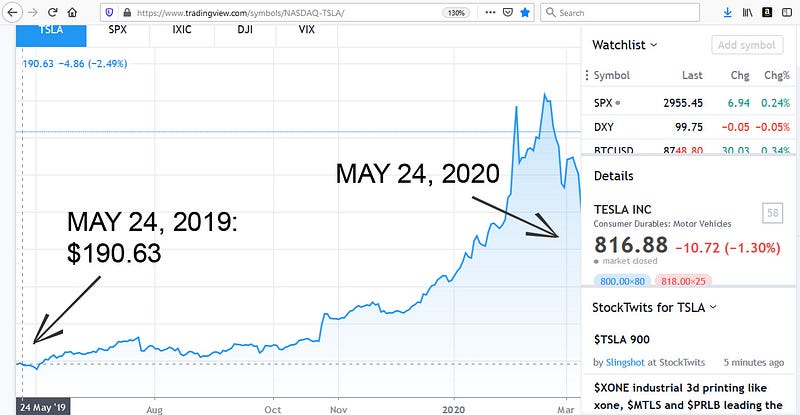
In simple words, it’s a marketplace where people buy a small part of a company which decided to sell some of its equity to the public. For example, Apple is selling its stock, so as Tesla. Regular people enter the market and buy their shares, and others sell the ones they purchased before. The goal is to buy the stock when it sells low and sell it later when it costs more. If you were to buy Tesla’s stock a year ago, when it cost $190.63, and sell it right now, as it’s valued at $816.88, you would have made $626.25 per each unit:
This brings us to the simplest and the most critical concept of trading stocks: buy low, sell high.
How Do I Know When to Buy and Sell?
In theory, “buy low, sell high” sounds like the most susceptible rule ever. But you never know if the price you see today is going to be lower or higher tomorrow, in a month, in a year, and so on. This is why you need to learn how to analyze the market, review the news and read through the lines.
Now, it takes some time and experience to grasp the market analysis. It also sounds simple: when something negative happens to the company, the share price goes down; and when you see positive news, the price goes up. However, there are certain stipulations to this rule. On top of that, it’s crucial to connect the dots and figure out which changes benefit the company, as it’s not always crystal clear.
The simplest and the most critical concept of trading stocks: buy low, sell high.
The Simplest Way to Make Money Selling Stocks
I’ve only been trading on the stock market for seven years, and I don’t do it every day or even every month. I’m not a beginner; however, I’m not the expert either. Despite that, I have identified a simple way that works for me.
Here are the concepts I use:
- Buy stocks of companies that recently entered the market and have decent potential. Once the public gets access to purchasing stocks, it’s usually the best time to buy. Nothing guarantees the company will become more profitable after a while, but this is usually your best bet to make money. Unless the organization suddenly goes belly up shortly after entering the market, or something horrific happens to them, you have a pretty good chance to profit.
- Purchase stocks which recently went down. For example, if a company is going through a hardship, the stock price will plummet. However, troubles don’t last forever. At some point in the future, the company will get back on track and start prospering again. If you buy a stock that lost half of its value, and then sell it a year later when it goes back up, you’ll be doubling your investment. The danger is, the organization may not bounce back, and it can continue struggling. At some point, the company may shut down, and many investors will lose their money. You should remember that, as there are always risks associated with investing.
When something negative happens to the company, the share price goes down; and when you see positive news, the price goes up.
The Companies Which Made Me Money
You may remember how numerous weed stocks entered the market in 2016, and even before that. I researched many of them and selected Aphria. I bought it in September 2016 for $3.14, and then sold it in March 2017 for $6.71:
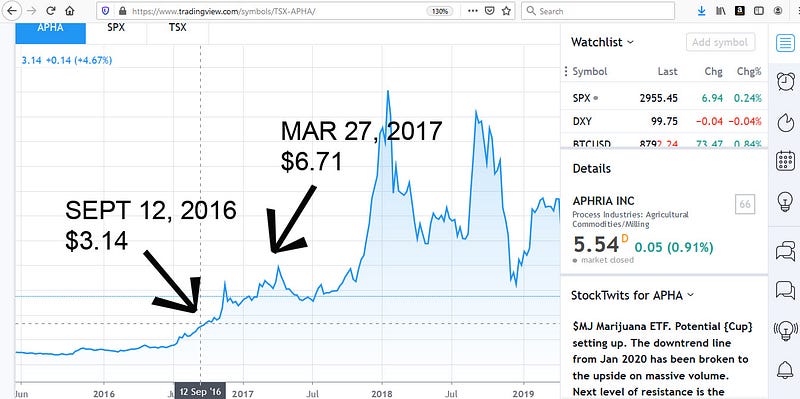
Therefore, I more than doubled my investment. To be fair, I was not in a position to invest a lot, as my income wasn’t enormous. But investing $600 and making around $680 was quite fruitful.
Another company I invested in was a small bank in my city. I would like to keep the company name private, as I’m trying to have a certain level of anonymity online. But I was reading the news and realized they were going through financial difficulties, and the stock was almost at the record low. I quickly invested $600 and left it for 6 to 8 months. Once the price doubled, I sold the stock, effectively making $600 on this trade as well. I accepted the risks, as the bank may have filed for bankruptcy and shut down. It didn’t happen, but I was ready to lose my investment. This brings me to another golden rule of investing: only put up the money you can afford to lose.
As you can see, my profit wasn’t crazy high. However, when I sold both stocks, I went back to school to finish my education. And trust me, having an extra $1,280 never hurts when you’re a student.
Golden rule of investing: only put up the money you can afford to lose.
Investing in 2020: Yes or No?
Theoretically, right now is the prime time to purchase stocks. The coronavirus pandemic caused the entire market to crash, and most stocks are ridiculously low priced. However, you need to consider the risks involved.
Any of the struggling companies can file for bankruptcy tomorrow or a month from now. They might as well survive and prosper a few years down the road. Investment bankers always do thorough research before risking their money, and it involves everything starting from reading the most recent news, to going through the company’s financial statements and financial ratios.
Unless you are willing to do thorough research and dive deep into the organization’s finances, I would advise against risky investments. If you wish to learn and practice, you may want to consider investing small amounts of money, but only after you do your homework.
I currently hold three different stocks, which I purchased once the pandemic started. Two of them are reasonably safe, but one is particularly volatile — there is a good chance it will go out of business. But I knowingly accepted the risk, and I can afford to lose that money. The goal is to turn a profit while protecting yourself from a loss as much as you can.
Right now is a difficult time for many individuals, and losing money when you are not financially secure is a bad idea. If you decide to invest amid the financial crisis, ensure you have funds saved up for a rainy day. You don’t want to be in a position off selling the stocks at a loss, because we need to cover your actual expenses.
If you wish to learn about investing — it can be an excellent opportunity. Ensure to exercise caution and weigh the pros and cons before making a decision. A discussion with a financial advisor may also be a good idea.


