
How I Deal with Stock Market Losses
My account went down nearly $5,000 within two hours today.
Eating breakfast while staring at a several thousand dollar loss isn’t fun. By this point, I know this feeling all too well. I don’t know about you, but I often see stories about how others are managing to score enviable gains in the stock market. However, learning how to navigate red days in my account has been instrumental to helping me keep my overall trading trajectory.
If you’re looking to learn how to manage losses in the stock market, you will need to find what works best for you. What I share here is simply my personal perspective, and I highly encourage you to go and read about others’ experiences with losses after reading this one to get more ideas to draw on.
When my account is showing red on the day, these are the two questions I ask myself and the actions I take in response to either hold out or realize losses.
What Positions Are Driving My Losses?

I scan my portfolio to see the breakdown of my current positions. Because I am diversified in my investments, typically a big red day in my account means that multiple positions have gone red all around the same time. Doing this check allows me to see if there is a single position that is losing more than others.
I usually get a read on this by looking at my overall percentage change in each position. I will also sometimes check the day’s equity change to see the dollar amount lost in each position I have on.
For days when there are just some stocks in my portfolio that have lost a disproportionate amount compared to my other holdings, I will look at those tickers and see if there’s a catalyst responsible for driving the price down (I am a mostly bullish trader, but there are a few cases where it might be vice versa if I have a bearish trade on). The typical culprits include negative short seller reports, analyst downgrades, and earnings beat downs.
With negative catalysts, there are two questions to answer:
- Do I believe that the company will recover within the time frame I planned for the now losing position?
- How confident am I in my previous thesis that led to me taking on that position?
As an options and swing trader for the most part, I open positions with the intention of closing them within a month. That’s why the answer to the first question is particularly important for me. If my original thesis is unchanged, I will consider extending the position to a longer time frame.
Sudden negative catalysts are less of a concern for long term investment positions unless my thesis on the company has fundamentally shifted. For these positions, I will hold through the storm.
If my answers to the two questions are unfavorable, then it’s time to cut losses by getting rid of the position. If I’m more ambivalent, then how much I cut losses will depend on how much more risk I am willing to take on the position. It is extremely important to have risk thresholds in your trading plan if a stock moves completely against you.
What is the Direction of the Overall Market?
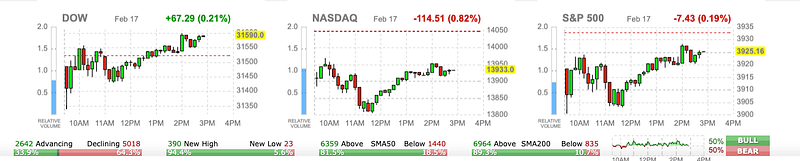
How bullish or bearish the current market plays a large role in my account’s day profit or loss. The three major indices, the Dow Jones Index, S&P 500, and the Nasdaq Composite Index typically move in the same direction in any given day. As the major indices track thousands of companies between them, they are a good indicator of where the overall market is.
Because my positions are pretty tech heavy, I’m closely correlated with the performance of QQQ, an ETF that tracks the top 100 companies in the Nasdaq. If you haven’t already, I highly recommend analyzing your portfolio to see how correlated you are with the indices.
On a typical market open day, I will open the Stocks app from my iPhone to see the current levels of the major indices since I have them saved at the top. I like doing this since I will see related news articles that may provide insights on why the market is trending in a particular direction. You can also look up the indices individually to see where they are trading at.
How does this impact how I deal with losses?
Most of the time when the Nasdaq 100 goes negative, my account will also be in the red. If this is the case, after I have dealt with any single positions from the first step that dealt with negative catalysts, I will look more closely at financial news and the indices’ trading graphs.
Reading the news provides insight on market sentiment. Maybe a jobs report has disappointed, a world leader has unexpectedly made a statement that has the rest of the world panicking, or individual investors drove up the price of Gamestop so severely that hedgefunds may have been forced to liquidate other positions.
When checking the trading graphs of the indices, I typically will look at QQQ and SPY, ETFs that track the Nasdaq and S&P respectively. If I see that the ETF has been running up for some time, it makes sense if it goes down a bit. All of the major indices have down days.
If the news is not overwhelmingly negative, I will often use these down days to add to existing positions. Since the index already managed to go up to a certain level before coming back down on a red day, I see this as an opportunity to catch it on a upswing before it hits the previous level again. To balance out my buying, I make it a practice to exit some positions on market green days.
How I Handled Today’s Red Day
For reference, the day is 2/17/2021 and the trading day isn’t over yet as I’m writing this. Since the dip down nearly $5,000, I have since recovered over $2,000. My losses are magnified since my portfolio is primarily made up of options positions, which are more volatile than the respective underlying
While I definitely went down a lot harder than the major indices, my thesis on my current positions is unchanged. A lot of tech companies took a beating today, and I’m confident that they will come back in the coming days. In fact, I took the dip today as an opportunity to buy more into several ARK Invest ETFs which I discussed in my article, Eight ETFs with Staggering Returns in 2020.
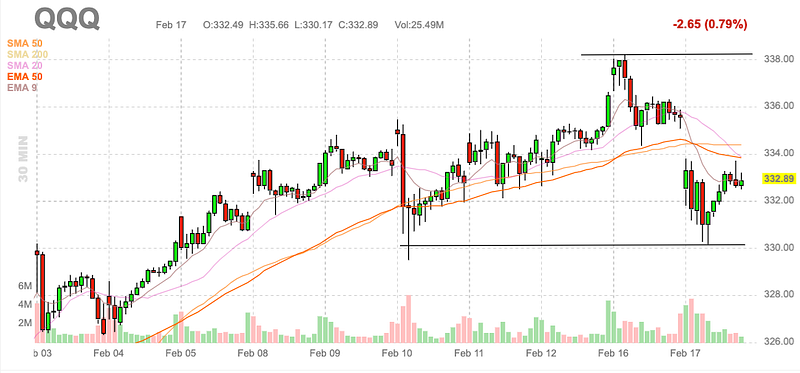
Looking at the trading graph of QQQ, there has been a strong trend upward in the last couple months. The last time it traded in the low $330’s, it recovered. Since this is now behaving as a level of resistance, I think that it should have a better shot at going back up.
How Do You Manage Your Losses?
What are you doing differently when you manage your positions? There is always something to learn, and I would love to see what has worked for you in your experience.


