
How I Control My Anxiety in Our Troubled Times
Three holistic health practices to stay calm amidst the chaos
Last night I felt a heavy, existential weight on my chest, which felt like the start of a panic attack.
This is rare for me now.
Many years ago, though, I struggled with emotional imbalances — depression, anxiety, OCD.
It started in my teens quite inexplicably, when one day I felt like a supernatural being reached into my brain and flipped an invisible switch. All kinds of negative, fearful, uncontrollable thoughts flooded my mind.
After a few weeks of internal torment, the switch would flip again, and my mind would return to its normal state of relative clarity and calm. Then I would experience long periods of happiness and joy.
Despite this, I lived in constant dread of that evil being returning to cast a dark spell over me. And it did, multiple times.
I kept the secret of my erratic moods for almost 20 years. I didn’t tell anyone…not my parents, not my best friend, and later, not my first husband. I was high functioning, with a successful career and a seemingly normal, happy personal life.
I could have won an Oscar for my ability to hide the truth from the entire world.
To this day, I ask myself why I withheld such crucial information, especially from those I loved.
For one thing, I suppose I didn’t even know what to call my experience so that others could understand. My symptoms didn’t check all the boxes for any one kind of mental health disorder.
What was actually wrong with my mind? I didn’t know. How could I make people understand? It seemed like an impossible task.
I think I also felt ashamed of my actual thoughts, which at their worst would probably sound like a bad piece of Gothic fiction if I ever spoke them aloud.
In my early 30s, I decided to confide in a good friend who happened to be a clinical psychologist. I suppose I finally opened up to someone because the burden of keeping my secret had grown unbearably heavy. And because of her professional background, I felt safe revealing my secret.
Finally I got some professional help — a combination of talk therapy and medication. This pulled me out of the darkest places when I fell in, but still it wasn’t a long-term solution.
Modern psychology and psychiatry could not keep me off the roller coaster of my own mind. I was seeking permanent peace. Not a safety net to catch me when I fell for the 100th time.
Enter Yoga
While passing time on an international flight, I casually picked up a copy of Vanity Fair magazine stuck in the seat pocket.
When I opened it to the middle, I found full-page head shots of well-known yogis. Many of them were middle-aged or older, like the famous father of modern yoga, BKS Iyengar, who was in his 80s by then.
At the time, I knew nothing about yoga and had no idea who these people were.
But I did know one thing: These yogis were clearly at peace. I could see it in their happy, shining eyes. In their gentle smiles. In their wrinkled yet glowing skin.

I wanted that! They embodied my deepest longing to be liberated from my own mind.
When I got home, I joined a local yoga studio and started practicing. Every, single day. Sometimes in a class with others, but often at home by myself.
I knew at the core of my being that yoga would bring me the relief I craved. I didn’t know exactly how, but I trusted an inner voice that told me to persist.
During that time, I learned that yoga is not a series of stretches in Indian garb. The postures are designed to move the subtle energies in the body, which for many people become blocked over time, causing any number of physical and emotional disorders.
The practice also involves breath exercises, meditation, and purposeful relaxation. Not to mention a positive science of mind based on the ancient Indian spiritual texts known collectively as the Vedas.
After a few months of daily practice, I began to experience an internal shift in perception. Balance replaced agitation in my mind. I felt lighter, clearer and more joyful.
I experienced what the ancient yogic text, The Yoga Sutras by Sage Patanjali, had promised:
“Yoga is the cessation of the fluctuations of the mind.” (Chapter 1, Verse 2).
After one year or so, I no longer feared falling into the darkness because I knew I had transcended it. And if I ever felt a pull back to my old self, I knew I had the tools to deal with, and ultimately transform, my negative emotions.
Yoga changed my internal landscape so dramatically that I became a yoga teacher so I could share the mental health benefits of the practice with others.
2020: The Year of Emotional Challenges
Now in the year 2020, my mental health is being challenged again, this time from external forces. I’m sure this is true for thousands of other people as well.
In the US and many other places around the world, we are in the midst of a perfect storm: a global pandemic, economic devastation, and racial injustice.
Many of us are grieving because we have lost our livelihoods or our loved ones. Maybe we have close friends, family members or colleagues who are suffering. We are all diminished by the violence and inequality in our society.
On top of this, we’re being constantly bombarded with powerful, often disturbing images of the chaotic state of world. 24-hour news sources, ubiquitous cell phones with video capability, and worldwide social media ensure we never miss a beat.
It’s no wonder that our nervous systems are getting fried.
If you’re on edge these days, beating back anxiety, I’m right there with you!
Like so many of us, I have legitimate personal concerns — such as, my job will be there in a few months or if a loved one will fall ill? I also have more existential concerns — like can humanity and our planet survive this?
In troubled times like these, I pull out my yoga toolbox. I double down on those practices I know will keep me emotionally balanced and connected to the peace in my heart.
Even if you’ve never done yoga, no problem. You can do a few simple things to find your inner peace. These three practices help keep me grounded when everything feels like it’s spinning out of control.
1) Breathe Like a Yogi
It’s such a cliché to say “take a deep breath” when you’re feeling anxious. But it’s true. You can calm your sympathetic nervous system (the fight-or-flight response) within a few minutes by breathing deeply.
The problem is that most people don’t know how to breathe effectively.
As adults, we’ve forgotten what babies do automatically — belly breathing. If you watch babies breathing, you’ll see that their tummies rise and fall with the breath. They fill up her lungs completely, from top to bottom, from side to side.
When adults breathe, we tend to use only a small portion of our lungs, breathing into the top third as our chest moves up and down. These short, shallow breaths can disturb the healthy oxygen-carbon dioxide ratio in the body and lead to anxiety.
From a yogic perspective, the key is to practice long, deep belly breathing before feelings of distress set it. You can use your breath to stay calm and grounded throughout the day, and not succumb to panicky feelings in the first place.
Set aside a time to breathe intentionally, at least twice a day, if not more often. It’s important to make it a scheduled practice, not just a random event when it dawns on you.
Here’s my favorite breath exercise for calming the sympathetic nervous system:
Sit up tall, on the edge of a chair or on a meditation pillow or bench. Take a slow, deep breath in through the nose, making sure to fill your lungs completely from top to bottom and side to side. You can put one hand on your tummy to see if your belly is rising and falling like a baby’s breath.
When you exhale, purse your lips and pretend like you’re blowing through a straw. The stream of air you create should be soft, gentle and as slow as possible. When you make your exhalations longer than your inhalations, you calm the sympathetic nervous system even more.
Repeat this breath at least 20 times per sitting, several times a day.
2) Practice “Yoga Nidra” — Yogic Sleep Meditation
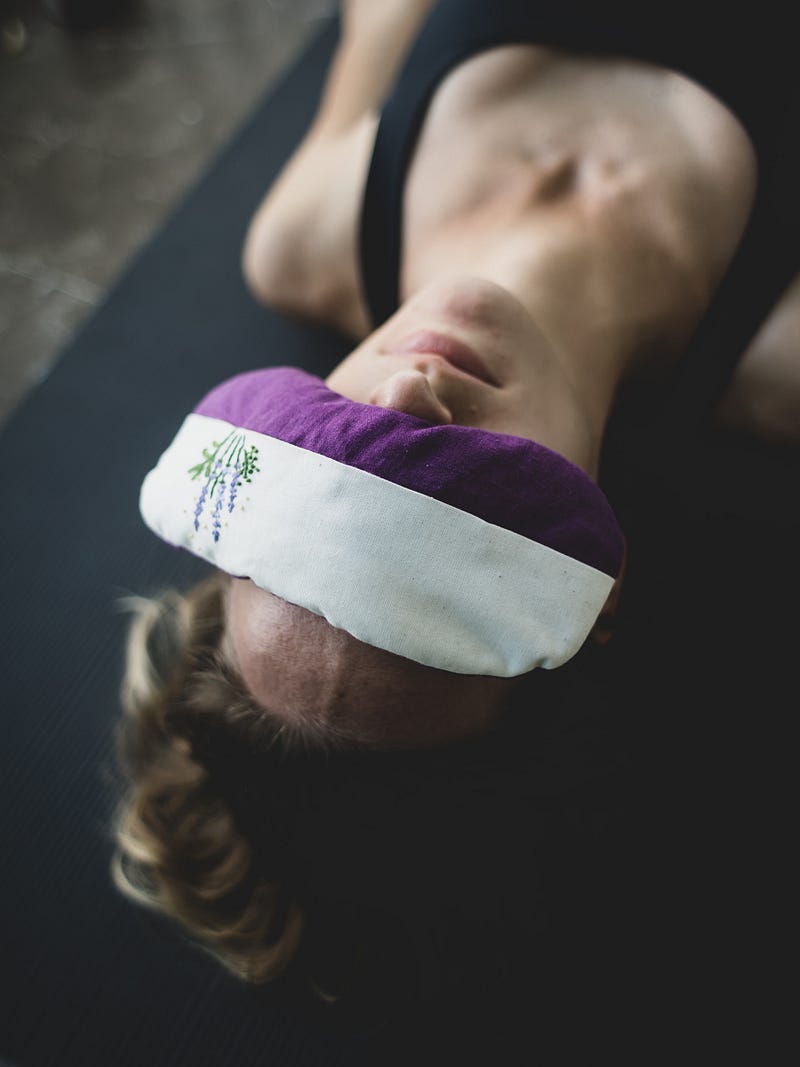
Yoga nidra is one of the most effortless yoga practices because you don’t need to do anything! You get to simply be for 30–40 minutes. You lie on your back, close your eyes, and allow yourself to be guided into a state a deep relaxation by a facilitator, either in person or from an audio recording.
This state of being is known in yoga as pratyahara, or withdrawal of the senses. The Yoga Sutras mention it as one of eight parts of a path that leads to Yoga with a capital Y — the union of mind, body and soul where the fluctuations of the mind have ceased and perfect peace resides.
Here’s how it works:
In our awake state, we tend to live in the highly active state of beta brainwaves, where our thoughts, feelings and reactions occur. It’s in this state where we take in and process all of the external stimuli that can cause worry, fear and anxiety.
In yoga nidra, you leave this active state behind and experience slower brainwave activity. You naturally let go of a strong sense of the egoic “I.” This allows you to relax deeply into a twilight sleep state.
You escape from the constant mental chatter that torments your psyche, increases your adrenaline and upsets your emotional balance. Instead, you feel connected to a deep sense of peace and stillness, without any effort.
On a purely physical level, yoga nidra reduces levels of adrenaline and cortisol in the body that can lead to mental stress and possibly full-blown anxiety.
It’s been said that 30 minutes of yoga nidra equals 2–3 hours of sound sleep. I don’t know if this has been proven in studies, but I do know this is how I feel after a yoga nidra session. Many other people report the same results.
You can find many yoga nidra recordings on YouTube. I recommend the form I’ve been trained in as a facilitator and the one I use for myself: the Amrit method, developed by Yogi Amrit Desai and his daughter, Kamini Desai, Ph.D.
When you’ve found a recording you want to use, do this: lie on your back in a quiet place, but preferably not in bed. (If you do yoga nidra in bed, you might fall sound asleep and not complete the practice.)
Use props and blankets to make yourself comfortable. You can also use an eye pillow to block out light. Put your earbuds in, listen to the facilitator. For the best effect, stay connected to the facilitator’s voice and try not to fall asleep.
That’s it. Relax and enjoy. You’ll feel calm and deeply rested when you finish.
My advice from personal experience is to practice several times a week, and even every day if you have time. The more often you practice yoga nidra, the more profound and lasting the effect will be.
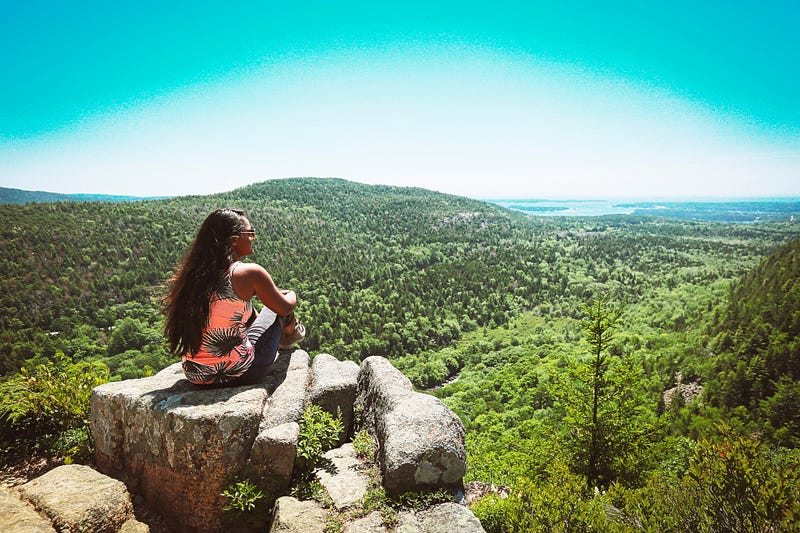
3) Escape to Nature
Nature is a healing tonic for mind, body and spirit.
Do you remember how rejuvenated you felt the last time you sat under a tree in your local park? Visited an animal sanctuary? Went on a walk at sunrise?

Researchers have tried to explain the healing power of nature, citing evidence such as less stress-producing cortisol and fewer negative, ruminating thoughts. If you love modern science, you can find loads of research findings about it on the internet.
Some of this research, though, misses out on a more holistic, experiential understanding of nature.
In her book Ayurveda Lifestyle Wisdom, Vedic wisdom teacher Acharya Shunya writes,
“When we simply stop our battle and allow Nature to take over, abiding health reasserts its presence along with all its attending comfort, relief, and joy.”
From a holistic perspective, each of us is a small aspect of nature.
So when we connect to nature, we are coming home. Home to the stillness of our own being. Home to our ultimate Mother, who protects us from harm and calms our troubled minds.
What a relief when our worldly problems fade away for just a short time! This is not just a “forgetting” of our current reality; it’s a remembering of the cosmic reality.
In the big scheme of things, we are safe, whole and loved.
Our minds and nervous systems need this balance. Yin and yang. But if we don’t consciously seek it out, modern society will pull us down the rushing river of chaos and drown us in worries, fear and anxiety.
That’s why it’s important to schedule time in nature. I’m not talking about exercising outdoors, although it’s fine if you do, of course.
For anxiety relief, you should make a conscious date with Mother Earth. Go there with the intention of connecting. Of calming your mind and balancing your internal rhythms.
You can sit or stroll. Observe creation in its myriad of forms. Note what’s beautiful (an orange sunset) and what’s not (ants devouring another life form). Notice the aromas, sounds, the nuances of color. (Once it struck me how many different shades of green exist in nature.)
Then return to your normal life, refreshed and renewed. Ready to jump back into the fray.
Postscript
These three practices are powerful. They have helped change the quality of my life, and they can do the same for you. I return to them again and again.
Still, I don’t want to oversell them and tell you that you’ll never again feel fear, anxiety or worry. Of course, you will, and so will I.
Just like the unexpected episode of anxiety I experienced last night.
But at least I have some tools to help keep me on an even keel — thinking clearly and enjoying life (for the most part) even in rough waters.
It’s crucial that we all take care of ourselves if we’re going to solve our own personal issues and be a part of the collective solutions.


