
Memoirist Idol
How I Became a Jet Magazine Centerfold
Coming of age in the 70s
Neither of us understood the implications of our decision.
I was a teenager — mom old enough to know better. According to Granddaddy, mom couldn’t pour piss out of a boot if they wrote the instructions on the heel. I had to bear the burden of proof he was wrong.
Following the 1971 Sylmar earthquake that rocked the city of lost angels to its core — senseless gang violence erupted. News about the kid who lost his life outside of the Hollywood Palladium over a pair of tennis shoes was equally jolting. Los Angeles was changing.
The earth’s violent convulsions stole my last minute of slumber before the alarm was to remind me it was a school day. Before, my reality was about to change and before I would enter high school by default. Half the buildings at my junior high had crumbled like hot buttered corn bread.
Two weeks before school let out, I declared my independence. “Mom, I’m not going to Philadelphia this summer.”
With a raised, penciled in eyebrow, she said, “You’re not?” “Well, I have news for you — you will not sit around here all summer with nothing to do. You will go to summer school,” she said.
“Why? I made straight A’s on my last report card; there’s no reason for me to go to summer school with kids who failed. I’m not going!” Mom swished the amber elixir over ice in circular motions.
Then sat her glass down on the marble end table next to her favorite recliner. Her almond-shaped eyes glazed over. I may have gone too far.
“Who the hell do you think you’re talking to?” I knew not to answer. But if looks could kill, she’d be dead. Instead, I hunkered down on the brown leather love seat in the den. Stared at the angelfish through the aquatic prison my stepdad built into the adjacent wall.
It was in a meditative state — lost in thought. I never realized the similarities of our existence. Except it seemed content.
By June, mom was sick of me, and I was sick of her. She couldn’t wait to ship me off and I couldn’t wait to visit my grandparents who would let me breathe. The previous summer had been long, hot, and boring. I wanted to do something different.
No sense in arguing with mom — she had ruled my life with a candy-coated iron fist. The slightest indiscretions met with a fierce reprimand. We wouldn’t talk for days after her tirades.
I could count on a box of See’s assorted suckers at the end of the week — mom’s idea of an olive branch. Her elixir induced rage and my bruises dissipated by then.
The regular school year ended, and I registered for summer school. Without telling me, mom had signed me up for a six-week modeling course at her friend’s new modeling school.
“Mom, I don’t want to go to modeling school, why can’t I get a summer job like everyone else?”
“It’s all settled, you’re going — you need something to do. Besides, it will help bring you out of your shell,” she said. The shell she had created.
Mom’s friend who was doing well as hairstylist to Black celebrities in the early 70s tired of the same ole story in the community: Black girl gets pregnant, drops out of school or joins a gang and ends up dead. The conversation started after hours in Anne’s salon one night.
She felt obligated to give back — do her part to eradicate the low self-esteem that plagued Black inner-city youth. The agency would target girls from 13 to 19. Mom wrote the business proposal and Founders National Bank — the first Black-owned bank in Los Angeles funded the venture.
Once mom relayed the details, it didn’t sound that bad. It sounded more like a pipe dream, a grand illusion — until the doors opened and I attended my first class.
Mom and I barely spoke as we ascended the hill on Stocker Boulevard en route to Anne’s Black Modeling Agency. It was in a strip mall on the second floor of a three-story building surrounded by other Black businesses.
Gigi Casuals, a trendy store with tie died bell bottoms, head bands and colorful blouses with batwing sleeves. The Flying Fox — a popular nightclub that headlined all the Black entertainers of the decade and Gracie’s, a favorite soul food restaurant.
The space was narrow at the top of the stairs with high-beamed ceilings. Anne lined the walls on each side with rectangular mirrors and classroom style tables, complete with a chair for each girl. There was a larger room in the back with a sewing machine and manikin for fittings.
Fifteen girls of varying height, weight and shades of brown — light pecan to dark chocolate from the surrounding neighborhood stood against the wall. They all spoke in hushed tones — most were daughters of Anne’s friends and their friends from Baldwin Hills, nicknamed the Black Beverly hills.
Introductions were the first item on the agenda, followed by a brief presentation of Anne’s vision and expectations. The only two things that grabbed my attention were class started at nine every Saturday morning and there would be a pageant at the end.
Both turned me off. Getting up early on a Saturday? A pageant with judges? I was not crazy about parading around in front of complete strangers in a formal gown or bikini.
That was the longest six weeks of my life albeit I learned a few makeup tricks that still serve me well. I wasn’t delusional — I knew I had little chance of winning the contest at 5'3.
The girl who won had the most potential. She was at least 5'10 with a creamy peanut butter complexion and long muscular legs. After the pageant concluded, Anne asked by a show of hands who would have an interest in participating in a photo session.
The school would provide a free makeover and the girl would be the photographer’s choice. Mom stood on the sidelines, egging me on until I finally raised my hand.
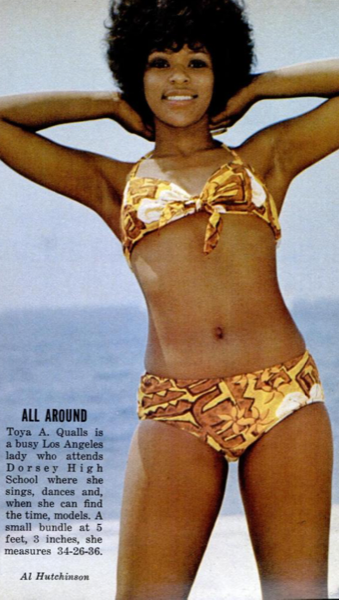
The day of the photo session, we met in front of the school. The sun was playing hide and go seek with scattered clouds. I loved my makeup. It made me look like an adult — every teenaged girl’s dream. Mom let me borrow her brown and yellow safari printed bikini since I didn’t have one.
I quickly covered up with a white terry-cloth robe and stood on a grassy hill outside along with the other hopefuls.
After 20 minutes, I was ready to go home. A few photographers had chosen their girls, and I stood alone with mom when a boyish looking man with glasses approached.
Dressed casually, in khakis with a belt —plaid blue shirt tucked inside and his gear hanging from a strap around his neck — he said, “Hi, my name is Al.” “I’m new to this. I just moved here from Chicago.”
“Hi, nice to meet you,” mom said.
“Would it be okay if I take a few pictures of your daughter?” Mom agreed and my heart started pounding in my throat.
I looked at mom for approval, then said, “okay.”
“Take your robe off,” mom said. I peeled it off as if I were losing my virginity. Al waited while fiddling with his lens for the best lighting and distance.
“Ready?” he said. “Do whatever you want — be free.” My poses came out of nowhere, as if they possessed me. A crowd gathered and mom looked at me like I had just auditioned for the Exorcist.
“That was fantastic — you came alive for the camera. It’s a wrap today, I’m out of film,” Al said. He asked mom if she would mind if he submitted my best shot to a magazine. Mom gave him the side eye, “what kind of magazine?”
“I was thinking she’d make a great centerfold in Jet Magazine.” He gave mom a business card and said he would be in touch the following week. Life went on as usual for the angelfish and me: eat, sleep, swim, school, homework, music lessons.
Mom came home one day with a goofy grin plastered on her face. With not a single doorway complaint, she walked in, put her purse in the leather chair and reached for her amber elixir.
“Mom, what’s wrong with you?”
I don’t want you to get excited, but I received a call from the photographer today who submitted your picture to the magazine. He had to falsify your age and we need to sign a release, but they chose your picture for the centerfold in the November issue.
“Falsify my age, why?”
“Because the age requirement is 18,” she said. I was barely a sophomore in high school.
“Mom, are we going to get in trouble?”
“He said they probably wouldn’t check, but it’s a chance we’re taking. If you’re not comfortable, I will tell him to rescind.”
“Are you kidding me?” I jumped up and down and danced around the living room. I grabbed mom’s hands, and we went around in a circle for at least a minute. We both fell on the couch laughing like giddy teenagers.
Usually, it felt like we lived in a steel bottomed pressure cooker. Something had finally lifted the lid. The release felt good.
School started in September and the magazine hit the newsstands November 8, 1973. The first Black mayor of Atlanta graced the cover. I was proud to be in a magazine celebrating Black excellence. There I was in the centerfold in mom’s bikini — hands behind my head, curly afro blowing in the wind with the name of my high school included in the short bio?
Seriously, why would they do that? Shit, I had P.E. first period.
As soon as I walked into the locker room, my best frenemy was holding a copy of the small publication. Her locker was next to mine.
“How the hell did you get into a magazine?” she said.
“I went to Anne’s Black Modeling School in Baldwin Hills,” I answered.
“I never heard of that school — I’ve been working and paying my way through Barbizon for a year and I ain’t got no picture in no fucking magazine.” She slammed her locker so hard it shook the entire row, then stormed off like a spoiled child.
By recess, the entire school was huddled in the middle of campus. A group of boys gawked and whistled when I walked by. Girls turned a mean shade of green. The buzz was exhilarating and scary.
I was in third period Algebra when summoned to the office — my name blasted over the school’s PA system as if I were the next flight departure from LAX. Nearly scared me to death.
Whatever I had done, mom would kill me. I was sure of that.
When I got to the office, they handed me an oversized manila envelope full of personal handwritten letters. I was so excited.
Fan mail from prison inmates? I felt ashamed. I threw them in the garbage when I got home. We had to change our phone number because pornographic photographers were calling my home asking if I wanted to do a photo shoot almost every day.
A frenemy since junior high accused me of trying to steal her boyfriend I’d known since I was five, threatened to kill me. Girl, please.
In late winter, a few minutes after I had said good night, Mom had come into my room and sat on the side of my bed.
“Are you okay?”
“Yes mom, I’m fine.” A tear rolled down her cheek and splashed onto my blue floral bedspread.
“I just want you to know that I love you and understand you are blossoming into a beautiful woman. I know I’ve been hard on you and perhaps the day will come when I can share the reasons.”
It’s taken a lifetime to understand the reasons.
Thank you for reading my entry into the Memoirist Idol writing contest! Missy Crystal’s piece about how words can hurt years later when you hear them in your head resonated with me because of my experience with similar abuse in my relationship with my mother. Her story is sad, but beautifully descriptive.
Shout out to Carmellita for the encouragement to publish my story after reading her tribute to Jet Magazine.