
How I Accidentally Discovered Magnolias and Mind Reading
Dancing Elephants book project positivity — group one
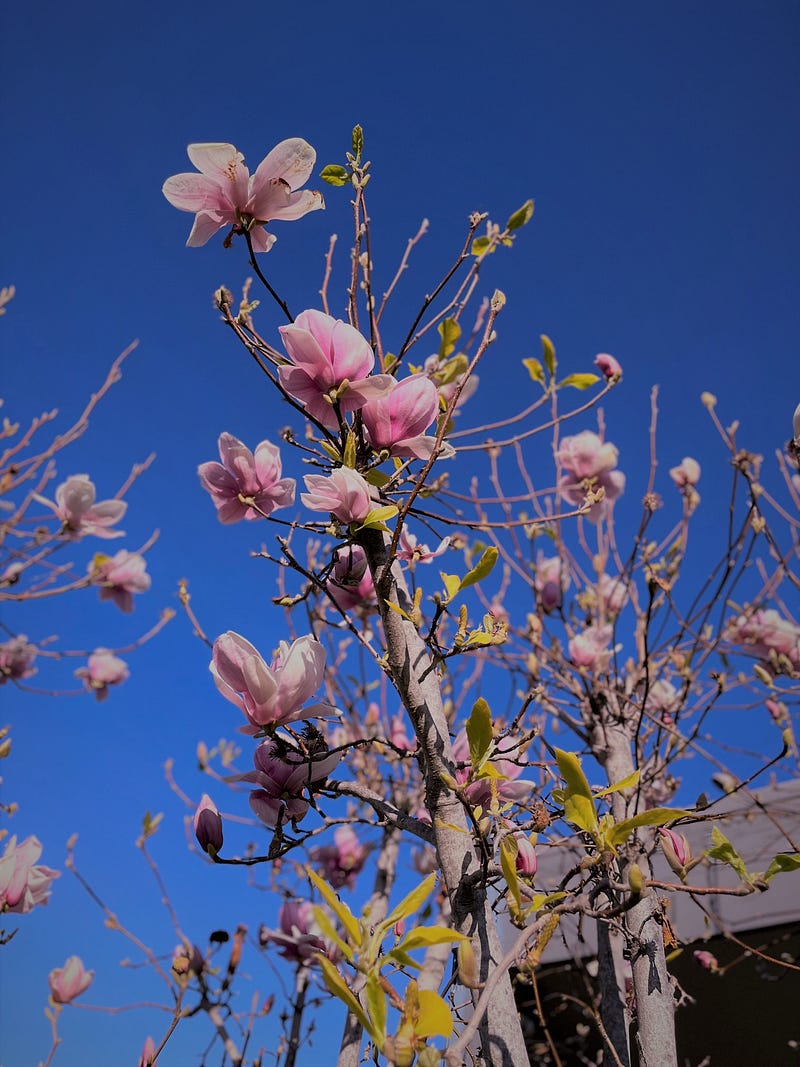
I am convinced that most people do not grow up…We marry and dare to have children and call that growing up. I think what we do is mostly grow old. We carry accumulation of years in our bodies, and on our faces, but generally our real selves, the children inside, are innocent and shy as magnolias. — Maya Angelou
On my way home, I noticed a blooming magnolia tree lifting its pink petals to the blue sky.
I was supposed to make a right turn onto my street, but instead, I pulled over and admired the blossoms that extended their wide smiles to all the passersby. I snapped a few pictures, too, but I mainly stood there silently.
A short stop that felt like an immersion into the language of flowers. A detour to detoxify my soul. An intentional drift from the hustle and bustle that ensnare and engulf our souls as fiercely as an anaconda snake.
The magnificent magnolias have so much to teach us
Trees, flowers, unique buildings attract my attention and my voracious modus vivendi, which is my way of living and looking at the world around me with new eyes and appreciation.
For instance, according to magnolia tree facts, magnolias are ancient plants that have fused petals and sepals, since its flower contains both male and female reproductive organs. Dating back to approximately 95 million years, magnolia trees can live more than 100 years, as they are resistant to most pests and diseases, which is why it’s no wonder that I had to write a poem about this incredible tree whose beauty and wisdom can teach us how to smile and maintain a positive outlook on life.
The poem is part of my second poetry book published in 2021 entitled Morsels of Love, A Book of Poetry and Short Form.
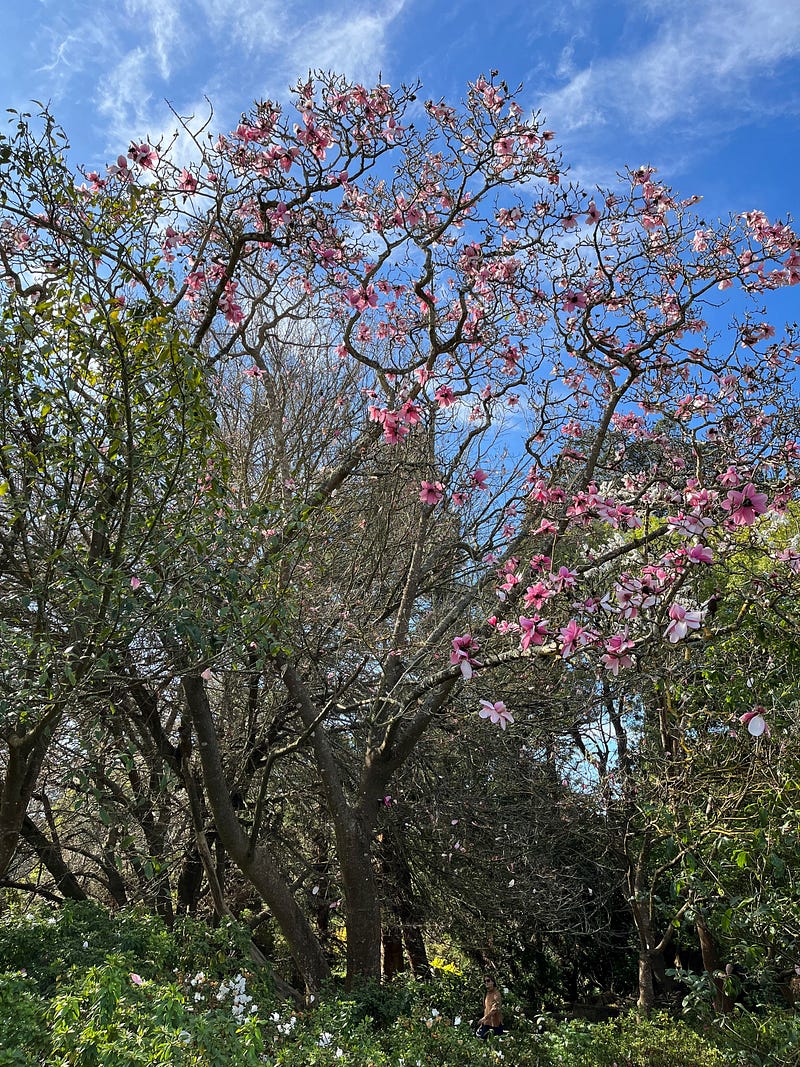
If only Magnolias
If only we figured out how to turn our frowns into smiles as wide as magnolias. if only our hearts and souls were as opened as bloomed magnolias in early spring.
If only magnolias, white petals of longevity, which existed since the beginning of times, if only magnolias pink petals of perseverance
If only magnolias …
Finding joy in not so joyous circumstances
“I strike up conversations all the time and it is very interesting, finding out about things I know nothing about.” — Peter Ackroyd
Yet, no matter how many facts I have learned about magnolias, one thing will always stay with me from my childhood back in Romania: Magnolia Street, a short street with well-maintained and expensive homes, where doctors and attorneys used to live, lined up with magnolia trees that diffused their different scintillating scents into the communist air of my small town Lugoj in the 1980s.
Only about 200 meters away from the apartment building where my parents and I lived on the third floor with a spacious covered balcony overlooking a park with a large playground and a small soccer/tennis court, Magnolia Street made life more magnificent and more manageable during times when my parents stood for hours in long lines to buy eggs, bread, flour, sugar, meat, and other essentials.
I also used to help out and stand in line, while my parents took a break to cook, or do other chores around the house. At first, I was upset that my play time was eaten by the long line. Yet, being the positive person that I am — a trait that I have inherited from my father, who as a watchmaker, had lived his life dusting off the hands of time, as he used to repair watches and grandfather’s clocks, I found joy in chatting with other children and adults who were patiently waiting their turn to buy the rationed amount allowed per family.
My standing in line during my childhood had nothing to do with The Science of Standing in Line by Jo Craven McGinty. For instance, the author analyzes Raj Jain, a computer-science and engineering professor at Washington University in St. Louis who takes an analytical approach and estimates the wait.
Jain said: “Then I count the number of people ahead of me, and I know how much time I am to wait.”
I was more like Dr. Larson from the same article, who took a different approach: “I just strike up a conversation with an adjacent queue dweller,” he said, “and wait.”
Not only have I become a conversationalist master because of standing in line next to strangers for many hours, but I have also developed great mind reading skills, which I constantly use today with my family, my friends, and my clients. I remember how I used to play a game, where I had to guess what people were thinking just by analyzing their facial expressions, their arched eyebrows, and their befuddled looks on their faces. I even played tricks on my friends and offered to read their minds to expose their most intimate thoughts as if they were just clothes clipped on the clothesline on a sunny, windy summer day.
“You’re just tricking us, Carmen,” they would reply.
“No way! Didn’t I just guess what you were thinking?” I would ask them as victoriously as when I caught the first fish and shrieked with excitement, scaring all the fish in the pond, as my dad jokingly pointed out.
“Yeah, but you know us very well, so that’s not hard.”
“I can read strangers’ minds, too,” I would point out.
And although my friends used to tease me about my so-called gifts, to this day, I strive to understand people’s actions by reading their minds, which according to the theory of mind “we humans assume that others want, think, believe and the like, and thereby infer states that are not directly observable, using these states anticipatorily, to predict the behavior of others as well as our own. These inferences, which amount to a theory of mind, are to our knowledge, universal in human adults” (Premack & Woodruff, 1978).
Meanwhile, I will keep reading minds by behavior prediction, guessing, inferring, using the inside information I have about someone, as well as by treating people’s thoughts like clouds in the sky that come and go, as Haruki Murakami pointed out in his beautiful memoir What I Talk About When I Talk About Running.
The claw of the magnolia, drunk on its own scents, asks nothing of life. — Sylvia Plath
I probably was the only one who stopped to gawk at the flowers that burst with color and sent vivid vibrations — their roots extending through the cracks of the parking lot in front of a commercial building on a busy street full of distracted drivers zooming by and zoning out the magnolia tree, but ONLY WE can stop this craziness and choose more positivity that can come in the form of soft, velvet pink petals of a magnolia tree, or anything else that will enhance your enjoyment of living in the moment every single day.
Pull over! It will be worth it!
And who knows? You might also become a better mind reader like me!
Works Cited:
Magnolia Tree Facts (softschools.com)
The Science of Standing in Line — WSJ, McGinty, Jo Craven, Oct. 7, 2016
Theory of Mind | Simply Psychology, By Charlotte Ruhl, Aug 07, 2020
Thank you so much for publishing my essay on positivity Lady Dr. Gabriella Korosi, Vidya Sury, Collecting Smiles, and Sharing Randomly.