
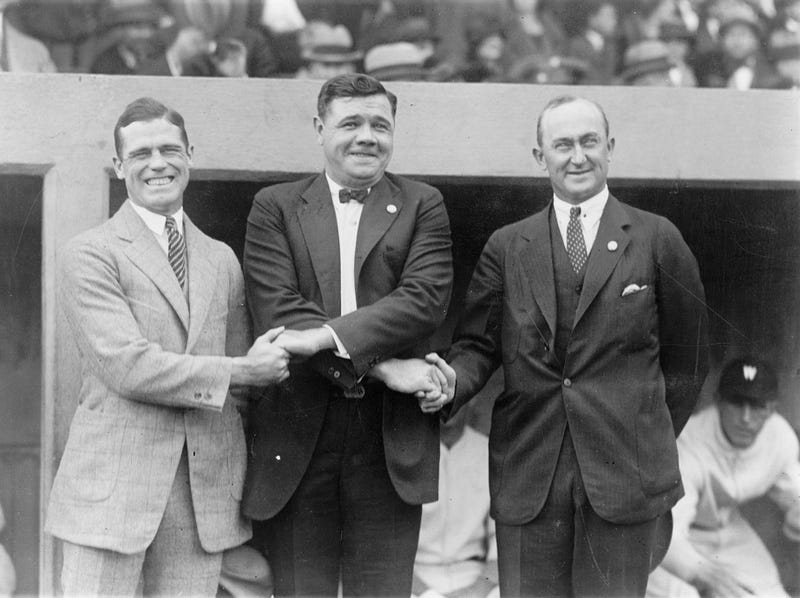
How Hall-of-Famer George Sisler Was Brought Back To Baseball Because Of A Dinner
An MLB legend thought he might have left the sport for good, but a chance encounter with a fellow Cooperstown inductee allowed for him to have a lengthy second career
When it comes to baseball, the best players are usually welcome to stick around the game as long as they want, even if their playing days are behind them. They become so well regarded that there is always a position somewhere open to them. Sometimes, players want to step away and try something else, making it harder to get back in if they have a change of heart later on. That’s what happened with Hall-of-Famer first baseman George Sisler, who tried ordinary citizen life after hanging up his spikes, but years later was able to punch his return ticket after a chance encounter at a dinner party involving one of the most famous figures in the game.
During a 15-year playing career (1915–1922; 1924–1930) spent primarily with the St. Louis Browns, the left-handed Sisler proved to be a whiz with the bat. He batted a combined .340 with 2,812 hits, 425 doubles, 164 triples, 102 home runs, 1,178 RBIs and 375 stolen bases. The winner of the 1922 American League MVP also captured two batting titles (highlighted by his .420 mark in 1922) and was considered a stout defensive player. He was later enshrined in the Hall of Fame in 1939.
Having spent so much of his life on a diamond, Sisler decided to try something different after he was done as a player. That worked for a time, but like many athletes, he maintained a connection and yearning to the sport he had mastered. He was eventually able to return as a highly respected scout and coach (recommending and working with the likes of young players like Jackie Robinson and Roberto Clemente), but only after finding an opening in an unlikely way — saying hello to someone at a dinner.
The January 20, 1963 issue of the St. Louis Post Dispatch ran a feature on Sisler, who had meant so much to their city and to baseball for so long. The old first baseman recalled what he did after he retired as a player, and why it didn’t work out:
“I had a sporting goods business after I quit baseball in 1932, and I didn’t like it. I missed baseball. I don’t know why I didn’t try to get back to it.”
Hoping to regain a foothold, Sisler did radio broadcasts of Cardinals and St. Louis Browns home games for a couple of years in the mid-1930s, but it wasn’t enough to scratch his itch. He had managed before, having been hired by the Browns as a player-manager for several seasons (1924–26), but his teams generally hung around the .500 level (he had a 218–241 record), which clearly left a bitterness in his mouth that made him loathe to pursue such positions again, as he described in his interview:
“I simply wasn’t ready to be a manager. I hadn’t thought of being a manager, and it was a little too early for me to be one.”
Finally, in 1942, Sisler found his new niche in baseball — player development. He got a job offer as a special assignment scout with Branch Rickey of the Brooklyn Dodgers, who he approached at an honorary dinner simply to shake his hand:
“I did get back simply because I attended a dinner at which Mr. Rickey was being honored. I went up to the head table just to shake hands and say hello, but Mr. Rickey asked me if I wanted to be a scout for him, and I was back in baseball.”
Over the next two decades, Sisler earned a stellar reputation for identifying top young talent, and also working with young players to enhance their games and bring out the best of their skill sets. He worked for a number of teams, but his results seemed to be the same no matter where he went. Through it all, he maintained a mindset squarely set to baseball values from back when he played. He explained how he had to work around some of the ways that the game had changed dramatically:
“It could be that baseball doesn’t give a high enough rating to defense. Maybe that’s because one run doesn’t mean as much any more. There’s an emphasis on home runs. A good many batters go to the plate with the idea of hitting a home run every time. This is an idea which always had been foreign to a good hitter, which may explain the lower averages now.
“I know Jimmie Foxx never went up there trying to hit a home run. He went up ready only to hit the ball hard. I bet Ruth was the same way. And I’ve heard Rogers Hornsby say, ‘I was a line-drive power hitter.’”
Sisler passed away in 1973 at the age of 80. In addition to his amazing contributions to baseball as a player, he went on to have a remarkable second act in the game because of his simmering passion and his decision to go and say hello to someone he respected who was being honored at a dinner.


