
How Great Writing Helped Charlotte Curtis Blaze Trails in Journalism
The first woman on the New York Times masthead had wit, courage, and political savvy
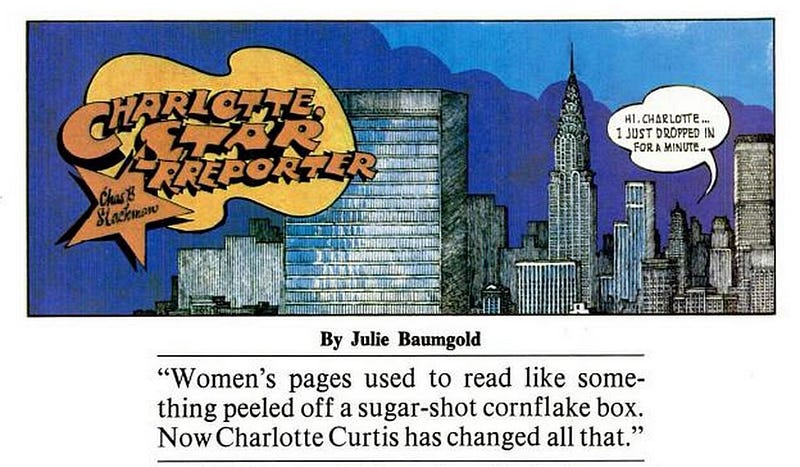
As a student at Vassar, Charlotte Curtis hoped to land a summer job as a news reporter at her hometown newspaper, the Columbus (Ohio) Citizen. But when she applied, she was told that the paper “already had a woman” in that position.
The Citizen instead gave her a $40-a-week job on the women’s and society pages and hired her back in a similar role after her graduation in 1950. In the pre-feminist era, that beat tended to be a pink ghetto for female reporters.
Lindsy Van Gelder, a former New York Post reporter, wrote in Ms. Magazine that she hated women’s page assignments in the late 1960s:
“The women’s page was for frivolous, boring, puffy, irrelevant, 86-ways-to-make-tuna-casserole-news.”
The first woman to edit the Times’ op-ed page
Curtis proved that tuna casseroles didn’t have to prevail. After leaving the Citizen for the New York Times, she helped to transform how newspapers covered women. Along the way, she became the most powerful female editor in the history of the Times: the first woman to edit its op-ed page, the first to appear on its masthead, and the first join the ranks of its top management.
What made her career all the more striking was that Curtis was an anomaly in the rough-and-tumble, male-dominated newsrooms of her day: a private school–educated, Junior Leaguer who had gone to Vassar with the future Jaqueline Kennedy. She stood 5’1” tall in her Chanel heels and wore “ladylike suits, discreet quantities of real jewelry, and a faint aura of expensive French perfume,” a colleague wrote.
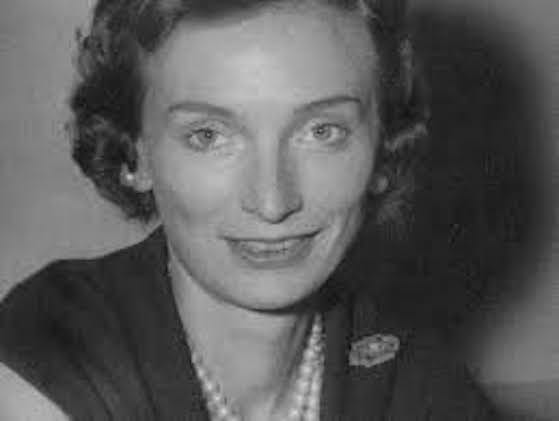
Curtis came from money and privilege that might have enabled her to forgo a career. Her father was an eminent Columbus surgeon whose hands were insured by Lloyd’s of London, and her mother was an Ohio suffrage leader and the first American female diplomat to work overseas.
Instead of slow-walking her career, Curtis became “the ultimate inside outsider” at the Times, as the media scholar Marilyn S. Greenwald writes in her biography, A Woman of the Times: Journalism, Feminism, and the Career of Charlotte Curtis (Ohio University Press, 1999).
Her trailblazing ascent began in Columbus. Back in her hometown after Vassar, she shed a brief post-college marriage to a Yale law student and would not marry again for two decades, which allowed her to focus on her work with a single-minded drive. She loved reporting and at the Citizen had editors who let her write with the irreverence that became a signature.
Faced with a tight travel budget at the paper, Curtis paid her own way to Paris to cover a United Nations General Assembly meeting and to Russia to write about Soviet women. During the 1960 presidential campaign she broke with the journalistic tradition of treating candidates’ family members gently.
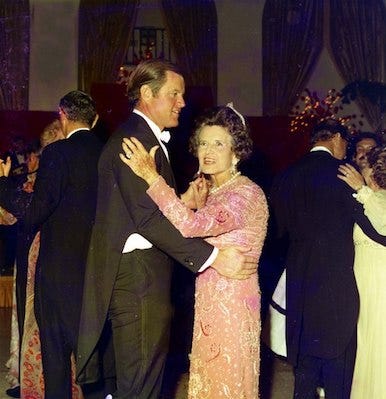

Curtis called Pat Nixon a “shrewd” professional, “a cool Gretel who won’t be caught climbing into any ovens.” She portrayed Rose Kennedy as, in Greenwald’s words, “rich and spoiled.”
Columbus turned out to be a warm-up for the Times, which hired Curtis in 1961 as a reporter for its women’s section. That section merged with the society pages after her arrival, and as she had at the Citizen, she tried to break away from a spot that could short-circuit women’s advancement.
‘All brides are not beautiful’
But she had found a powerful mentor at the Times, managing editor Clifton Daniel, and he offered her a chance to bring the society beat into the modern era by using it to look more deeply at the overprivileged and what lay behind their flaunting their wealth at benefit events such as charity balls.
Her success at that task would make her better known than some of her sources. Curtis revitalized the newspaper’s stodgy coverage of weddings, engagements, and social events with her dry wit and a fresh point of view she summed up as: “All brides are not beautiful.”
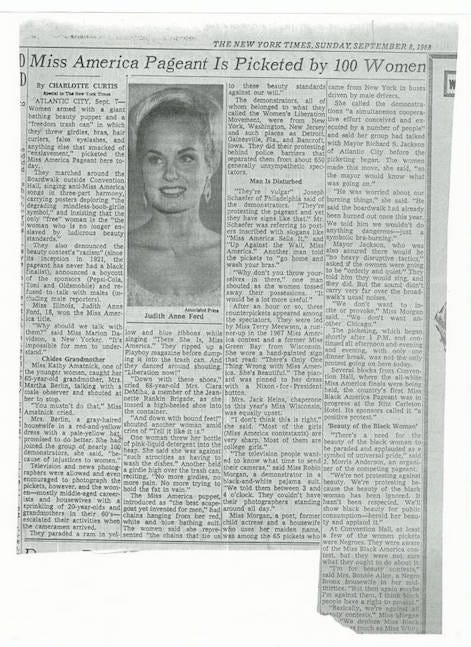
In a story about Miami, Curtis revealed that four of the city’s prominent clubs had no Jewish members. She let a society matron in San Francisco hang herself with her words when the woman admitted she was trying get by with just five servants: “All I have is a personal maid, a cook, a butler and a cleaning woman. Well, no, that’s not right, either. There’s the chauffeur.”
Curtis treated New York bejeweled mandarins with a bite that grew out of her deep appreciation of the power the rich wielded in society. Her two most famous stories covered Truman Capote’s masked Black and White Dance and a party recalled in her New York Times obituary:
“At a cocktail party held by Leonard Bernstein for the Black Panthers in 1970, when a Panther field marshal stridently outlined his tenets before a small group that included Mr. Bernstein, principal conductor of the New York Philharmonic, Miss Curtis caught the telling moment:
‘’ ‘If business won’t give us full employment, then we must take the means of production and put them in the hands of the people.’
‘’ ‘I dig absolutely,’ Mr. Bernstein said.’’
Tom Wolfe, who wrote about the same party in Radical Chic and Mau-Mauing the Flak Catchers, said that Curtis enraged people by exposing the pretensions of the event:
“It wasn’t anything she wrote that infuriated them. It was that she put down exactly what they said. That’s always what seems cruelest of all, to hold up a mirror to people that way.”
By then Curtis had become the editor of the merged women’s-and-society section and was adding to or replacing its usual fare with stories on subjects like abortion and the emerging Second Wave of feminism. She wasn’t the only female newspaper reporter or editor of her day who was shaking up that beat.
But her ironic wit and penetrating insights set her apart, and because she worked for the nation’s newspaper of record, she had unusual clout. Nan Robertson, a Pulitzer Prize–winning Times reporter recalled:
“She was imitated by women’s news editors across the country and by the reporters at her own paper who were her proteges.”
Curtis’ ability to hold her own with power brokers from many realms — the arts, business, politics, and more — helped her become the first female editor of the op-ed page at the Times and the first woman in history to appear on its masthead. In 1972 she had surgery for breast cancer, from which she died in 1987, and she did much of her landmark work under its shadow.

What was Curtis’ secret?
It didn’t hurt that Curtis had a powerful mentor in Clifton Daniel and that she cultivated friendships with other important men at the Times, or that she had an assertive but polite manner that was less threatening than the brashness of many female journalists rightly fed up with being held back.
Curtis also came of age at the Times as feminism was resurgent and newspapers and magazines were under intense legal pressure to remedy past injustices to women and minorities. The Times promoted Curtis to op-ed editor and to her spot on the masthead just as its female employees were preparing to launch a class action suit against the paper, which may have given fresh urgency to its impulse to promote her and other staff members.
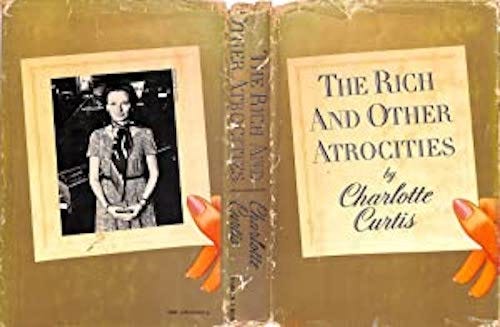
Yet those social and legal realities take nothing away from the moral courage, superb news judgment, and exceptional writing that lay at the heart of Curtis’ rise through the ranks at the Times. All of those qualities shine in The Rich and Other Atrocities, a collection of her best work for the paper, as does her fearlessness in the face of power.
A magazine asked Curtis, as she was preparing to become the op-ed editor, if she was frighted by the U.S. presidents.
“Why would it frighten me? Just as I’m not frighted by the city of New York, I’m not frightened by presidents of the United States, either.”
Partial list of sources:
Greenwald, Marilyn S. A Woman of the Times: Journalism, Feminism, and the Career of Charlotte Curtis. Athens, Ohio: Ohio University Press, 1999.
Curtis, Charlotte. The Rich and Other Atrocities. New York: Harper & Row, 1976.
Julie Baumgold. “Charlotte, Star Reporter,” New York, Oct. 6, 1969.
Robert D. McFadden. “Charlotte Curtis, A Columnist For The Times, Is Dead at 58,” The New York Times, April 17, 1987.
“Papers of Charlotte Curtis, 1928–1987 (inclusive), 1950–1981 (bulk).” Schlesinger Library, Radcliffe Institute, Hollis Archives. https://hollisarchives.lib.harvard.edu/repositories/8/resources/9947
Want to read some of Curtis’ writing for the Times? I give 17 samples here: