
How good is Microsoft Azure Synapse Analytics?
Terminology and how to profit from the Data Warehouse Technology

With Azure Synapse Analytics, Microsoft provides the successor to Azure SQL Data Warehouse. With the new service, Microsoft wants to expand its modern Data Warehouse and Big Data strategy and enable companies to analyze their data more effectively and faster.
Benefits of Azure Synapse
So what are the advantages that Microsoft is advertising here?
Powerful Scaling to gain insights from all your data in Data Warehouses and Big Data analytics systems in the shortest possible time and apply machine learning models to your smart apps. Reduce project development time many times over with a unified interface for developing end-to-end analytics solutions. Eliminate data barriers and perform analytics on operational data and business app data without moving data with Azure Synapse Link while protect data with the most advanced security and privacy features on the market, such as column-level and row-level security and dynamic data masking [1].
Sounds promising at first, but it is not much more than what Google says about BigQuery and AWS says about Redshift.
Pricing
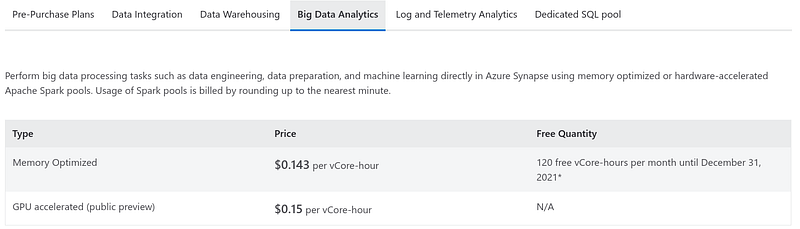
Microsoft charges $5 per TB of data processed here, which is roughly in line with the other major cloud providers as well. In addition, of course, you have to calculate the costs for storage and data integration.
Show Case
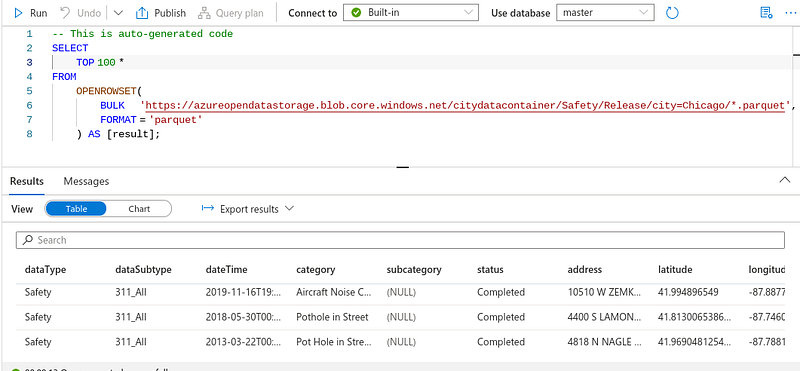
The first thing that might surprise users of other solutions, such as Google’s BigQuery, is that we have to set up Azure Synapse and add it to a resource group, for example. We also need to add public datasets to our environment and set the firewall to allow us to fire queries with our own IP. Whether you like the fact that you have to configure it first or not is up to you — for me, it was definitely something different than the Google variant, where you can actually start writing SQL queries right away.
However, this is also done quickly and now we can also see here how quickly Synapse analyzes large amounts of data:
Summary
As a long-time user of the Google Cloud, I have to say that the Azure Cloud does indeed show certain similarities here. With the Azure Synapse service, Microsoft offers a Data Warehouse solution that can keep up with BigQuery or AWS Redshift. The handling is equally simple, prices are similar and I was also satisfied with the performance of the queries. For long-time Microsoft customers, the Azure Cloud offers a really powerful cloud Data Warehouse. Due to the simple handling and scaling options, there are of course some advantages compared to an on premise solution.
Which cloud solution is better, I do not dare to say, I think anyway that this is more dependent on how your previous IT infrastructure is built. Previous Microsoft customers may have the better solution with Azure, while Google cloud users and companies who want to go to the cloud may score with Google and its easy-to-use mentality.
Sources and Further Readings
[1] Azure, Azure Synapse Analytics (2021)