How Good Are Your Buckets?
It’s not how much you make that counts, it’s how much you keep

In this article, I explored the meaning of financial independence.
According to Wikipedia, financial independence is the status of having enough income to pay one’s living expenses for the rest of one’s life without having to be employed or dependent on others.
In order to accumulate sufficient funds to take care of your living expenses for the rest of your life, you have to generate income today by working or by running a business.
You then take those funds, and save and invest in “buckets” that will compound the growth to build up sufficient funds that will allow you to achieve financial independence.
So, what are these buckets?
These buckets are the different tools and vehicles we use to save and invest for retirement. These vehicles, if used correctly, will allow for the compounding and growth of your hard-earned resources so you can achieve your dream of financial independence in the future.
Many people work so hard for several years. They follow the advice of their employers and their financial advisors. And they think they have been saving and investing in retirement buckets that look like this:

Unfortunately, this is, in fact, not the case.
The majority of Canadians have been saving for retirement using Registered Retirement Savings Plan (RRSP), Company-sponsored Registered Pension Plans (RPP), Tax-Free Savings Account (TFSA). Those in the U.S. have been saving for retirement using 401k, IRA, 403b. These vehicles mostly invest in mutual funds, index funds, stocks, bonds, and other money market instruments.
Unknowingly to most of these working-class professionals is that these retirement buckets they have been saving and investing in, actually look and behave a lot more like this bucket:

How much of your retirement money do you suspect has already “leaked” out of your buckets over the years?
Do you have any idea how much money is leaking out of your retirement bucket right now?
Do you know what/who is responsible for the holes in your bucket?
Do you know what steps you can take to plug the holes in your existing bucket, or how you can upgrade to a better bucket?
These are important questions that must be answered if you really want to secure your financial freedom.
We’ve all heard stories of retirees who worked so hard for 20, 30, 40 years dedicating their talents and life to a particular corporation only to retire half a million dollars short, $400,000 short, or $300,000 short, because of these holes in their buckets.
Painfully, these retirees will now have to work longer — another 3, 4, 5 years or more, often at jobs that don’t fulfill them in order to make up for the shortfall.
These holes in your retirement buckets represent:
- Disclosed and hidden fees on your investments, including the high mutual funds' fees
- Avoidable taxes paid on your investment earnings
- Losses from market volatility
- Inefficient use of these vehicles due to improper planning that is not tax-efficient
- Lack of financial knowledge on the part of the individual investor
Without question, the number one concern among people in retirement, and those approaching retirement, is the fear of running out of money. So, it is, therefore, critical to ensure that you eliminate the holes in your bucket.
And this is why…
Every dollar that leaks out of your bucket is one less dollar you can spend today, or one less dollar growing for a future use.
We often focus on making more money so we can add more money to our retirement bucket. However, we fail to understand that making new money often involves taking some element of risk. Instead, if you take steps to keep more of the money you already have, you can achieve a great outcome 100% of the time when you take the right action.
It’s Not How Much You Make That Counts, It’s How Much You Keep
So, how do you plug some or all of these holes?
Here are a few quick suggestions:
- Invest in your financial education so you can ask intelligent questions of your financial advisors and be a part of your investment management team.
- Review your statements, call your investment advisors and your banks to find out exactly how much fees you’re paying. Then look for alternative investments with lower fees to invest in.
- Consider managing a portion or all of your investments to avoid or minimize investment management fees.
- Consider better vehicles that provide tax advantages, such as real estate, business, and tax-exempt life insurance.
Final Thoughts
Your journey to financial freedom or a life of great retirement doesn’t have to be complicated or confusing. But you wonder why investing and planning for retirement can be so hard to understand.
It’s because the odds are stacked against you.
The multitrillion-dollar financial institutions and mutual funds industries that profit from “helping” you save for retirement have unfortunately made this seem more complex so you can remain dependent on them and their advisors.
The more complex and confusing managing your money is, or at least as it appears to be, the more likely you are to hire a “trained professional” to manage your money for you.
The more complicated or confusing something is, the less likely you are to understand what is actually going on. As a result, you limit your ability to ask the important tough questions regarding what’s being done with your money.
Therefore, it has never been more urgent to arm yourself with the financial knowledge you require to challenge this massive financial industry and protect yourself from these leaks that are making your journey to financial freedom harder than it should be.
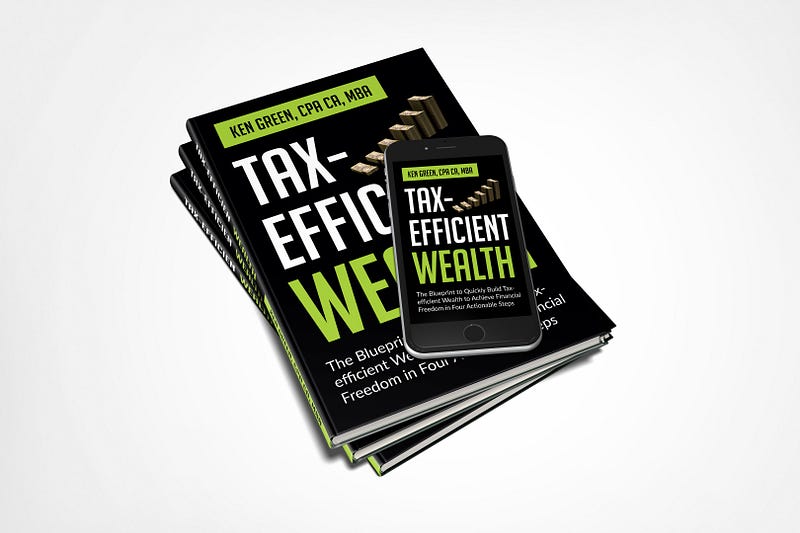
P.S. I am on a mission to arm you with financial education. That’s one reason I started writing on medium and that’s why I wrote Tax-Efficient Wealth. This book will help you accelerate your wealth in a tax-efficient way. Grab a FREE eBook version of my new book, Tax-Efficient Wealth, to learn how you can build wealth quickly using strategies that will save you a ton in taxes.