
#History #Finland #Language
How Finnish Rose From the Language of Peasants to That of the Nation
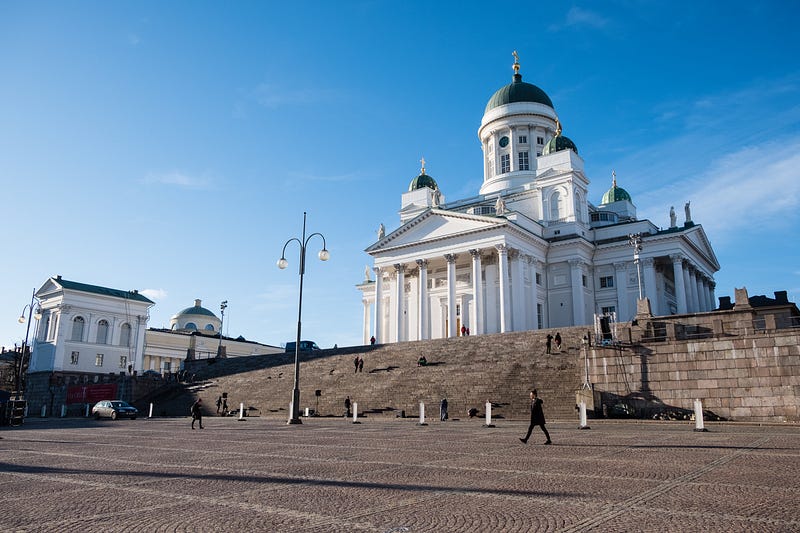
Finnish nationalism was still in its infancy during the first decade of the nineteenth century.
When the Finnish War between Sweden and Russia ended in 1809, Finland was annexed to the Russian Empire after over six centuries of Swedish rule.
The Tsarist authorities of Russia made Finland a grand duchy within the empire, and granted autonomy to the new conquest too. They did not change the Swedish governance system and laws.
Moreover, Swedish continued to be the language of administration in the grand duchy.
It was during the Russian period when the idea of a distinct national identity began to take hold in Finland.
Part of the reason was the dominance of Swedish language in cultural and political arenas despite official separation from Sweden.
The two-language dilemma
A range of social, political and economic reforms resulted in a vigorous atmosphere in the grand duchy during the second half of the nineteenth century. This helped strengthen the idea of a common national identity in the society.
However, the process of building such an identity involved a conundrum.
Both Finnish and Swedish were used in the grand duchy, and a dispute emerged over choosing the language to be used in nation-building.
It was a major strife between two groups — one advocating Finnish, and the other Swedish.
Finland thus saw the rise of two nationalist movements around the question of language — Finnish language nationalism and Swedish language nationalism.
Fennoman movement
The Finnish language nationalism was known as the Fennoman movement.
It aimed to increase the use of Finnish in order to make it the predominant language at all levels of the society.
Moreover, it insisted on the Hegelian concept of building a united nation around the language used by the majority people.
Even though Fennoman movement advocated the use of Finnish, it was actually led by the Swedish-speaking upper class. Their idea of national awakening was focused on the extensive promotion of Finnish language and culture.
As part of the movement, they not only learned Finnish but also Finnicised their names. They deliberately chose to use Finnish both at home and outside.
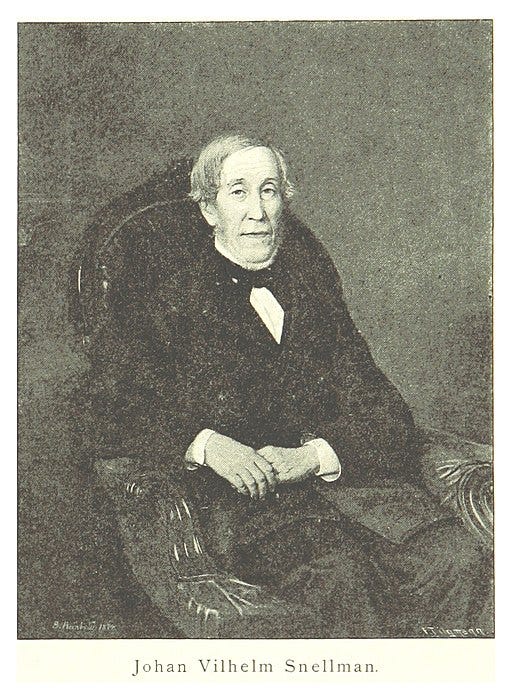
Fennoman supporters made great efforts to establish Finnish as the language of poetry and literature.
Johan Vilhelm Snellman was the key figure of the Fennoman movement. He was a philosopher, politician and journalist who played a substantial role in elevating the status of Finnish language.
It was Snellman who reiterated the importance of written Finnish literature to establish national consciousness.
In 1835, Kalevala, authored by Elias Lönnrot, a country physician in eastern Finland, was published. It was an epic poem of nearly 23,000 lines containing Finnish folk poetry.
Kalevala marked a major milestone in the Fennoman movement, and later went on to become Finland’s national epic.
Svecoman movement
As the Fennoman movement continued to rise in popularity and strength, there was another group of Swedish-speaking elites who initiated a countermovement. This pro-Swedish movement was called the Svecoman movement.
Its supporters vehemently opposed Fennoman-based reforms. They argued that the growing popularity of Finnish was threatening the traditional dominance of Swedish.
They also emphasised that it was only Swedish language and culture that would guarantee Finland’s status as a Western nation.
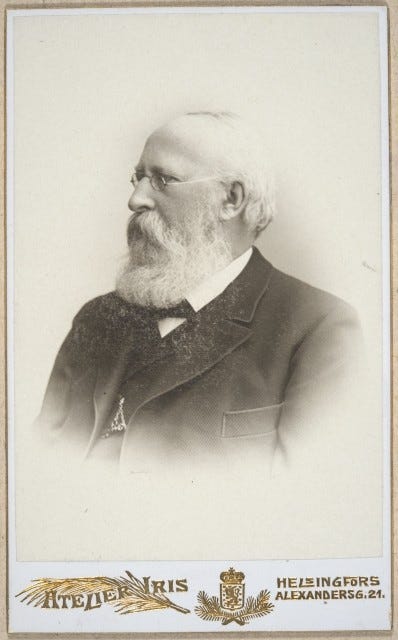
They even linked Fennoman with possible Russification.
The Svecoman movement was influenced by Pan-Scandinavianism, a movement that surfaced in the 1850s, and called for cultural and political unities across Scandinavian nations.
In line with Pan-Scandinavianism objectives, the Svecoman movement even dreamed of Finland’s reunification with Sweden during the Crimean War. Pan-Scandinavianism failed eventually.
Philologist Axel Olof Freudenthal led the Svecoman movement. He developed a theory that mentioned a separate Swedish nationality in Finland based on the Swedish language.
He opined that it was the duty of the upper class to uphold the use of Swedish in order to preserve the Swedish heritage of Finland.
Freudenthal’s theory also combined language, nationality and race together. It went so far as to even claim that Swedes had racial superiority over Finns.
The Svecoman movement gradually garnered support of the Swedish-speaking communities in the society. But not every supporter wholly agreed on Freudenthal’s extreme theory of two separate nationalities based on language.
Equality comes, finally
The growing language conflict continued until the beginning of the twentieth century. But the language decree issued by Tsar Alexander II in 1863 had a far-reaching impact on it.
The decree stated that Finnish was to have a legal and official status equal to that of Swedish within 20 years.
Swedish speakers moved to thwart the full implementation of the decree while there was also bureaucratic and judicial resistance to increasing the use of Finnish.
Despite all opposition, however, the grand duchy witnessed the growth of widespread use of Finnish.
There were even fundraising efforts in the early 1870s to support private Finnish language education as an alternative to attending Swedish schools.
An educated class of Finnish speakers thus gradually emerged who took Finnish nationalism to far greater heights.
In June 1902, Emperor Nicholas II decreed that Finnish would be an official language alongside Swedish across Finland.
The decree also reduced the administration’s freedom of choice of language for carrying out official tasks.
It was this decree that eventually ended the bilingual nationalism conflict. For Fennoman supporters, it was a big accomplishment.
Thus Finnish, once considered a language of peasants, became the main language of the Grand Duchy of Finland.


