

How far can 250 days of Duolingo get you?
Can you really learn to speak a language with just 10–15 minutes of Duolingo?
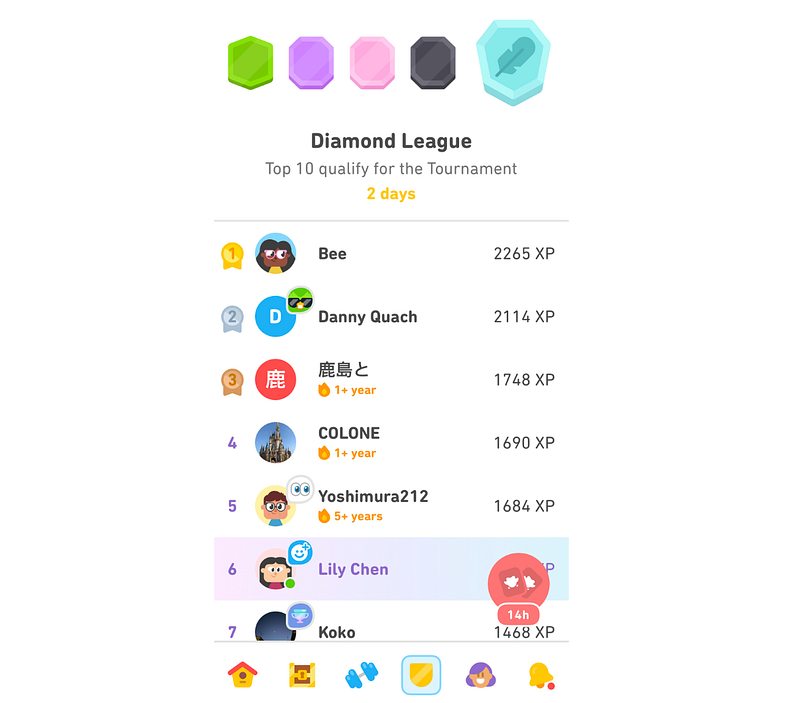
I’ve been using Duolingo to learn German for 8 months now. On most days, I do about 10–15 minutes per day. I rarely go below 5 minutes, and on rare occasions, I practice about an hour. This is usually when I’m feeling extra motivated to hit the next league, particularly the highest, Diamond league.
So, how well can you learn a language with Duolingo?
If you want a TLDR, let’s just say you’d have no problem setting up a date on Bumble after 250 days on Duolingo. It is definitely enough to get past most introductions and ice breakers. To make any meaningful connection on said date however, will be more challenging. If you want more details, read on!
The rest of this article is divided into 4 parts:
- My linguistic background and how it helps with learning German.
- How much content can you get through in 250 days.
- What that content translates to in terms of written skill.
- What that content translates to in terms of conversational skill.
My linguistic background and how it helps with learning German
I already knew 3 languages prior to learning German: English, French, and Chinese. I also studied Latin for 3 years in high school many many many years ago.
Even though I did not know any German prior to this journey, I’m not starting from square zero. Sure, my knowledge of Chinese is useless when it comes to learning German. However, German has a lot of overlapping words with English. Like French, German has complicated verbal conjugations and gender for nouns. Though I think German grammar is even more complicated than French, it is about equivalent to Latin. Having learned Latin in school, the complexity of German grammar rules was less of a mind f*ck.
Both German and Latin have masculine, feminine, and neuter genders for nouns, while French only has masculine and feminine. Both German and Latin have different word endings depending on the relationship of these words to the rest of the sentence. For example, the ending of an adjective or possessive pronoun would differ depending on the gender of the noun it is referring to. Take a look at the example below:
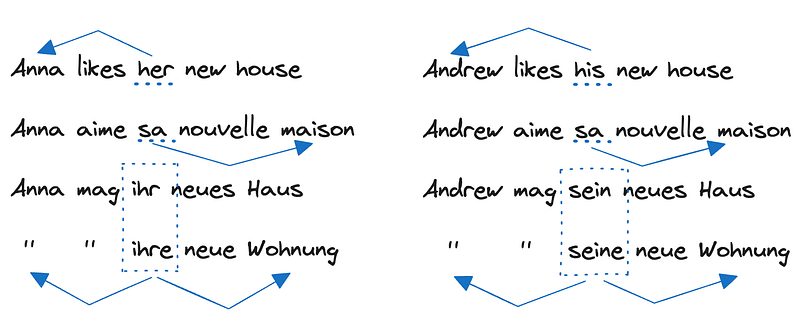
In the last sentence, “Wohnung” means “apartment” and is feminine. “Haus” on the other hand, is neuter. Notice how the ending of both the possessive pronoun and the adjective “new” changed depending on the object’s gender.
In English, the possessive pronoun’s form is affected by the gender of the person that the object belongs to (i.e. the subject). Since Anna’s a girl, we say “her house.” In French, the possessive pronoun’s form is affected by the gender of the object itself. Even though Andrew is a boy, we say “sa maison.” Sa is the feminine possessive pronoun form.
In German, the possessive pronoun’s form (ihr/ihre/sein/seine in the example above) is affected by both the gender of the subject and the object. That’s not even it! Additionally, the form of possessive pronouns is also affected by the case (direct object vs. indirect object).

So yes, German is complex. However, because of my linguistic background, it wasn’t too difficult to come to terms with these complexities. I imagine it’d be a lot harder for someone who does not speak English and French to learn German.
With that said, let’s look at how far I’ve come!
How much content can you get through?
From a pure content perspective, 250 days at roughly 10 — 15 minutes per day can bring you to about halfway through the A2 language level.
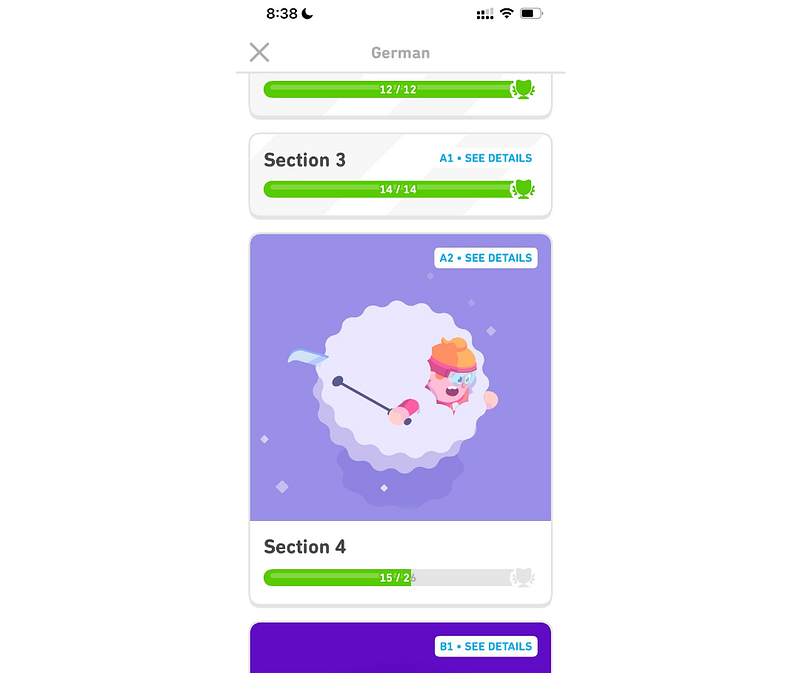
Note: how far you can get after 250 days also depends on whether you skip lessons or not. Sometimes, when I’m bored with an unit, I skip the remainder of the unit by taking a test.
Duolingo lessons are divided into sections. Each section corresponds to a language level.
These levels are CERF levels, an international standard for language proficiency. CERF levels are A1 (Beginner), A2 (Elementary), B1 (Intermediate), B2 (Upper Intermediate), C1 (Advanced), and C2 (Proficient).
The highest level that Duolingo German goes is B1. At the B1 level, people can understand the main ideas of everyday conversations and written texts about familiar topics like work, school, or hobbies, and can handle most situations they might encounter while traveling in a place where the language is spoken.
I do think this is fair, and about as far as an app can get you. To go beyond this level, you really need to be immersed in a German-speaking area and actually practice with native German speakers.
I’d say my French is at a solid B1 level, and I can tell you for sure that halfway through A2 on Duolingo, my German is NOT NEARLY as good as my French.
According to CERF, at the A2 level, individuals can understand simple sentences related to familiar topics such as personal information, shopping, or daily routines, and can communicate in basic everyday situations using simple phrases.
So, let’s see what that translates to in terms of written and conversational skills in practice.
How good can your written skills get?
Duolingo does not let you put your learnings to the test. To see how well I can have basic conversations with people, I downloaded HelloTalk and used that app to chat with native German speakers.
There are a couple features I really like about HelloTalk — the “Translate” and “Correction” features.
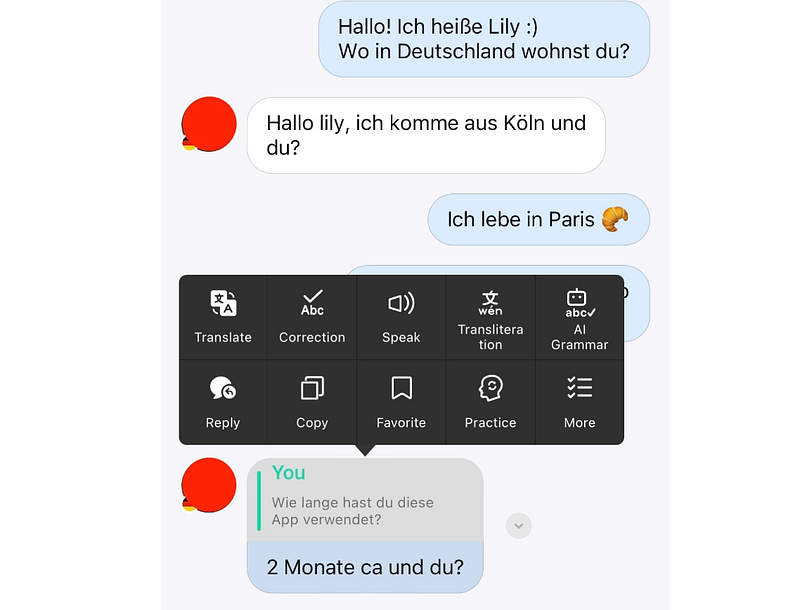
Protip: though the free feature has a limited number of free translations per day, Google Translate is free. I very quickly learned that texting with native speakers is a great way to expand my vocabulary. I’ve learned so many new words in an organic manner this way.
I also really like when my virtual pals use the “Correction” feature to correct my errors.
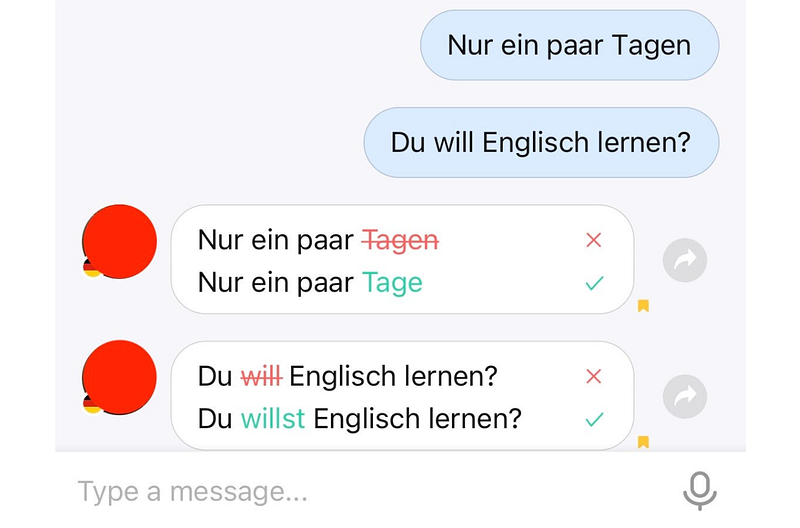
As a reminder, the A2 level is described as: individuals can understand simple sentences related to familiar topics such as personal information, shopping, or daily routines, and can communicate in basic everyday situations using simple phrases.
I’d say this is a fair assessment of my ability to communicate via text. I rarely have problems with introductions and ice breakers when talking to people on HelloTalk. So, if HelloTalk were Bumble, you’d have no problem setting up a date after 250 days on Duolingo.
Things get challenging past the initial “where do you live,” “what do you like to do,” etc. For more complicated messages, I would need additional help from Google Translate.
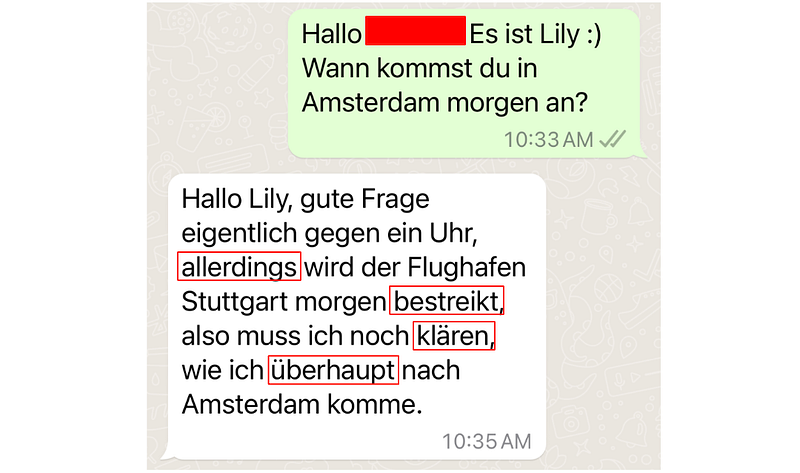
For example, I asked a work colleague when he’ll arrive in Amsterdam for a conference. I marked the words I haven’t yet learned in red rectangles. These words made it impossible to understand the meaning of the sentence as a whole. I’d say it’ll probably take someone with a high A2 or low B1 level to understand that message. Translated to English, it means:
“Hello Lily, good question actually around one o’clock, but Stuttgart airport is on strike tomorrow, so I still have to figure out how I can get to Amsterdam.”
250 days of Duolingo is not enough for that.
How good can your conversational skill get?
To test my conversational skill, I asked a couple German colleagues on my team to have conversations with me in German. We chatted for about 10 to 15 minutes on various topics such as:
- Weekend plans
- Latest vacation
- Family and children
- Why Frankfurt is not a great city
After those conversations, I’d still say that A2 is a fair assessment of my communication skill in one-on-one conversations. We were able to talk about these various topics at a basic level. 250 is definitely not enough for in-depth discussions, and therefore definitely not enough to make real meaningful connections. My colleagues did say my pronunciation was fairly good, so at least we can trust Duolingo on that!
Overall, I am quite impressed with Duolingo. Even though it’s a very controlled environment without organic learning opportunities, it does get you far enough that you can indeed have conversations in that language. I’m excited to get through the entire German lesson, and see how far that takes me!