
How Failures in Modern Police Training Are Causing Chaos on the Streets
From a former officer.
Policing in the UK is in crisis. Rocked by one scandal after another. The problem goes back to training school. What do we learn there? What do we expect from our police officers? Can one person switch temperament as the role of an officer demands?
One minute you are comforting the relative of someone killed in a horrific accident. Then you might have to help wash away the blood; then it’s off to a fight in a bar or a dispute about a fence. What’s it like to experience such emotional highs and lows in such short periods?
Let’s look at police training and see how it’s failing our officers.
The use of force.
The big one. The most definitive example of mixed messages sent to our police officers.
Most cops here are unarmed. We are given a can of CS incapacitant spray, an extendable baton, and a pair of handcuffs. If you’re fortunate now, you get a Tazer.
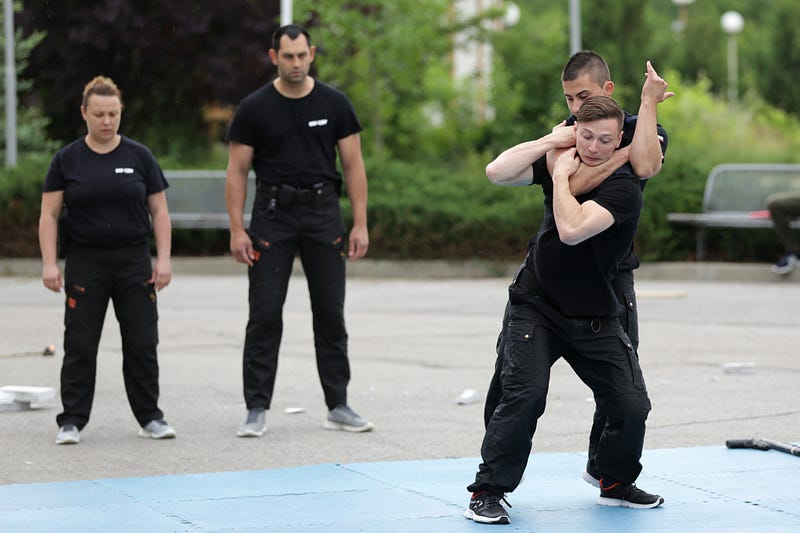
We get a few sessions of training in these, as well as hand-to-hand techniques. These hand-to-hand techniques are useless. They revolve around “holds” and wrist locks.
Take a 5ft female officer and try getting her to put a 6ft violent criminal in a wrist lock. It’s a joke. The law says we can use reasonable force to defend ourselves, like any member of the public. Reasonable force can include killing someone if appropriate.
Yet police are dissuaded from so much as punching a suspect and aren’t even taught how to do so.
I’ve seen an officer being knocked unconscious (on CCTV) while his colleague runs around him like a headless chicken trying to push the suspect off and put him in an armlock.
If I were being beaten into oblivion, I would hope my colleague would punch, kick, and bite through my attacker.
So suspects know they have very little to fear from the police. It’s the only job where, in a fight, you have to worry about the welfare of the person attacking you.
Yet some sectors of the public are forever shouting about Police brutality. Of course, there are clear examples of this. But in my career, I rarely saw it. More common was the sight of a policeman having his entire family threatened with rape and murder by a suspect, yet never taking the bait.
Also more common was a fat, inept officer unable to subdue a violent offender.
Because let’s not forget, as much as we “police by consent” in this country, it’s not the criminals doing the consenting. When someone is needed to deal with the worst of the worst — the most dangerous, violent people, it’s the police that are called. We aren’t dealing with boy scouts here.
So do we want an aggressive, physically capable, and brave police force? Would you prefer a softer, social worker-style service? Or do you like what we have now? A weird mix that does neither extreme very well and tries to appease everyone.
2. Training on racism and sexism vs. crime.
When I was at training school, we spent 6 WEEKS talking about racism, sexism, and unconscious bias. This was back in the early 2000s, and I never saw any evidence of racism in my career. Yet to this day, the police are still labeled institutionally racist. How much more can we train in that area?
At the same time, we spent one morning covering the definition of burglary, how it could be aggravated, and the difference between burglary and robbery.
Out of a 15-week course, the majority of the time was not spent covering crime or anything the public expects of their police.
Instead, we churn out politically correct drones who still aren’t good enough for the perpetually offended.
It was over 20 years ago, after the murder of Stephen Lawrence, that the police were labeled institutionally racist. Now we bend over backward, train in equality, and still carry the same label.
So again, do you want this kind of ineffective training where officers have to look up their notes to decide if a burglary has occurred, but they know the top 15 ways to avoid offending a person of color, yet still the person of color labels them racist anyway?
3. Inadequate training on mental health and crisis intervention.
Between 20 and 40 percent of police time is spent dealing with people suffering from mental health issues. Many officers go into policing thinking they will spend most of their time chasing down burglars and tackling robbers.
It’s not like that at all. Most services that deal with mental health are closed at night. That means all the professionals who have trained for years to deal with mental health crises are in bed at nighttime when most mental health crises occur.
So when a person threatens to jump off a high-rise building or kill their family in a Psychotic rage in the dead of night, it falls to the police to respond.
In my training, I had a brief overview of mental health problems and unrelated training on how to defuse tense situations. But that was it. I had to learn as I went along.
Thankfully, I had prior training in talking with suicidal people and qualifications in counseling. So on the numerous occasions I was called to the top of a multi-story parking lot to try and stop someone from killing themselves, I had an idea of what to do. No one jumped after talking to me.
But it shouldn’t be a lottery when you call the police. We should all be trained to the same standard.
And if you don’t train the police properly, at least make the other professionals, such as social workers, psychiatrists, and doctors, work shifts where they can respond to these scenarios.
4. Poor communication and conflict resolution skills.
In fairness, we spend some time in training covering how to talk to people and resolve conflicts without violence. But policing is still a macho world, and outside of training, the rank and file still think they are above everyone else and that they can talk to people how they like because their uniform will protect them.
When the uniform fails to protect them, they end up in the ridiculous physical scenarios I described earlier because they don’t know how to fight. It’s terrible for all concerned.
I remember three of us had to go into a boxing gym to give someone a harassment warning for bothering his ex-girlfriend. We could see the gym was busy, and it was safe to assume everyone there was a trained fighter and they would stick together.
So we planned to go in there respectfully, take the suspect to one side so as not to embarrass him, be polite, and leave.
My colleague had other ideas. He stormed in, demanded to see the suspect, and took him outside in full view of everyone else, who promptly followed us and laid down the law in front of the whole gym.
He aggravated the suspect, who turned aggressive, and at one stage, I thought the whole gym would attack us. Thankfully, two of us still had brains, and we managed to smooth it over.
Again, you call the police, and it’s a lottery as to the quality of service you get.
5. Limited focus on community policing.
The UK police chiefs have a love affair with “community policing.” We used to have a tv show called “Dixon of Dock Green,” where the village Constable would cycle around and help old ladies cross the road.
It’s a great concept. Give each area some local police who the townsfolk can get to know, and they will be the eyes and ears of the community.
We don’t have enough police to do this AND respond to emergencies. The village Constable on his push bike is a relic from a bygone age and doesn’t reflect the volume and danger of the calls facing officers today.
But the Chiefs are loathed to give up this daydream. So when I was an officer in a busy city, 75% of us were taken from responding to emergencies and put on these community policing teams.
It failed miserably. Within weeks, all the community policing teams were unofficially dealing with emergencies again, but now we were splintered into different groups with different line managers.
It was complete chaos and failed on both sides — all because chiefs with rose-colored glasses get misty-eyed about the good old days and can’t let old-fashioned concepts die.
Conclusion.
Becoming a police officer today is a sign of madness. Respected by few and hated by almost everyone, you’re torn in so many directions that you couldn’t explain your actual remit if you were asked.
You spend the most time on the things you are trained in the least, and the conflicting messages about the use of force are so bad that you’ll hesitate at the wrong time, and that hesitation could get you killed.
Maybe my friends overseas have a different experience, but my advice for people considering joining the police in the UK is to think long and hard about what you’re planning to do and then don’t do it.
Get a job that makes more sense — like a Tarot card reader.
Click here to join my Substack community, where we focus on all things related to mental health.