avatarDividendHorizon

Free AI web copilot to create summaries, insights and extended knowledge, download it at here

1943

Abstract

6">It has been proven that the Universe is in continuous expansion, and thus, it is possible to figure out that there is one point where the movement started from. It is even possible to calculate <b>when</b> the movement started, and that event is known as Big Bang.</p><p id="e2fd">An interesting fact brought by the author is that in that singularity general relativity does not apply any longer as do the known laws of physics.</p><p id="52e6">Asking what before Big Bang is a senseless question since there was <b>no time</b> before Big Bang. It is like asking what is further south of the South Pole. The question simply makes no sense.</p><h1 id="b637">The different Universes</h1><figure id="e5f5"><img src="https://cdn-images-1.readmedium.com/v2/resize:fit:800/1*4m-oXJrKwtcdFVLPBVMtnA.jpeg"><figcaption>Picture by <a href="https://www.canva.com/p/sciencephotolibrary/">Science Photo Library</a> on <a href="https://www.canva.com/">Canva</a></figcaption></figure><p id="3bf8">Stephen introduces the term “imaginary time” which leads to the theory of a “limitless universe”. If the theory holds, that means the Universe has no limits in the imaginary time, thus it has more than a single history.</p><p id="0458">From the infinite multitude of Universes, we could scrap the great majority of them right away, because they would not converge to a sustainable state, i.e. they would not lead to the formation of stars and galaxies. We do not care about void Universes. We exclusively care about those who had the ability to develop intelligent life.</p><p id="c094">It was not absolutely necessary that intelligent life takes a human shape. The Green Creatures could have done it even better, as humans do not have a reputation for intelligent behavior.</p><h1 id="07fc">Multiple Dimensions</h1><figure id="022b"><img src="https://cdn-images-1.readmedium.com/v2/resize:fit:800/1*x2z-BbMR6-wNvBanQjQ3rQ.jpeg"><figcaption>Picture by <a hre

Options

f="https://www.canva.com/p/gettyimages/">agsandrew</a> on <a href="https://www.canva.com/">Canva</a></figcaption></figure><p id="f368">It is clear to everybody that we live in a 3-dimensional space. We can specify the exact position of any object by giving 3 coordinates. However, the natural question is why three. Why not two or why not four?</p><p id="fd49">The answer is very pragmatic.</p><p id="2963">Imagine any daily physical process and how it would occur in two dimensions. It would be quite difficult to digger your food if your stomach would be bidimensional. The same with everything else. No animal could survive in two-dimensional existence.</p><p id="d33e">In fact, there are supposed to be 11 dimensions (including time), but the others are “curled up”. Just imagine a drinking straw. It has a very small circular dimension. Only the three dimensions are manifesting themselves at the macroscopic scale, and we can experience them.</p><p id="6001">Now, why not eight dimensions?!</p><p id="51aa">The pragmatic answer comes in form of gravity. The attraction between two objects is proportional to the square of the distance, i.e. if we double the distance between two planets, the gravitational attraction between them decreases by a factor of four.</p><p id="c4a3">If there were 4 macroscopic dimensions, then the gravitational force would be proportional to the cubic power of the distance, i.e. doubling the distance would result in an eight times reduction of the attraction force.</p><p id="2d5c">That would mean <b>no Sun would hold its planets, no atom would hold its electrons, and no writer would hold his followers!</b></p><p id="734f">Hope you enjoyed! Follow to see my other takeaways from the “<a href="https://amzn.to/3wUSIEP"><b>Brief Answers to the Big Questions</b></a>” book, or the following books that I will share with you.</p><p id="0971">Keep your curiosity up!</p><p id="e443">Alex</p></article></body>

How everything began? —

My second takeaway from “Brief Answers to the Big Questions” by Stephen Hawking

O God, I could be bounded in a nut shell and count myself a king of infinite space. — Hamlet
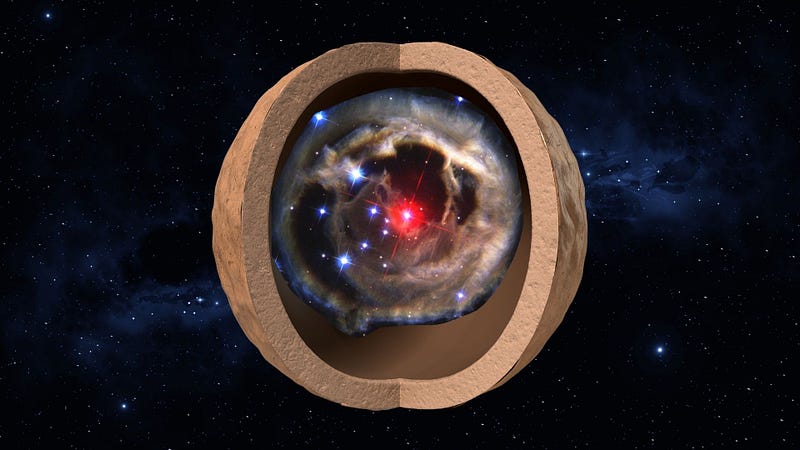
composed by the author using Canva

That’s how the second chapter begins. We could be trapped in our physical environment, but nothing stops our imagination to travel all over the universe just in a matter of seconds.

If you missed the first part, you can check it here:

Is there God?

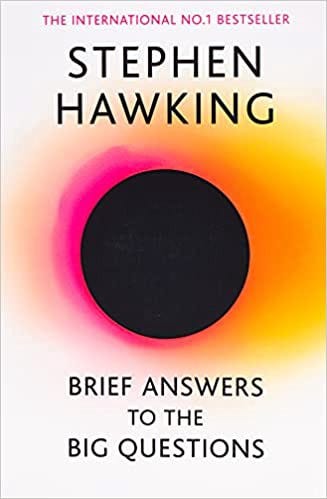
If you have not read the book, I highly recommend doing that. “Brief Answers to the Big Questions” is an addictive lecture that drags you into a world of philosophical and scientific arguments to the major question we might have as humankind.
Was there a beginning at all?

In is “programmed” in our minds that everything shall have a beginning, everything is subject to the cause-effect relation, but that might not be obviously applicable to the Universe. There were theories suggesting that the world existed since ever, i.e. there was no beginning.

Well, Stephen does not agree with that theory as he does not agree with the Static Universe model. Indeed, he uses the Dynamic Universe argument to prove that there was a beginning.

It has been proven that the Universe is in continuous expansion, and thus, it is possible to figure out that there is one point where the movement started from. It is even possible to calculate when the movement started, and that event is known as Big Bang.

An interesting fact brought by the author is that in that singularity general relativity does not apply any longer as do the known laws of physics.

Asking what before Big Bang is a senseless question since there was no time before Big Bang. It is like asking what is further south of the South Pole. The question simply makes no sense.

The different Universes
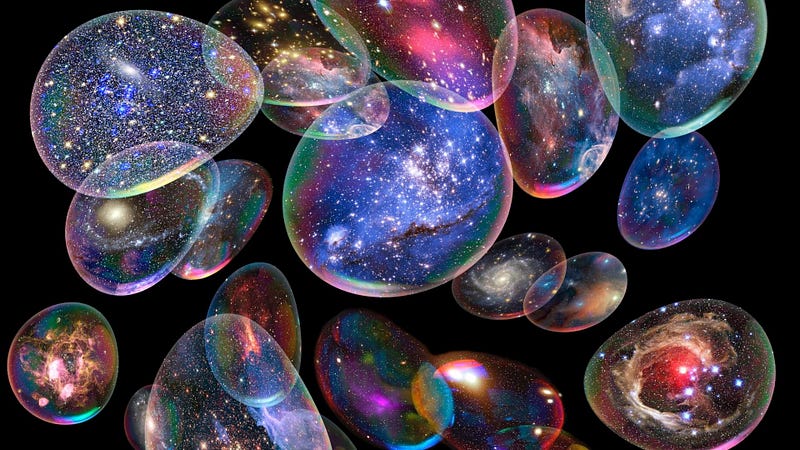
Picture by Science Photo Library on Canva

Stephen introduces the term “imaginary time” which leads to the theory of a “limitless universe”. If the theory holds, that means the Universe has no limits in the imaginary time, thus it has more than a single history.

From the infinite multitude of Universes, we could scrap the great majority of them right away, because they would not converge to a sustainable state, i.e. they would not lead to the formation of stars and galaxies. We do not care about void Universes. We exclusively care about those who had the ability to develop intelligent life.

It was not absolutely necessary that intelligent life takes a human shape. The Green Creatures could have done it even better, as humans do not have a reputation for intelligent behavior.

Multiple Dimensions

Picture by agsandrew on Canva

It is clear to everybody that we live in a 3-dimensional space. We can specify the exact position of any object by giving 3 coordinates. However, the natural question is why three. Why not two or why not four?

The answer is very pragmatic.

Imagine any daily physical process and how it would occur in two dimensions. It would be quite difficult to digger your food if your stomach would be bidimensional. The same with everything else. No animal could survive in two-dimensional existence.

In fact, there are supposed to be 11 dimensions (including time), but the others are “curled up”. Just imagine a drinking straw. It has a very small circular dimension. Only the three dimensions are manifesting themselves at the macroscopic scale, and we can experience them.

Now, why not eight dimensions?!

The pragmatic answer comes in form of gravity. The attraction between two objects is proportional to the square of the distance, i.e. if we double the distance between two planets, the gravitational attraction between them decreases by a factor of four.

If there were 4 macroscopic dimensions, then the gravitational force would be proportional to the cubic power of the distance, i.e. doubling the distance would result in an eight times reduction of the attraction force.

That would mean no Sun would hold its planets, no atom would hold its electrons, and no writer would hold his followers!

Hope you enjoyed! Follow to see my other takeaways from the “Brief Answers to the Big Questions” book, or the following books that I will share with you.

Keep your curiosity up!

Alex

Universe
Space
Science
Physics
Books
Recommended from ReadMedium