
How Editors (Instantly) Spot A Fake “Best-Selling” Writer
4 sins world-class writers just don’t commit
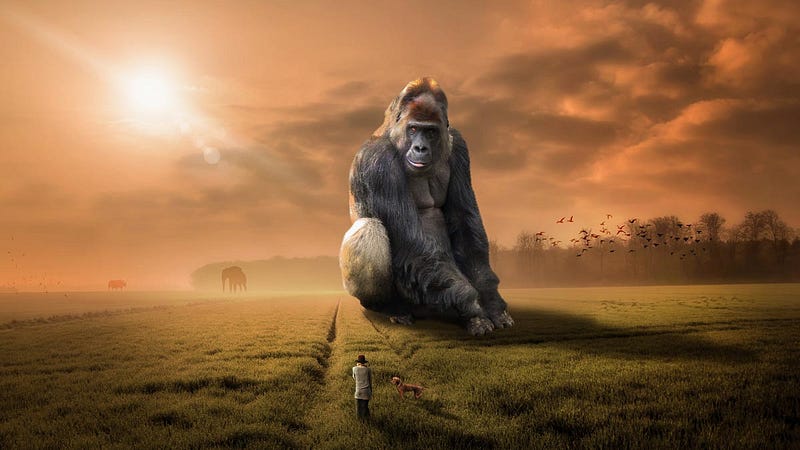
As an editor, I wake up to an inbox filled with emails of writers trying to tell me why they’re the next “paradigm-shifting” giant gorilla. I know what the rare giant gorilla looks like.
Influential from the outside yet gentle from within.
I’ve seen it all, from the postgrad baby monkey still sucking onto his Harvard student email to the novelist chimpanzee who (conveniently) pasted a 66,523-word novel in a plain text email.
That’s just not how world-class writers think. They extol their creative virtues in a down-to-earth yet self-critical way.
1. They don’t tell
Instead, they show you what delicacies you’re missing out on.
Most writers just don’t show enough visual experiences. They’re writing from their imaginations. They’re making it up as they go along prattling about their topics.
Most people write what you could call reporting. The writing is telling the reader something instead of showing it to them.
World-class writers obsess not on how to tell their stories.
Instead, they obsess about their imagery. They immerse themselves in thinking about how they can make their readers dive into an imaginary reality triggering just the right emotions at just the right time.
It gets so refined that when we read these artful images, we fall in love with the writing. It grabs our interest and we want to keep reading — to the point we probably forget about the actual topic we were interested in reading about, to begin with.
2. They don’t waste time
Instead, they make it as easy as possible for the reader to get their point.
World-class writers get straight to business. They understand readers came to their article for a reason. They bring out the mighty gorilla’s roar right away.
As authors, Chip and Dan Heath put it in Made To Stick, share the core. World-class writers know this, they think like good newspapers. They put essential ideas first and complementary ideas last — even if it provides context.
In fact, they advertise them with headings.
Most writers hide valuable bits like easter eggs because they are scared the reader will quickly find the juicy bit and move on.
World-class writers don’t care if some readers will move on because at least these readers will leave with some value and a good user experience.
The unlucky deserters will anyway probably come back for more soon.
3. They don’t write the obvious angle
Instead, they look from the most obscure perspectives.
The best writing angles are the ones you don’t expect. They reel you in until you’re right on the edge of a cliff you didn’t even know existed.
Most writers will give the general street view perspective of what they're trying to say. And most readers ignore the typical perspective simply because it is the way our primal brains are wired.
But why is it that humans remember certain events in their life but not others? It’s because of an idea called the “sticky factor” or the notion of peculiarity as behavioral psychologists refer to it.
World-class writers know this. They exploit it.
They build an idea on the scaffolding of what the reader already knows, but then they disobey the reader’s anticipation. They add a touch of weirdness. They abandon the sinful general street view perspective. They also know some good writers will opt for the lifeless satellite view.
So instead, they show the hummingbird’s eye view. They not only show what’s going on inside the dull flower in front of them, but they take the reader on an escape through the unfamiliarly familiar street forest.
4. They don’t use clichés
Instead, they craft their own vivid analogies.
Cliches are like monkeys — they’re just everywhere. And the problem is most writers use clichés all the time, often without realizing it.
But the most creative world-class writers who want to make their writing stand out, chuck that monkey and show their readers something new and exciting. A giant gorilla.
A cliche is an idea or expression that has become overused to the point of losing its original meaning, even to the point of being trite or irritating, especially when at some earlier time it was considered meaningful or new.
World-class writers understand that the reader’s eye has become so accustomed to these ideas that it doesn’t make them feel something anymore. It goes back to the principle of peculiarity.
Familiar analogies are overrated.
World-class writers instead opt for the underrated dirt road to tap into a staff elevator pathway in the brain that engraves the emotions of their ideas into their readers’ hearts.
They far think beyond the page.
Whenever you read something that makes you feel a profound emotion and you cannot figure out why — beware, you’re most likely dealing with a world-class writer. The rare giant gorilla.