
How Dreams Die
The power of belief in not giving up on your dreams.
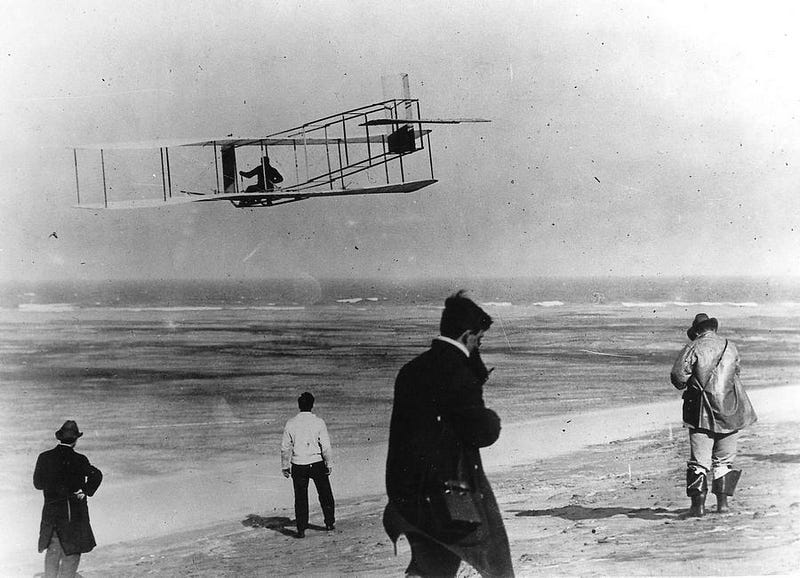
When Wilbur and Orville Wright’s flying machine — as the airplane was then called — took to the skies on a December afternoon in 1903, it was giant step on the journey to one of the world’s most significant inventions.
The invention of the airplane was one of the most important innovation of human history. It changed the world in every imaginable way.
To celebrate their accomplishment, the world offered a yawn and a shrug.
As Morgan Housel reported it,
“Only a few newspapers reported the Wright’s first flight at Kitty Hawk, N.C. All of them butchered the facts. Later flights in Dayton, Ohio, the brothers’ home, still drew little attention.”
David McCullough explains in his book The Wright Brothers:
“Have you heard what they’re up to out there?” people in town would say. “Oh, yes,” would be the usual answer, and the conversation would move on. Few took any interest in the matter or in the two brothers who were to become Dayton’s greatest heroes ever.
An exception was Luther Beard, managing editor of the Dayton Journal … “I used to chat with them in a friendly way and was always polite to them,” Beard would recall, “because I sort of felt sorry for them. They seemed like well-meaning, decent enough young men. Yet there they were, neglecting their business to waste their time day after day on that ridiculous flying machine.”
“It wasn’t until 1908 — five years after the first flight and two years after the brothers patented their flying machine — that the press paid serious attention and the world realized how amazing the Wrights’ invention was. Not until World War II, three decades later, did the significance of the airplane become appreciated.”
The Rocket Man
23 years after the Wright Brothers gave the world a life-altering invention, Dr. Robert Goddard knelt on the frozen ground in his Aunt Effie’s cabbage patch at Auburn, Massachusetts, and casually used a blowtorch to ignite the world’s first liquid-fuelled rocket.
Robert Goddard devoted a lifetime to working in the field of rocketry. And his groundbreaking understanding and invention altered the course of scientific and military history.
His fascination with the physical sciences turned into a determination. He told of his goal to bequeath the world an invention — a device that could reach the moon.
He performed various experiment and of his key discoveries was published in Popular Science in 1924, titled “How my speed rocket can propel itself in vacuum”. There he explained the physics and gave details of the vacuum experiments he had performed to prove the theory.
Nobody took him seriously.
In 1929, after one of Goddard’s experiments — in his determination to help build a rocket that could reach the moon, — the rocket went only 2000 feet before crashing down back to earth. And the following morning the local Worcester newspaper carried the mocking headline:
“Moon rocket misses target by 238,7991⁄2 miles!”
To Goddard’s ground-breaking accomplishment, both the scientific community and general public responded with heart-breaking derision.
In 1945, Goddard lost his battle with throat cancer, just at the dawn of the space age that he helped usher in.
American and German-émigré scientists continued to improve upon the Goddard-inspired V-2 rocket to create the Redstone rocket, which carried the first Americans into space.
Like the Wright Brothers, Goddard’s pioneering innovative work gained the recognition its deserved…eventually.
In 1959, NASA established the Goddard Space Flight Center in Greenbelt, Maryland. And when the United States sent the first men to the moon in 1969, the New York Times made amends for a mocking editorial that it had published about Goddard in 1920.
The Times wrote:
“Further investigation and experimentation have established that a rocket can function in a vacuum as well as in an atmosphere. The Times regrets the error.”
It was more than twenty years after his death, that the world finally acknowledged the work of Professor Goddard, the pioneering rocket scientist.
How Dreams Die
The point of telling you this stories isn’t to make you dream of becoming the next airplane-style inventor or a rocket scientist.
Perfectly OK, if those are your dreams. But dreams comes in many different sizes and shapes.
The point is to make you see the relationship between your dreams — whatever they may be — and your beliefs. To make you see the relationships between the actualisation of your dreams and your ability to persist in the face of obstacles.
- What happens to your dream when others declare, from their vantage point, that it would be impossible?
- What happens when your nearest and dearest withdraws their support?
- What happens when your best efforts is met with derisory chuckle?
Do you immediately take their word for it, or do you think “I’ll find a way, or make one.”
The point is that — as both stories and countless other examples illustrate — no matter what your cherished dreams are, dreams rarely die because others don’t believe in them, dreams die when the dreamer (YOU) stop believing in them — and going after them.
As Henry Ford remarked, “Whether you think you can, or you think you can’t — you’re right.”
You get to call the shots on your dreams and, whatever is anyone else’s submission, it’s really not game over until you decide to leave the ring.


