
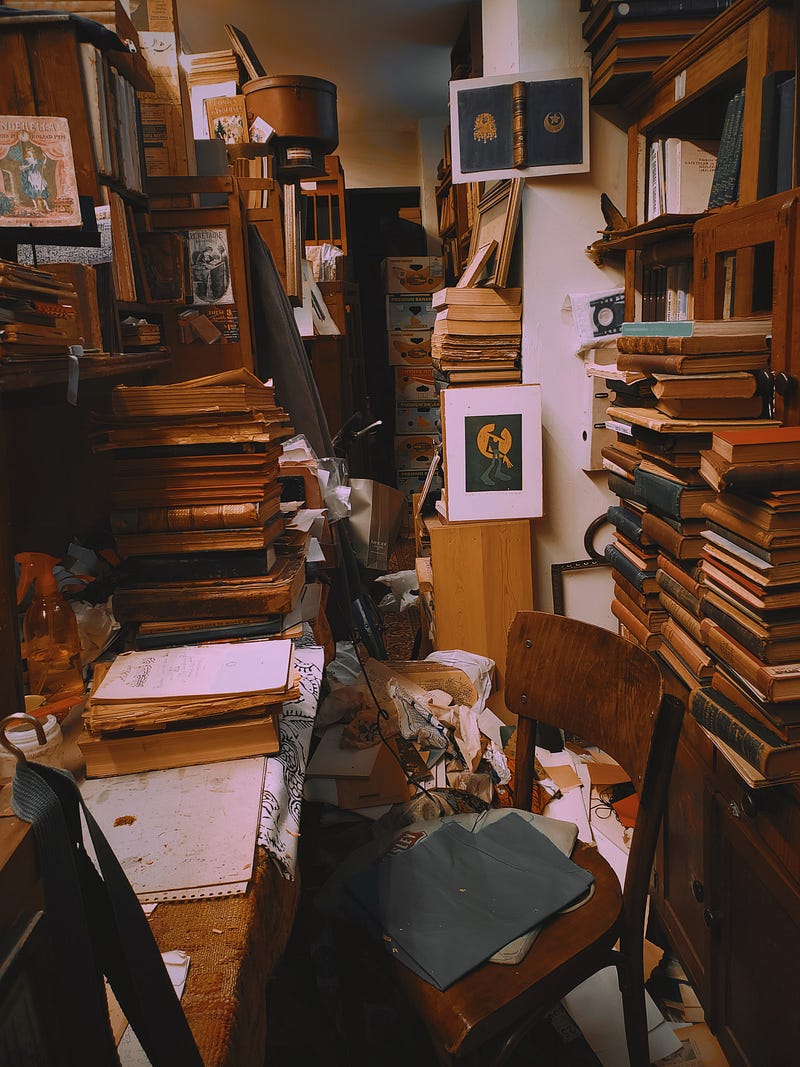
How does your messy home say something about your trauma
I’m not accusing the clutter in your life in this article, but I will reveal the reasons why you have some unsolved trauma that connects to your messy manifestation.
Perfectionism comes from an inability to regulate negative emotions whereas “laziness” comes from the inability to realize you’re having a negative emotion you can’t cope with and you tend to neglect it. So normally you would not associate lazy people with perfectionists but the reality is that these things can coexist in the same person. And the reason for that is because they both have the same core route: the inability to cope with negative emotions!
Lazy people and perfectionists have the same core emotional problem: they can’t regulate their negative emotions properly !
Let me give you my own example:
I grew up in a family that used to split me between 2 houses and live 2 days/ week in one place and 5 days/week in another one. It wasn’t because my parents were divorced but because I was partly raised by my grandparents who were co-parenting together with my overwhelmed mother who would not be able to offer me a full week experience in an emotionally balanced environment.
Growing up with 2 different references to how family life goes, I had the luxury to compare. That’s where I started noticing things around me and with my friends who were living in homes where either of these models would come up.
Years later, I live on my own, in a different country, with a different mentality and I have almost nothing in common to either of these 2 families that raised me. However, one thing followed me: my emotional regulation skills followed me until I became aware of the problem I carried with me from these 2 models I was able to compare.
Looking back at how my life unfolded after seeing these 2 different models, having the messy house with my parents allowed me to feel I have options and choices to make about how I choose to leave my own things around in that mess. On the other hand, with my very disciplined and clean house at my grandparents, I never felt I have my own place to fit in there. Only years later when the rigid rules of my now old grandparents started to fade off, I could slowly find my own way in a house as meticulously organized as a pharmacy. Every little detail of the house was so well-appointed that if something would change in their life from one week to another, I would be able to tell from how they arranged things differently in the house. The routine and impeccable organization was the norm there. My grandmother was a librarian so she cared a lot about perfectly arranged systems and my grandfather was very successful in his career in his youth and that showed in his management skills in the house as well.
So in the example of my parents' household, I had an overwhelmed mother that couldn’t cope with negative emotions and that made her house be messier. Both my parents are much more intelligent than my grandparents as both are engineers, but that also created more mess in their minds and emotional lives. Whereas my highly authoritarian grandparents were perfectionists and therefore imposed the clean house as a way to cope with their own negative emotions. As they became older and more overwhelmed by situations, their own house became a mess to the point that in time my grandma was neglecting everything around her refusing to see what’s becoming of her high standards and giving in to her age.
The cultural aspect that contributes to subjective cleaning and organizational skills
It’s clear to me by now that there is an element of habit that you built through your role models and references in life and another which you build with the culture of the society around you.
For example, if we take the Nordics, we know that they invented the minimalistic designs in the interior. But they have these very high standards and perfectionism in their designs that it’s simply hard to find room for any mistakes and thus, compassion won’t be part of the emotional skills they develop easily because the “infrastructure” is not supporting that “by design”.
Our reference systems predict much of our adult behavior because it’s a bit like cooking: if you haven’t added any spices to the food, you can’t expect it to become spicy all of a sudden after you finished cooking. It’s what you seed that will grow. And thus, many of the hypotheses that people can change are only supported by exposure to different models. And yet, have you tried picking up a new language? How do you pick up languages at different age stages in your life? The new “software” of a new language added comes on full hardware of other programs that might interfere with this new one. That’s how we lose a language when we add a new one. It doesn’t fade because we don’t use it but because we have limited capacity to handle the computation of different programs at the same time. As such, we might find that it’s easier for a language professor who only deals with that to learn 10 different languages but not know how to do some basic cooking or not have any crafting skills. That’s why we are so different but so much alike. We have access to different “ingredients” according to the region we come from and the resources and systems we are exposed, form our way of functioning to the point that adding anything new will overwhelm us.
Now coming back to the clutter problem, you see why some people are bad at handling negative emotions or get overwhelmed by having to handle them?
Because they might have had to switch programs and software a lot or because their reference system was inconsistent like mine having 2 families and 2 households in which I grew up.
Negative emotions are not necessarily something very intense, heavy or dark.
They are part of life just like any other emotion. The exception is that our resilience to it differs according to the amount of exposure we had to them and how often.
Coming one level back to culture, you can see now why the Scandinavians are so “cold” and they have so little emotional bandwidth and choose to treat everything with extreme rationality. They were exposed to changing weather conditions for generations and their resilience was formed by coping with negative emotions through rationalization. Rationalization is also the reason why we become perfectionists.
Now let’s look at the tropical countries or Indians to be more precise which are known to be more prone to “laziness”. It’s not a generalization I intend to make but a lot of westerners tend to think this way. Let’s look at their weather conditions and their coping style for negative emotions. They developed mindfulness techniques and yoga to relax the mind and declutter when it gets full. But it is clear they are not as perfectionists. And that happens while their weather is constantly the same throughout the entire year. It’s the body response to having fewer stimuli and more time to focus and process other emotions.
So why aren’t the Indians the happiest people on earth then? Well, it’s probably because the standards for happiness were not developed by them. It’s the reference system of the westerners that made the happiness guidelines so the easterners can’t beat them at their own game.
So coming back to individual levels, if you put yourself in either of these 2 extremes, how do you think your home environment has influenced how you grew up to be more tidy or more messy?
As new generations are born everywhere in the world of both westerners and Easterners as immigrants in other countries, the boundaries are blurred, and then the only way to assess your trauma is by looking more in-depth at your family environment rather than your culture.
How can someone with a good potential end up not managing their emotions?
Since I was giving the example of my own 2 households, it’s important to mention that I never thought of my home environment to be anything less than privileged. I think of my family as being a respectable, intellectual family that did a good job of raising me with good role models. However, the “devil is in the details” as they say and the difference is not necessarily related to major trauma anymore as it is connected to very subtle things.
So I will map some of the typical expressions used by either of these 2 couples so you can see how much they impact the way you handle your negative emotions.
The perfectionists
- They would often mask that they are looking for anything else but a “workable” prototype, but they encouraged only when things looked above some standards.
- They would disregard people of a lower social class
- They would discriminate based on their own reference system
- They would think highly of the people who achieved material things in life
- They would be able to laser-focus their attention to finish something and in the end,be completely drained of resources
- They are never tired but then they develop chronicle illnesses ( both my grandparents had cancer)
- They considered shameful to ask for help ( therefor even in her last moment of life grandma wouldn’t allow me to massage her feet when she was in pain with terminal cancer)
- They can’t be shamed because they have a high ego
- They rationalized their emotional decisions ( my grandparents had an arranged marriage)
The laise-faire
- They would often postpone deadlines or work until the last minute to finish them
- They would cover the mess and simply attend another activity until the negative emotions about the mess would do away
- They asked for help even when they could do it on their own because they couldn’t handle the stress of the situation
- They get distracted and are not able to focus properly because they are afraid to fail
- They have constant tiredness or fatigue. They tend to sleep a lot to cover their emotional bandwidth
- They don’t praise or reward achievements and they judge the process to get there more. It’s relaxed, they agree to congratulate you. If it was stressful they don’t recognize as a success.
- They care a lot about what others think of them
- They deal very badly with shame
The problem in growing up with 2 different references is that I am neither of the extremes but I can easily identify myself to both extremes in different contexts. My chameleonic personality made me a confused teenager and growing up confused I wasn’t very sure of myself as an adult. That was until I moved abroad and started waking up from it by comparing the “system if the systems” because my family system was now one level less important than my cultural one which became the main differentiation between me and the Dutch. As such, having had to compare so many things so many times, I developed the resilience while also keeping my nature of the programs I haven’t had uninstalled yet. Some of those are loaded with compassion towards the mistakes I make and empathy towards others who are still in the infancy of their growth path.
I hope this is will open up our eyes towards the level of attention we pay to details in our lives that make up complex systems of our personality. If every little habit is part of a bigger piece of the system, why not start with making our bed every day? It might change like a domino effect our entire life!


