
Indian Economy-How does India Earn Money?
A simple read to understand how the Indian government earns money

THE UNION BUDGET
To understand how much money India makes and how it spends the money, it is important to first understand the Union Budget of India and its significance.
As per Article 112 of the Indian constitution, the Budget is presented by the Finance Minister at the parliament at the beginning of every financial year.
The Budget contains projected earnings & spending for the upcoming fiscal year , the revised estimates of the current year plus the actuals of the previous year.
For example the Union Budget presented on Feb 1 , 2021 consists of :
- Projected earning & spending Numbers for 2021–2022 (April 1st, 2021 — March 30th 2022)
- Revised estimates of 2020–2021 that were projected when the Budget was presented on Feb 1, 2020. (April 1st 2020 to March 2021)
- Actual Numbers for 2019–2020(April 1st 2019 to March 2020)
INDIA’S REVENUE & CAPITAL SOURCES
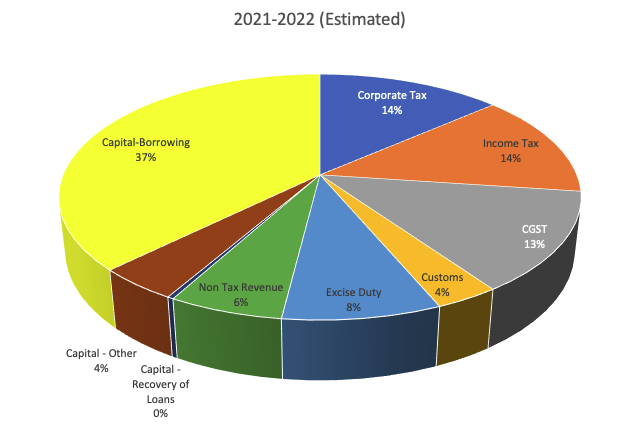
India primarily gains money through various revenue receipts (tax revenues & non tax revenues) & capital receipts.
REVENUE RECEIPTS
Government receipts that are recurring in nature and do not create liabilities or reduce assets are called revenue receipts. These would include income from taxes, interest & dividend on government investments, cess and other receipts for services rendered by the government.
These can be further grouped into Tax and Non Tax Revenue. Below we will look at the types of Revenue Receipts:
Corporation Tax
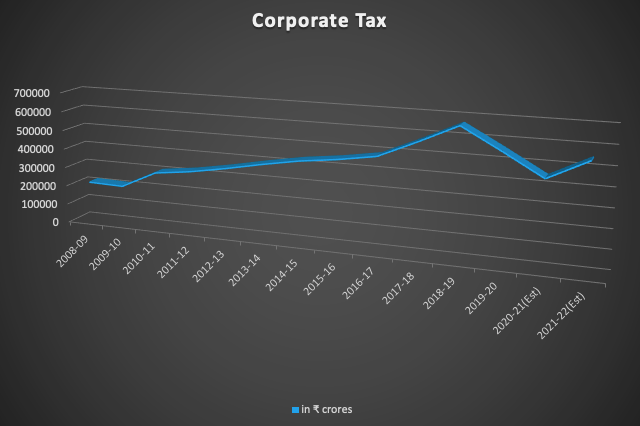
Private and Public companies registered in India are liable to pay tax on their profits under the companies Act of 1956. The corporate tax for 2021–22 is expected to be around 547000 crore rupees i.e approx. 73.6 billion USD.
Income Tax
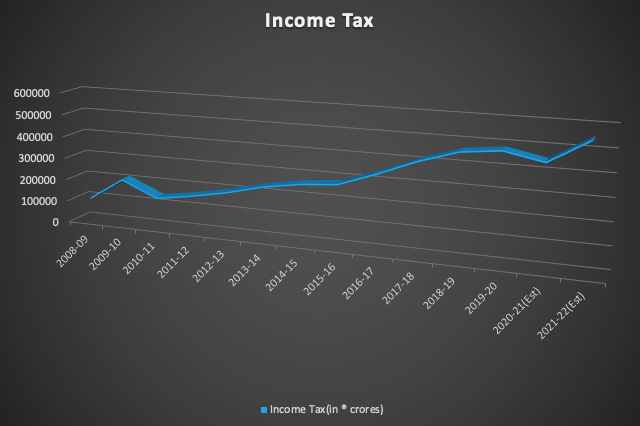
Tax levied on an individual’s wages, salaries, and other types of income such as pensions, interest, and dividends. Income tax in 2021–22 is expected to be 548500 crore rupees i.e approx. 73.8 billion USD.
GST
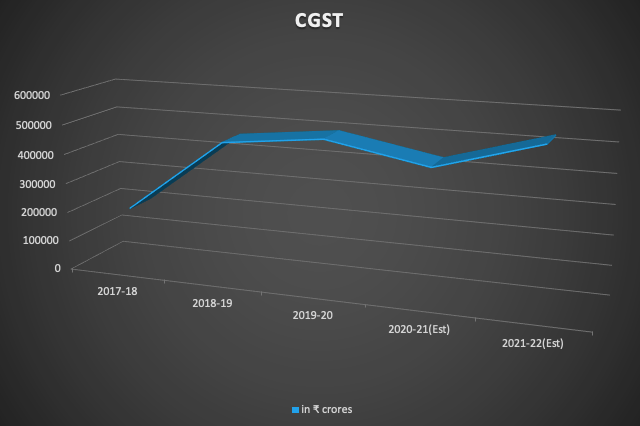
This is a tax on most goods and services sold for domestic consumption. This was introduced in 2017. There are different kinds of GST i.e CGST (Central Goods & Services Tax) , IGST (Integrated Goods & Services Tax), SGST(State Goods & Services Tax) & UGST(Union Territory Goods & Services Tax). I have shown only the CGST below since that is what goes to the central government.
The CGST for 2021–22 is expected to be 530000 crore rupees i.e approx. 71 billion USD.
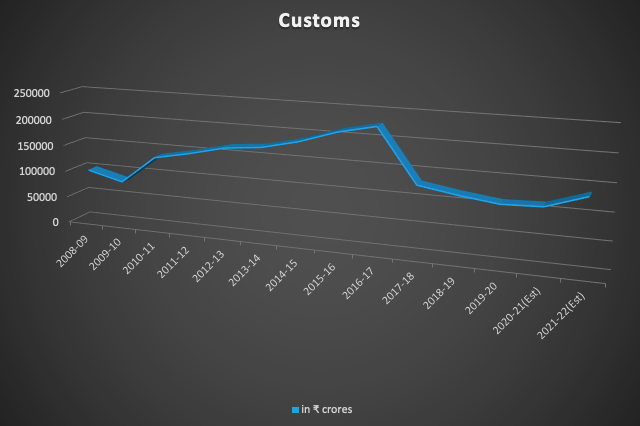
Customs Duty
Tax levied on import and export of goods. The Customs Duty in 2021–22 is expected to be 136000 crore rupees i.e approx. 18 billion USD.
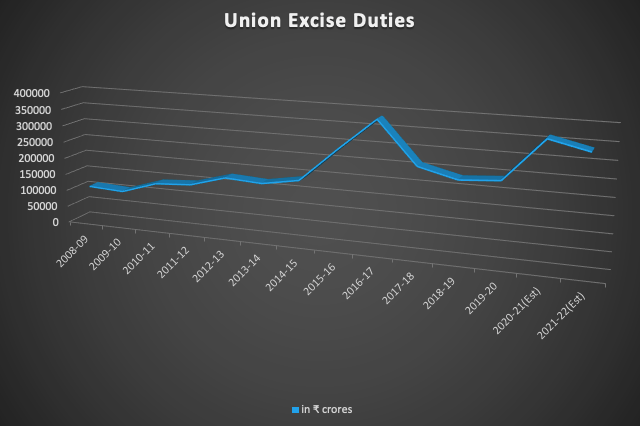
Union Excise Duties
This is a duty on manufactured goods levied at the time of manufacture. The excise duty for 2021–22 is expected to be 335000 crore rupees i.e approx. 45 billion USD.
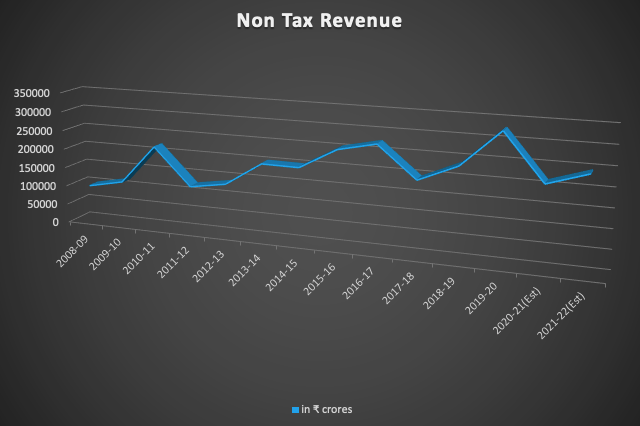
Non Tax Revenue
The recurring income earned by governments other than taxes. This is the income generated from the operating activities of businesses owned by public sector companies (eg: dividends, profits), interest on loans given by the central government, rents received, services rendered by the central government etc…
The Non tax Revenue for 2021–22 is expected to be 243028 crore rupees i.e approx. 32 billion USD
CAPITAL RECEIPTS
Government receipts that are not recurring in nature and either create liabilities or reduce assets. These include loans taken by the government, disinvestment(i.e sale of public enterprises), recovery of loans etc…
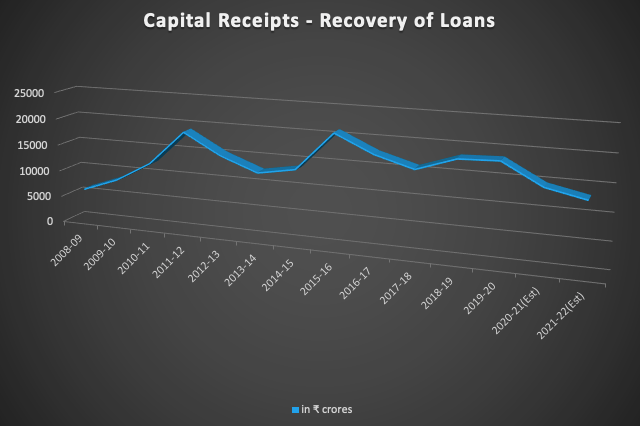
Capital Receipts (Recovery of Loans)
This includes the money received by the central government from the recovery of loans. In the budget these will show up under Capital Receipts as Recovery of Loans.
The Recovery of Loans in 2021–22 is expected to be 13000 crore rupees i.e approx. 1.7 billion USD
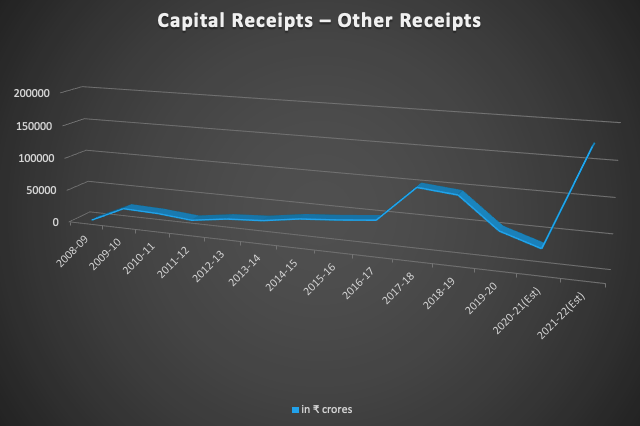
Capital Receipts (Other Receipts)
This includes the money received by the central government from sale of public enterprises. In the budget these will show up under Capital Receipts as Other Receipts.
This is expected to be 175000 crore rupees i.e approx. 23.5 billion USD.
Capital Receipts (Borrowing & Other Liabilities)
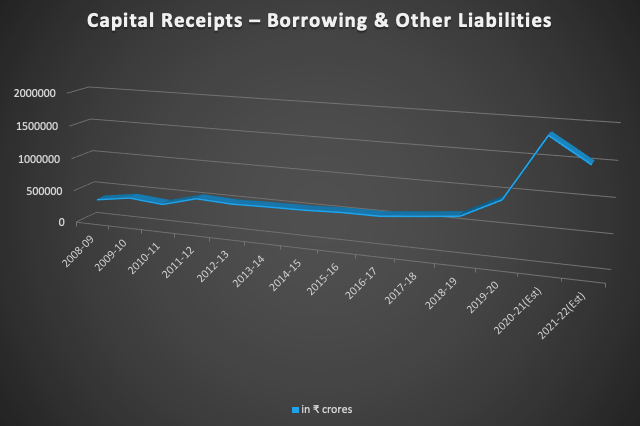
This is the money that the central government receives via loans from internal & external sources. When the governments budget has higher spending than earnings, it will take our loans to make up the deficit.
This is technically not a source of earnings but since its mentioned as a capital receipt in the financial statement, I included it here.
As we can below, the borrowing remained pretty steady until 2018 when there was a higher increase than normal and then a sharp increase in 2020 due to the covid pandemic where the government had to spend a lot on covid related efforts. However there is a decrease in the estimated borrowing in 2021–22 which is a good sign.
The central government is expecting the capital receipts from borrowing and other liabilities to be 1506812 crore rupees i.e approx. 203 billion USD.
INDIA’S OVERALL EARNINGS TREND
India’s overall income for the year 2021–22 is estimated to be approximately 19.5 lakh crores(around 307 billion dollars). I have excluded the capital received through borrowing & other liabilities as that does not constitute income or earning.
Let us now look at the trend of India’s earnings over the last decade.
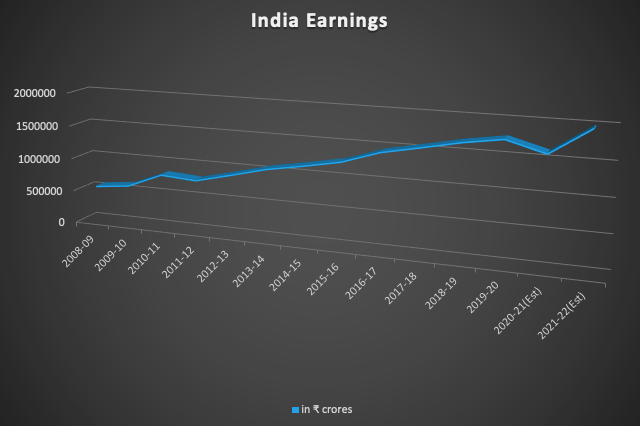
As we can see below there has been a steady positive increase in India’s revenue from 2008 to 2021 with the exception of 2020–21. This was due to the covid pandemic where companies and individuals income was impacted. You can see this in all the tax trends in the sections above.
However the estimated earnings for 2021–22 gets us back on the positive trend. Hopefully we leave the pandemic behind us and we get back on track to being one of the fastest growing nations economically.
My curiosity around how our(In dian) government earns money led me down this path of looking into India’s revenue sources. I hope it help others with the same curiosity.
The data shown in this article has been obtained from the Government of India Budget Documents.