
Method to Memoir
How Do You Turn a Memory Into a Story People Want to Read?
Steps to turn thoughts into words that reach the heart.
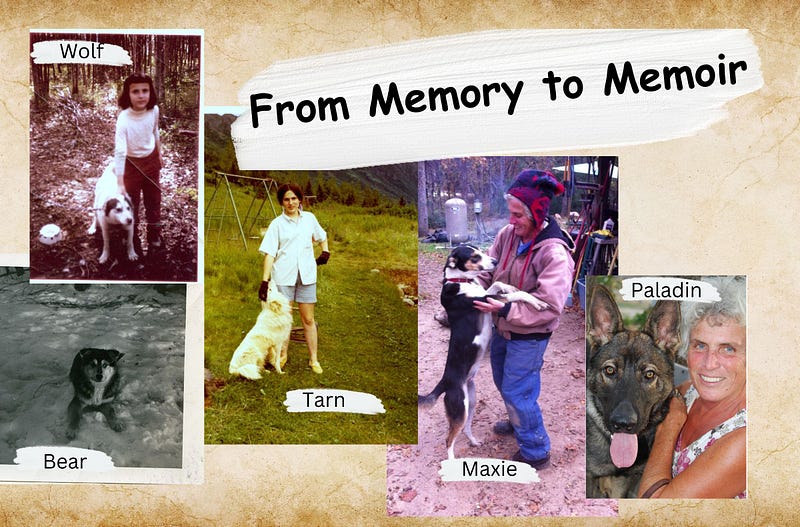
A memory, a subject, a thought can stay in our minds, and we just know it needs to be a story.
However, it takes more than an unforgettable or traumatic event, an idea, or a thought to create an essay. Often the story doesn’t resonate with readers because the meaning was lost in translation from thought to words. These enduring memories or events that shaped us into who we are, those stories close to our hearts—how do we shape them into stories?
Is it magic that transforms a memory from a personal experience to a moving essay? No, we can learn to pull back the curtains of time and let readers peek into our lives.
For me, those thoughts are often about dogs.
Since childhood, at least fifty dogs have shared my life. Honestly, I’ve had more canine buddies than human friends. I have loved, bred, raised, and sold dogs. They worked with me to herd livestock and search for drugs, explosives, and cadavers. I have no shortage of stories about dogs, so the tales are easy to tell.
But how can that word, dog — those memories, become an essay, or more specifically, a memoir essay?
In her craft book, The Situation and the Story, Vivian Gornick considers this question.
Truth in a memoir is achieved not through a recital of actual events; it is achieved when the reader comes to believe that the writer is working hard to engage with the experience at hand. What happened to the writer is not what matters; what matters is the large sense that the writer is able to make of what happened. For that the power of a writing imagination is required.—Vivian Gornick.
When I read this book three years ago, I believed my job as a writer was simply to tell the story, perhaps with some description and detail. But here, Gornick says that what happened is not what matters. In fact, she says the writer’s job is to understand the meaning of the events.
The writer must take the time to write, re-write, and feel, to discover meaning beyond the memory itself. Let your story develop into something new — it may surprise you.
How do we discover the deeper truths in our own experiences?
It’s necessary to begin with a theme, a memory, a vague idea. That’s the what. To go deeper, we must ask ourselves why. Those things we discover when we answer that question form the essence of memoir writing.
I’ve often tried to write about my dogs. For example, here’s the opening paragraph of one attempted essay:
Dogs stole my heart when I was a small child. Perhaps my childhood in Alaska made it inevitable since huskies were more common than house cats, at least back in the fifties. Once I could read, my favorite books were about the daring deeds of brave dogs.
On and on, I describe the books, movies, and television shows that fueled my passion for dogs. But the Why is missing. Why did dogs matter so much to me? Why should the reader care? Lots of people love dogs. There’s no emotion, no connection.
However, my time wasn’t wasted. Don’t delete work; just think about it and return later. So I think some more. Hmm…after over fifty years, I now have only a cat when I thought I’d never survive without a dog. So, what changed that I am now content to be dog-less?
My relationship with dogs was never simply an occupation or a source of income. The connection was deeper and emotional, which I needed to explore. So, I tried again, and I asked why.
As a child, I didn’t want to simply own a dog. I wanted to be a dog. Well, a wolf, but I’d settle for being a dog. Stop, I tell myself. Why did I want to be a dog? Can I return to that long-ago girl, be in her mind and body? Feel what she felt?
Dogs could stay outside as much as they wanted; they ran for miles pulling sleds over the snow, and they didn’t have to go to school and sit at a desk all day. To me, dogs represented freedom. What else?
When I was five, I saw our dog, Smokey, her muzzle brushing the ground, following her nose through the mossy forest. I got on my knees, sniffing wet leaves and getting my knees thoroughly muddy. I did not detect anything exciting. Well, of course! I’d never practiced sniffing, so I began what must have been an obnoxious habit of constantly smelling things since I assumed dogs must have practiced a lot. Smokey would freeze, listen, and take off running through the woods. She heard something I missed, so I began intently listening to the sounds of nature.
So began my intense observation of dogs and nature. I realized dogs had unique abilities.
I realized my love of the natural world began with dogs.
Over the years, as my human family unraveled and the loneliness of adolescence engulfed me, a dog was always by my side. Dogs never deserted me; they didn’t care what clothes I wore or whether I was popular. They radiated affection and acceptance. With a dog, I was never lonely; that’s meaningful.
If you’re a memoirist or personal essayist, your core subject, to some extent, is always you.— Author and teacher Dorian Fox.
So I ask what dogs meant to me. I thought about all the dogs I’ve known and loved through so many, many years and realized their most significant gift was unconditional acceptance, even love when I needed it desperately.
Some dogs were sinners and left me with scars. Others were saints or clowns. Few will be forgotten, and each one taught me something. These stories I can tell.
Dogs helped make me who I am and may have saved my life.
I could write many stories about the dogs in my life and how they changed me, the adventures we had, and the people I’ve met. These anecdotes and memories could become essays because they would include reflection.
The idea of sharing personal stories with strangers feels vulnerable, even terrifying. But writing memoirs can be a portal to self-discovery if we’re willing to go deeper.
However, I believe it’s the process of revision, returning to the story until it begins to make sense, that can provide meaning for both the writer and the reader. Yes, adding detail, finding metaphors, and even lyrical language is helpful, but the inner reflection on the meaning of the memory is essential.
You also have a story if you’ve had a relationship with an animal. And what that dog, cat, gerbil, or horse meant to you will differ.
So you tell me why that dog mattered.
That’s a memorable essay.
Questions about how to turn memories into meaning? Tips on what works? Please—share with us.
Cindy is writing a memoir of her adventures growing up on a homestead in Alaska, farming in the southwest, owning bookstores, and more. Access exclusive family photos here.