
How Do You Set Up Your Classroom During a Pandemic?
One year ago, almost to the day, I spent one morning in my classroom setting up desks. In a typical year, this process takes 20, maybe 30, minutes: You think about how you want your desks organized — in groups, in rows, in, if you’re feeling brave, a roundtable around the perimeter of the room — and you move them. Then, after the first week of school, you decide that you were all wrong and you change everything.
Last year, the process took me almost three hours. Armed with two meter sticks (other teachers used bright pool noodles) and a roll of green tape, I spent most of the morning on my knees, measuring a six-foot distance between desks. It presented more challenges than I anticipated: From what points of the desk do you measure the distance? The back of the chair? But what happens when they sit? Do I leave space between the desk and the chair to simulate a fifth-grade-sized student sitting? Or should I measure from the desk? If so, what parts should I use? Far corner to far corner? Or the closest two corners? Or one desk’s far corner to another desk’s close one?
Then there’s the actual distance. Turns out a meter stick is a little over three feet; two of them put together, to the nearest thousandth, are 6.562 feet. Do I use two meter sticks to be extra safe? Will that extra half-foot — that extra .562 feet — be the difference between a Covid outbreak and containment? Or do I just eyeball six feet as a little less than two meter sticks? But eyes are fickle, subjective. What if I estimated one as less than six feet? What if the kid sitting at the too-close desk got sick because of my negligence? What if they had a vulnerable family member at home?
It was clear I overthought it: By the end of the year, our class, thankfully, had only one brush with the virus, and most of the tape had rolled up or faded; the desks sat a few inches from their original sword-in-stone locations.
But this was August 2020, a full 18 years ago, when the pandemic was relatively new and raging. My students were only coming to school for the first week to confirm that I was indeed a real person before they knew me only from a box on their school-provided laptop for the next six weeks of all-virtual learning. They spent only two days at school that week — half came on Monday and Tuesday and the other half on Thursday and Friday — sitting in their desks 6.562 feet apart, standing in the hallways on strips of yellow tape precisely measured for their safety, unable to play basketball or soccer at recess because they had to stay separated.
It was a school year, more than any other, defined by space.
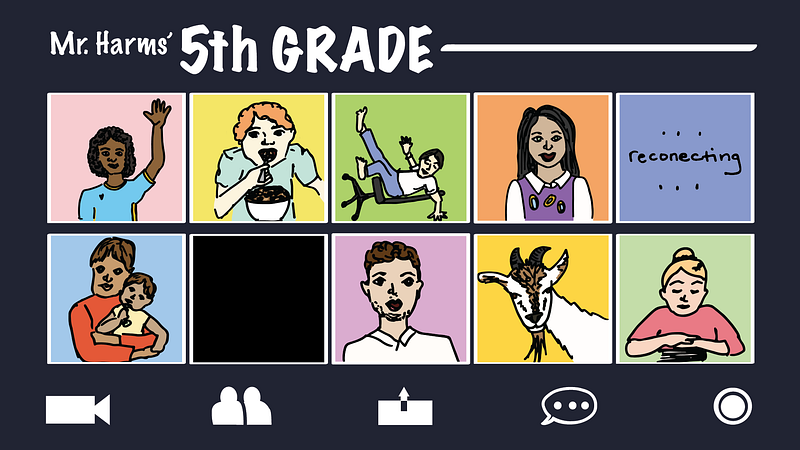
For those six weeks, we taught virtually from school. That means as I sat at my desk, staring at my computer, I could also see the dozen or so student desks around the room, unoccupied. I was teaching, for the first time, to an empty classroom. There were no kids jumping up from their seats at 10:35 for a criminally early lunch, no piles of dirt from the kickball field circling their chairs, no noise or laughter or life. It was eerie, and sad.
We were separated by miles, by boundaries, by screens and by necessity. Parents had the option to keep their kids at home all year; many chose to. Later in the year, when one of our all-virtual students showed up to drop off a gift, I was struck by how small he was; I realized then I had only known him from his neck up. By the end of the year, when the pandemic was receding and more students showed up for in-person learning, I taught math and science to a group of students inside the classroom at the same time another logged into my Zoom from their bedrooms and watched our class from a giant webcam. (My students dubbed it the cyclops because it had one large eye-like camera in the middle.) There we were, separated in the classroom and beyond it.
The kids handled it like champs, of course. They were resilient and kind and hilarious. They asked questions and ignored directions and gave one another leftover apples. They could have easily folded. They could have gotten lost among the chaos, called it quits on trying to figure out when the heck they were next supposed to join Zoom. But they didn’t, and that says everything. They took the hand they were dealt and they made the most of it, better than a lot of us.
The space also afforded some benefits (in addition to the obvious one of keeping people safer). We got to meet Bill and James, two of my students’ dogs that spent every virtual class curled up next to them. We got to hear John’s sister yell gleefully in the background of his Zoom and Tate’s mom ask if he needed his underwear washed in the load of laundry she was about to put in. We became obsessed with the hypnotic rhythm of Alice’s ceiling fan. We did everything we do in a normal year except become close.
Until the end. One of my enduring images from the year came on the last day of school, when four of my boys stood out by the car loop, saying goodbye. Fifth-grade boys, for the most part, are not overly sentimental; they typically leave one another with a fist bump and “Later.” But this time it was more. This time, after months of separation and distance and space, they stood out on the sidewalk, just the four of them, and hugged. The space, finally, for those precious few seconds, was gone.
I thought about that moment as I was preparing for this school year. Like everyone, I had hoped it would be more normal than it is. Last week, during pre-planning for teachers, I set up my desks hopefully, in rows of three without space between them. I felt good: This year would be different, better, less distant.
Later that day I separated them all.


