
How Do We Surrender to Life?
Our ego’s fight for control blocks us from creating the lives we truly want. So, how do we let go?

Surrendering to the flow of life is one of the hardest lessons to learn as a human being. Why? Because our egos feel the need to be in control at all times.
The ego is useful as a control center when we need to say, decide which toothpaste we want or what to have for dinner. It becomes a block, however, when we’re trying to build a life that aligns us fully with our highest potential. How so? Because the ego’s greatest concern isn’t our soul growth or spiritual expansion.
Our ego is solely concerned with keeping us safe. The soul, however, has its own aims, which often conflict with the base instinct of survival. (I talk about distinguishing the ego from the soul here.)
From the moment of our birth — as we come screaming out of the womb — we’re alone. Where we were once fed and held and nurtured in utero, tucked away beneath a cage of ribs in a warm body. And before that, our consciousness was maybe just some disembodied essence intrinsically linked to a greater whole.
Now, suddenly, here we are…alone.
And as we grow, we only continue to learn how we are, inescapably, alone: in our bodies, our minds, and our experience of emotions at any one moment.
The ego forms as it learns separateness, “I” and “you.”
“The ego likes to know, it likes conformity, and it loves predictability.”
So, we learn that to survive, we must protect our interests. How else will we get what we need? No one can feel that we’re hungry, for example. We’re the only ones who know; we have to express it (as babies, this means crying). We recognize the need, articulate it, and (usually) get fed.
We learn very early — even before we fully individuate — that our safety and survival depend on our ability to understand and control our environment.
Of course, when it’s time to surrender to Life, we are terrified of letting go of that control. We imagine if we let go, stop being constantly vigilant, and stop letting our egos run the show, we’ll never be safe and never get what we need.
Paradoxically, as most things in life tend to be, the more we release control at the ego-mind level, the more power we have to build an environment or reality perfect for us.
I’ll explain how, but first, here are three ways the ego tries to maintain control. The ego likes to know, it likes conformity, and it loves predictability.
We’ve Got Everything Figured Out
It comes up in many different spaces: academia, scientific communities, religious communities, etc. Everyone wants to believe that they know how the world works. Human beings love to find security through the delusion that we know everything or, at some point, will know everything.
I suppose it’s because if we accept all that we don’t know, an awful lot of people would be curled up in a ball of existential dread most of the time. Of course, this is just the ego’s response to its inability to manage our environment. It reasons what we don’t know or understand can hurt us. Once we’ve dissolved a good portion of the ego, we don’t need to find our security in knowledge because we recognize the endeavor for what it is; the ego’s futile grasp for control.
Safety In Numbers
The ego can find its seat of control in groupthink. There may be a natural drive to belong, to feel part of something greater, but the ego takes this to an extreme as it latches onto any group identity and uses it to feel secure.
It seems counterintuitive since the ego is the separate self, but the ego is concerned with safety. And it knows there is safety in numbers.
Often, identifying with a group means abiding by specific dogma or ways of being that set that group apart from the whole: vegans don’t eat animals, conservationists don’t trash plastic, etc. (There’s nothing wrong with being vegan or a conservationist. I’m just using them as examples.)
If we step outside of those rules, we are suddenly no longer part of the group. What happens now? Who can we depend on? If something goes wrong, who is responsible? These aren’t conscious concerns, but our subconscious (95% of our thoughts, actions, and impulses) is screaming. The ego prefers conformity because it reasons that belonging makes us less vulnerable, but, at times, forcing ourselves to assimilate means denying parts of ourselves that feel genuinely authentic.
Refusing to Let Go
We find it difficult to let go of people, places, things, emotions, stories, and identities. We cling because we feel that any kind of permanence will give us something to hold onto — a port in the storm. We can rely on that one thing to remain constant.
It could be a partner, a parent, a school, a job, or an emotional spiral. Anything. The ego loves predictability. If it can predict what will happen, it can plan. It can find contingencies, fail safes, and escape routes. It can…say it with me…keep itself safe. It puts up every fight to never be on the back foot.
But life doesn’t work that way; change is constant, whether we want it or not.
The ego is a builder. It was never intended to be a visionary.
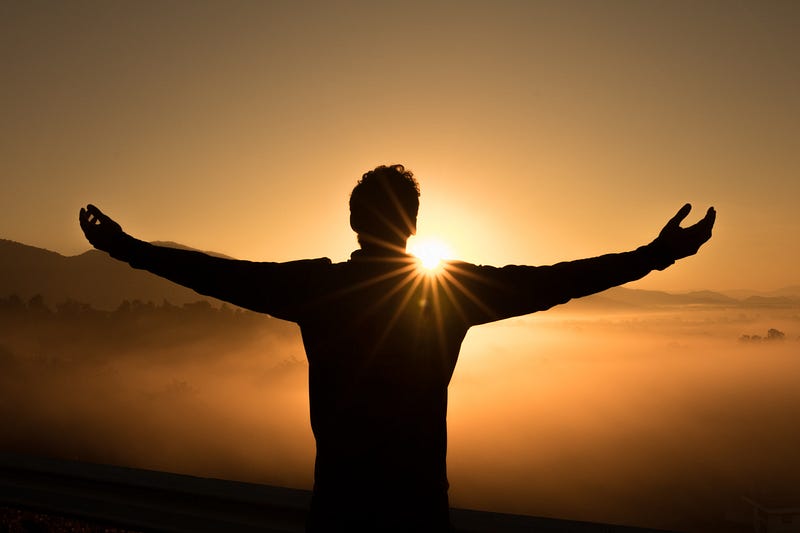
So, How Do We Let Go?
Fully surrendering to the flow of life means we allow uncertainty. We accept that there are things we don’t know and we’ll never know. We accept that our path to fulfillment may not always be comfortable.
We may not know where we’re headed, our final destination, or even who will be with us for every leg of the journey. We’ll take some wrong turns, get lost, and find our way back. We’ll encounter some detours, back roads, highway construction — you get it.
But you know what that means? It means we’re open to surprises. We’re not so stubbornly stuck to our route that we can’t recalculate when Life tells us there’s the most beautiful lookout point where we can watch the sunset in the next quarter-mile. Or, if we get off at the exit, we can stay in the coziest, comfiest Bed and Breakfast. We’re open to all the abundance that life has to offer.
More importantly, we aren’t so wrapped up in our minds (our egoic strategy, our egoic plan) that we’re unable to listen closely to the quieter parts of ourselves. Our hearts. Our souls. When we give our soul space to speak, we align with what will serve our highest good.
From that place, we are best positioned to build our lives.
Your Soul Is the Architect of Your Life
Think of it this way: our minds are the builders, and our souls are the architects. Say construction workers build haphazardly without an architect’s vision; what happens?
Chaos.
They build in the wrong place; the building is facing the wrong way, and they use the wrong materials; it’s a mess. But when the builders and the architect work together, it’s magic.
We still need the ego-mind to pour the concrete, to choose the paint, to put in the doors, but let its function end there. It is a builder. It was never intended to be a visionary.
Surrender the ego to the soul, to that piece in each of us still connected to the whole of existence, that knows how to speak the language of Life because it knows that there is no separation.
Where the mind falters, the soul knows, beyond knowing, that it is one aspect of that greater consciousness, that massive, breathing web of interconnectivity we call Life, and so it breathes as Life breathes.
It moves when Life calls it to move and stills when Life asks it to still, and it rejoices in it all. At the soul level, there is no will to resist the flow of Life, only ease, only acceptance, only surrender.
❤
If you’d like to talk more about spirituality, feel free to drop a comment! I love chatting down there. And if you’re interested in catching other things I write, you can become a Medium member here. XO