

How Do I Get Better at Writing?
Answers from The Engineering Manager

Welcome to a little reboot of The Engineering Manager. I’m going to be trying out a few new things.
Firstly, I’m going to get back into writing on a more regular cadence. It turns out that doing two books almost back to back is fairly time consuming. Who’d have thought?
Secondly, I’ve migrated my mailing list to Substack because this will give you, the reader, way more flexibility in how you can read the website. I’ll be posting on The Engineering Manager blog as per usual, but I’ll also be publishing those articles on the Substack mailing list as it gives an alternative reading experience through your inbox.
Make sure to subscribe if that’s up your street.
I thought I’d kick things off by answering a series of questions, since lots of people ask me for all sorts of advice. Recording my answers in one place might also bring them to a wider audience. In this post, we’ll tackle question one, about how to get better at writing.
Question One
How do I get better at writing?

That’s a good question that I get asked all the time. My answer won’t be entirely straightforward, because, fundamentally, I can’t teach you how to get better at writing. However, we can explore your motivations for asking the question and start you on your way to honing your craft.
Let’s begin with your motivation. Before you try to get better, it’s important to know why you want to. If you don’t have a genuine desire to get better at writing, you probably won’t. Following are some self-reflection questions to ask.
Why is it that you actually want to get better at writing? Are you wishing that you were able to communicate better with your colleagues? Do you currently struggle when it comes to putting together design documents or proposals? Do you find your email and chat conversations frustrating because you can never quite get your point across? Do you wish you could find more joy in pressing the keys on your keyboard?
These are all genuine, practical desires that you can work to address with intention.
Some motivations for writing may actually hinder your progress. Do you want to get better at writing because you would love to write a book? Do you want to have a high traffic blog and some internet fame? Maybe you just think it would be cool to be seen as a writer or author. If your motivation is, like these examples, only a surface-level one, you may become frustrated before you actually become a good writer.
Why?
Writing shares many similarities with programming. It is a lifelong craft, and you can always improve, right up until the end. People become excellent programmers when they fall in love with the ability to solve problems elegantly. People who code just to become wealthy or notable in some way often fail to reach excellence.
People who write well have gotten to that state by spending hundreds, if not thousands, of hours writing. The course to writing excellence can be simply taking every writing opportunity that presents itself to improve. In every email, chat message, or document you can strive for writing just a little bit better than before, purely for the love of the craft.
Anything that you genuinely want to become world class at cannot be only a means to an end, because the practice becomes shallow and won’t yield the same results. If you ask any writer how they became great — and I certainly don’t think that I am great — they’ll tell you there is no prescription for becoming a great writer.
Everybody’s journey is different. You have to take that journey yourself in order to experience the act of doing and learn what the path to mastery looks like for you.
I produce my best writing by just following my fingers, tapping out the stream of conversation in my brain. I don’t even know how to do it. Flow writing cannot be strictly taught or followed: it’s a state. The quality of that state comes with intentionality, practice, and reflection.
The way to get better at writing is to write. When you can access that flow state and develop the ability to self critique, your writing will improve. Find those seconds, minutes, and hours each day to find your flow state and just write.
Writing has become more important than ever in our careers. It is a key skill to progress to senior levels where the most impactful ideas and conversations are expressed in writing. Writing is the only medium where ideas can be expressed fully and distributed widely.
People who can write well find that their days are more focused, efficient, and asynchronous. Their work also sees a significant increase in visibility.
Conversely, people who find writing challenging find it difficult to express their ideas. Poorly written documents can bely messy thinking, even when the author has a very clear idea. If your messages and emails create confusion rather than clarity, and calls are often needed to clear up the details, then you may need to work on your writing. We can think of this problem as a writing bug.
People struggle with writing from just a few common bugs. Let’s have a look at some of them. The good news is that correction requires only small mindset shifts that have a disproportionately positive result.
Bug One
Writing to think and not writing to communicate.

When people write bad long-form text, like design documents and proposals, the most common reason is they are skipping phase two of the process. What are those two phases?
Larry McEnerney, Director of the University of Chicago’s Writing Program, explains the writing phases brilliantly. I’ve reproduced the diagram that he draws on the blackboard in his video:
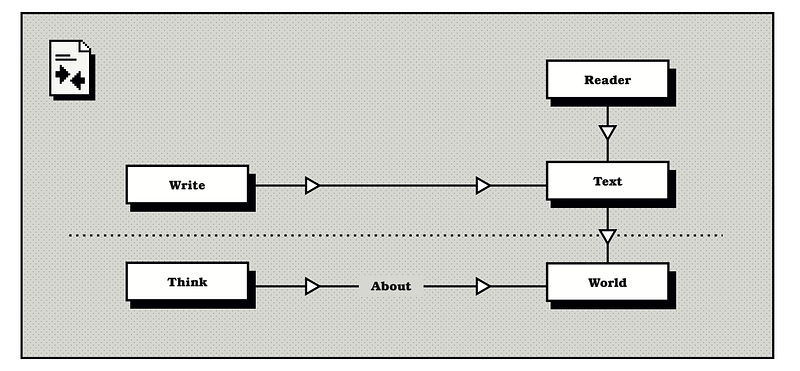
To think about the world, you have to write. In technology we work in a complex domain of problems that require a lot of thinking. The initial process of creating a proposal or a design document is to enable that thinking process.
We rarely have everything figured out in our heads before we write it down: instead, we write to uncover all the details. The act of writing forces us to explore the problem space. However this exploration writing causes a problem. The text you produce to think about the world and design a solution is rarely the best text to portray your view to readers.
You do need to write to derive a solution or to form an argument. But your writing needs additional work and rework to best address your audience. Without your audience using your writing to further their own thoughts, you simply wrote for yourself.
Bug Two
Inability to imagine yourself as the reader.

To write well, you must imagine yourself as the reader. Take a mental step back and read your work with fresh eyes and zero context. Does what you have written actually portray your intended worldview?
If it doesn’t, then do a first-pass edit to make sure your view is apparent. Pitch your idea with the right level of detail so that it makes sense effortlessly to the reader: you have to know your audience.
When you read emails, messages, or documents that don’t make much sense, or are otherwise flawed, what do you think? Do you reckon that the writer has truly read their work to make sure it represents the best possible version of their idea or of themselves? Did the writer have you in mind when they composed the piece?
Probably not. Instead there is a mismatch between the actual impact and what the writer thinks it reads like in their head — where all of the context already exists. That gap that needs filling by reworking the text to clarify intent.
Experienced writers are able to immediately switch their brain into reader mode. They offer themselves critique, and then switch back to writer mode and implement the changes. You have to act as your own editor first, even if you have an editor. Train the muscle of self-editing by exposure to excellent writing and feed its characteristics into your own self-critique model for future use.
💡 Tip: Better writing often means clear and concise rather than impressive. At work you are not being read as a novelist or poet, so leave the fancy words and grammatical trick-shots for your spare time. Again, know your audience. The reader of your text needs to immediately understand what you mean and what you want them to do as a result.
Bug Three
A lack of clear actions and next steps.

What do you want your reader to do after reading your work? If writing at work is to spread your ideas and to allow you to exert your influence, remember people you want to influence are often those with the least time.
You need to capture their attention, make it explicit what you want them to do (read, comment, decide, or ignore), and then make it as easy as possible for them to do it.
💡 Tip: Prefix any long form text that takes more than a minute to read with bullets of your main points and the required actions. For people who don’t have time read in detail, summaries of key points let people know if they can safely choose to move on if time-pressed.
Saving your readers time is the biggest gift you can give. We’ve all read books that could have been just a blog post, and we’ve all read long documents that seemingly go nowhere or are unfinished. Meandering text causes friction for the reader and reduces trust. Future pieces you write may go unread.
If you’re looking for a decision, be explicit. If you’re sharing your thoughts in case they’re interested, then say so. If the person is not interested, they can choose to skip it. If you need the reader to take action as a result of what you’ve written, make sure the required action is impossible to miss.
Saving readers time requires iteratively switching into reader mode and giving yourself a critique. Self-editing is a muscle that needs to be trained.
Bug Four
Not enough time in the gym.

You can’t expect to become a good writer overnight. It takes lots of practice, often in secret, often producing hot garbage that may never see the light of day. I’ve deleted far more sentences than I’ve published over my lifetime.
As I said earlier, the best way to become better at writing is to write. I missed a critical word from that sentence, however: improvement comes through writing intentionally.
The good news is that there are countless opportunities to be intentional. Every email, every document, every chat message, every SMS, and every note to yourself during your working day is a chance to sharpen your words 🗡️.
Write, Write, Right?
Most writing opportunities aren’t particularly glamorous, and your writing will often go unseen. That’s why we talked about motivation first. All of the opportunities you need to write and get better at writing are underneath your nose, but they won’t make you a famous writer. Recognition may or may not come in the future as a side effect of the level you reach in your craft.
So, there’s no prescription, just practice. And by the time you’re good at it, you won’t even care whether you’re good any more. You’ll write because you have to — or even because you love to.
About the Author
If you enjoyed this article, be sure to pick up James Stanier’s books from The Pragmatic Bookshelf:
If you’d like to be part of the writing process, you can leave feedback for James about his books on the reader forums on DevTalk, or even start a book club. You’ll also find a 35 percent off promo code there:
- Effective Remote Work on DevTalk.
- Become an Effective Software Engineering Manager on DevTalk.
Originally published at https://www.theengineeringmanager.com on July 10, 2022.