
How Did Salt Change The World?
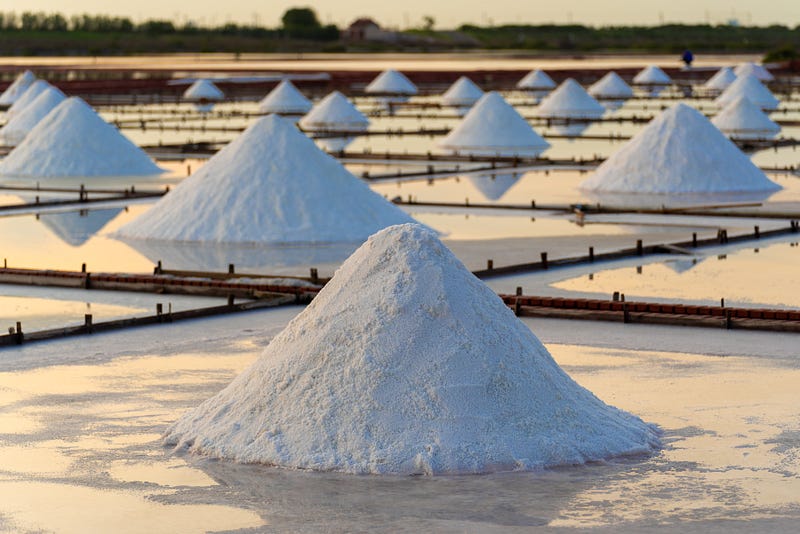
We must have constant access to the right amounts of salt. Salt has been used for thousands of years for medical purposes as an antiseptic, as well as to preserve food from spoilage. Animals similarly need this and obtain it by licking salty rocks. In times before civilization, roads in the wilderness were created by animals traveling to lick salt at certain points. Human beings, who did not have various tools to open roads in nature, created roads by following these roads, and settlements were established on these roads in the places closest to water. So, although civilizations were built on water, salt also had a significant impact on them.
As the place of grain in humankind’s food culture increased, more salt was required. However, since the necessary technologies did not yet exist, it was impossible to reach underground salt resources and the amount above ground was insufficient. Nowadays, we generally obtain salt through mining. However, until modern times, salt has always maintained its value.
Etymology Of The Word “Salt”
The etymology of the word “salt” dates back to Middle English and has roots in Old French. In Old French, it was used as “salte” or “sault”, derived from the Latin word “sal”. In Latin, “sal” means “salt”.
Etymologically, the word “salt” originally referred specifically to salt, but over time its meaning expanded to include a variety of uses unrelated to salt. For example, “salt” can be used to indicate that something is pure, unadulterated, or unaltered.
“Salt” in the Roman Empire
The Venetians were exchanging other Asian spices for salt in Constantinople.
The road that ended in Rome and was one of the most frequently used roads was called “Via Salaria”, meaning “Salt Road”.
The monthly salary of a Roman soldier consisted partly of salt, and this salary was called “Solarium Argentum”, which is salt money. This is where the word “Salary” we use today comes from.
The phrase “Not worth his salt” came to English from the Romans. Which means not worth the cost or value. This was a phrase used when a Roman soldier or slave was not doing his job well.

“Salt” in the French Revolution
Historically, many societies imposed taxes on salt. These salt taxes were generally imposed to increase state revenue, meet the financial needs of the kingdom, or provide economic control by exploiting the strategic importance of salt.
The “Gabelle” was a salt tax in France that played a significant role in the economic and social life of the country, especially leading up to and during the ancien régime, the period before the French Revolution. Here’s an explanation of the Gabelle
Salt Tax System: The Gabelle was a tax on salt, a vital commodity used for preserving food and enhancing flavor. The tax system was established to generate revenue for the French monarchy, as salt was a widely used and essential product.
Royal Monopoly: The French monarchy established a monopoly over the production, sale, and distribution of salt. This meant that the state controlled every aspect of the salt industry, from production to retail.
Regional Disparities: The Gabelle led to significant regional disparities in terms of salt availability and cost. Some regions had abundant salt resources, while others had to rely on imported salt, leading to higher prices.
Unequal Taxation: The tax was not uniformly applied and led to social inequality. Certain privileged groups, including the nobility and clergy, often received exemptions or paid lower rates, while the burden of the tax fell disproportionately on the common people.
Smuggling and Illegal Trade: Due to the high taxes and regional disparities, illegal salt smuggling became widespread. Salt was often smuggled from regions with lower taxes to those with higher taxes, contributing to the growth of an illegal salt trade.
Popular Discontent: The Gabelle became a symbol of royal tyranny and injustice. The heavy taxation on an essential commodity like salt contributed to the widespread discontent among the French population, particularly in the years leading up to the French Revolution.
Role in the French Revolution: The Gabelle played a role in the grievances that fueled the French Revolution. When the revolutionaries stormed the Bastille on July 14, 1789, the prison’s capture was partly symbolic of the people’s resistance against oppressive policies like the salt tax.
Abolition: As a result of the French Revolution and the abolition of feudal privileges, the Gabelle was officially abolished on August 5, 1789, by the National Constituent Assembly. This move was part of the broader efforts to dismantle the ancien régime and address the economic grievances of the common people.
In summary, the Gabelle was a salt tax system in France that contributed to social inequality, economic grievances, and popular discontent, playing a role in the lead-up to the French Revolution and eventually being abolished as part of the revolutionary changes.

The Impact Of Salt on The Modern World
Advances in chemistry and technology helped society better understand salt and its production processes. But until just 200 years ago, this was a mystery.
In 1800, chemists discovered the method of electrolysis. In 1807, Humphry Davy became the first person to isolate sodium using electrolysis. With further experiments, it was discovered that salt is a stable compound formed from the reaction of sodium and chlorine. When it was better understood what salt was, attempts were made to find where it could be found, and salt production spread around the world.
With industrialization, great environmental damage occurred in salt production regions. In the 1880s, Chesire, located in northwest England, met 90% of Britain’s salt needs.
However, changing existing natural systems has natural consequences. Due to the coal used to evaporate water, air pollution increased incredibly, and many people lost their lives. Large collapses occurred due to salt-rich water extracted from underground and caused material damage.
The Place of Salt Today and The Western Diet
Fast food, has been a trend since the 20th century, and salt, which is used abundantly in the Western diet, played an important role in increasing salt consumption. People have now become dependent on salt, which is needed in very small quantities to survive. As we consume salt, the human body begins to need more salt and an increase in various diseases such as goiter, obesity, and high blood pressure begins to be observed.
According to the World Health Organization, the daily salt consumption amount for a healthy and adult individual is 6 grams. Please be careful not to consume more than this amount.