How did China change the World a long, long time ago?
Great Wall Origin of The Renaissance
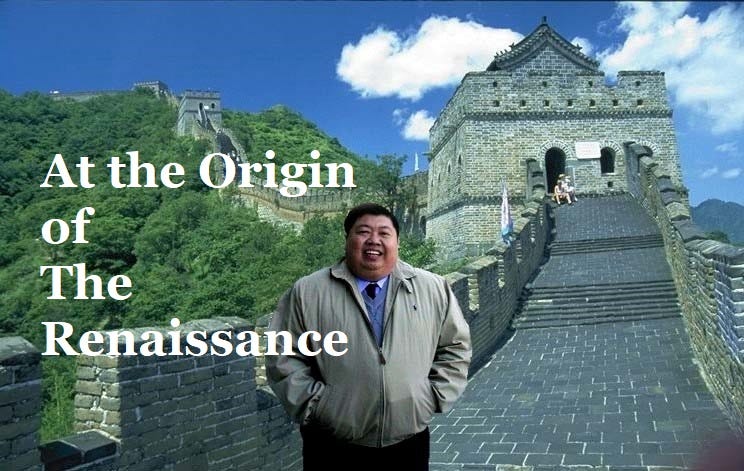
As I walked a section of the Great Wall at Juyongguan Pass near the Ming Tombs just outside Beijing, I was awed by its tremendous architecture, but more by its place and impact on the history of the world. It is the origin of the greatest transformational change of the world — the Renaissance.
The simple concept of a defensive “wall” to deter marauding ‘barbarians’ from the North was in fact responsible for the substantial and massive upheavals in world history for nearly 1,000 years. It is a clear example of the kind of impact that one can expect from a tipping point of change in the existential reality of permanent change.
According to a National Geographic info-documentary, the Huns people (called xiongnu by the Chinese) who were the forbears of the Mongols, emerged from the 3rd century BC in the North of China but were unable to seriously threaten China in the South because of the Great Wall. They failed to conquer China because of the Great Wall, built during the Qin dynasty (221–207 BC) by the First Emperor, which was further extended and strengthened by successive empires. For example, the Han dynasty, which ruled China from 206 B.C. to 220 AD, extended the Great Wall and watchtowers along the Hexi Corridor, a passage between mountains and high plateaus, leading through the Gobi Desert in Western China.
Looking for a way round the Great Wall, the Huns turned their attention Westward and, when blocked by the Urals Mountains, decided to march North instead and eventually conquered then Russia. At the beginning of the first century AD, the Huns crossed the Urals and swept Southwards towards Europe.
They invaded the lower Volga valley and advanced Westward, pushing the Germanic Ostrogoth and Visigoths before them and thus precipitating the great waves of migrations that eventually destroyed the Roman Empire and changed the face of Europe. They crossed the Danube, penetrated deep into the Eastern Roman Empire, and forced many countries to pay them tribute. Attila The Hun, their greatest king, had his palace in Hungary. Most of the territories that now constitute European Russia, Poland, and Germany were tributaries to him, and he was also collecting tributes from the Roman Caesars in Rome. When Rome refused to pay further tribute, the Huns invaded Italy and Gaul, were defeated, but not before they ravaged Italy when withdrawing from Europe after Attila’s death.
A thousand years later, their descendants, the Mongols, led by Genghis Khan, returned to invade Europe with a legacy vengeance after they finally breached the Great Wall and conquered China in 1215 AD. They remained in Europe until the 1400’s AD. This time, the Mongol invasion extended from Russia into the areas of present-day Iran, Iraq, Asia Minor, Syria, Turkey and reaching Southwards into Palestine (modern Israel), even Egypt. The wars drove thousands of refugees into Europe, mostly to France, Germany, Italy and Greece. The refugees became marginal people where they finally settled, to mingle and infuse their own cultures and thinking with the mainstream culture composing mainly Christian and Roman-Greco thinking and philosophies.
The confluence, conflation and syncretism of thoughts, beliefs and cultures in this late-medieval “globalism” provided the driving forces in Europe, at the intellectual and cultural hubs in Italy and Greece, to explode with the Renaissance at this historical moment.
The word “Renaissance” is French for “rebirth”. It was the age of learning. The intellectual explosion of creativity sharpened the sense of individual identity to embolden humanistic endeavours as well as skepticism and cynicism to open the doors of secularism. Faith believers began to question their beliefs openly and moved away from Roman Catholicism towards humanism, and science. The age of reason emerged with science and logical rationality to promote critical scientific inquiry, empiricism and new philosophical conceptualization of life, existence and the issues of temporality. They presented alternatives to faith-based arguments and move away from theology and superstitions. With the Reformation, philosophical liberalism and religious tolerance as well as the consequential decline of Church influence finally gave birth to the “early” modern man as he was ushered into and beyond the age of Renaissance enlightenment.
Some of the famous persons during the Renaissance period included Galileo Galilei, Martin Luther, Christopher Columbus, Michelangelo, William Shakespeare, Johannes Gutenberg and Leonardo da Vinci. For example, Leonardo da Vinci (1452–1519) is often cited as a model Renaissance man. He was a scientist, painter, mathematician, architect and poet.
Historians generally agreed that, had the First Qin Emperor Shih Huangti not begun to build the Great Wall, and the Huns had continued to attack China and likely would have conquered it a 1,000 years earlier, Europe could very well have been stuck in the dark Middle Age for a much longer period and spared the tragic human consequences of the Huns invasion. Europe would have developed along very different tracks at possibly a much different pace and has different outcomes.