How Did All These Cows Get Here?
It’s time we all learned a little more about how big, beautiful bovine bang.
Cows! They’re just like us! Sort of.
Like humans, cows have sex. The boy cows, also known as bulls, have long pink penises coupled with a set of big saggy balls and the girls, called cows, have vaginas that lead to large, duffel-bag sized uteruses. It’s the various combinations of these reproductive structures that we have to thank for cheese, yogurt, milk, steak, burgers and more.
As I tell my high school students, learning about science will make you a better person. So whether you’re in the red-meat-and-potatoes camp or the vegan-beyond-meat-burger camp, let’s dive in and learn how those big ol’ bossie moo cows do it!
A tale of two (types of) penises
The differences between human and bull reproductive anatomy are quite startling. As you may know, a human penis is loaded up with tiny blood vessels. Most of the time, they are pretty empty, but when they fill up with blood, the penis becomes erect and hard.
Tee-hee away, but if you think of this from an evolutionary perspective, it makes sense. It would take a lot of energy to maintain a constant erection. But a soft floppy penis could never accomplish the task of delivering the sperm deep into the vagina to make a baby. Penises that can be either hard or soft are described as vascular, and they can also be found on male horses, dogs and cats.
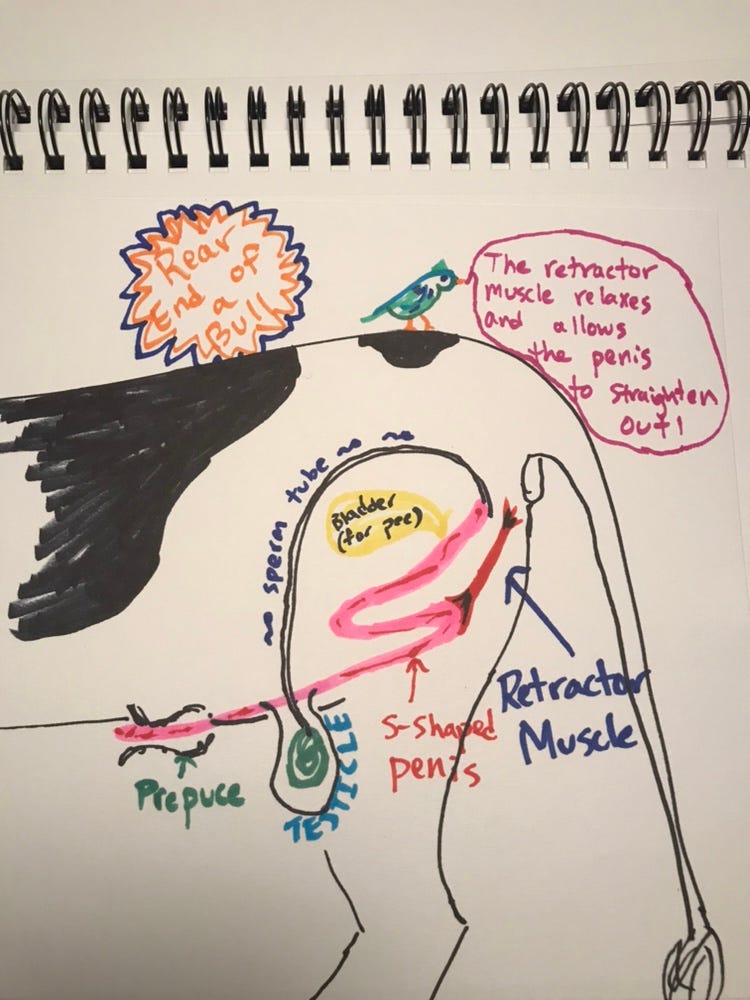
Bulls however, as well as sheep, deer and goats, have a different type of penis called a fibroelastic penis. The fun thing about this type of penis is that it is never flaccid! That’s right, it’s made of a different type of tissue that is constantly rigid. But if you think back to your visits to the farm or petting zoo as a child — you probably don’t remember seeing a bunch of big pink farm animal dicks swinging in the breeze, do you?
This is because animals with a fibroelastic penis also have an S-shaped curve in their penis called a sigmoid flexure. There is a strong band of tissue called the retractor muscle that holds the penis up in the S-shape. When that special moment arrives, the muscle relaxes, and allows the penis to stretch to its full straightened length so that it can reach its desired target. After ejaculation, the muscle contracts and pulls the penis back into the fleshy folds of its hiding place, called the prepuce.
Mooooving on to the ladies:
A baby girl calf is called a heifer and she can get pregnant at about a year old. Determining exactly when a heifer can get pregnant is a little bit art and a little bit science. Like humans, cows cycle through fertility and can only get pregnant at certain times. If you’re a farmer whose farm loan payment depends on getting cows pregnant, you care about this a lot.
If you’ve ever driven through cow country and seen one cow mounting another cow, you’ve witnessed fertility monitoring at its finest. If a cow is not in heat, which means her body is primed and ready to get knocked up, she will walk away when another girl cow tries to hump her. Get off me, you freak. But when she’s fertile, she will stand proud and still, letting other ladies climb right on.
That’s right, when a girl cow is ready to get knocked up, she lets another girl cow hump her as a signal to nearby males that she is in the mood.
Bulls aren’t known for being particularly smart, and they don’t have good eyesight, but it’s hard not to notice a 1,200 pound animal bellowing away under the weight of her friend or sister. It may be a crude system, but it works — otherwise, cows would have gone extinct long before we had the chance to domesticate them.
Since many farmers don’t keep real live bulls on hand to service the girls in real time, they have developed some creative ways to monitor fertility. One way is to put a chalk or paint line on the top of each cow’s tail. When a cow gets humped, the color gets wiped off. When the farmer returns, he knows it’s go time for any of the cows whose tail markings have disappeared.
Speaking of go time, you probably know that many cows are bred through artificial insemination. You’ve probably seen those long plastic gloves and if you’ve thought about it at all, I bet you thought that they were used by vets so they could grab some semen and hand deliver it to the cows vagina.
More than you’ve ever wanted to know about artificial insemination
The fact of the matter is that the breeder actually puts his or her arm right up the cow’s butt! Seems weird, right? They do this in order to grab the cervix from the outside and hold it still so that they can insert a small skinny straw of semen through the vagina and squirt it in to the cervix so that the cow gets pregnant. If you are frustrated in your work and want to change to a career that has a 70% success rate, you could probably get a job as a cow breeder.
I grew up on a farm and our cow breeder used to show up every few months. His name was Jim and he would have coffee and donuts with my parents before he went out to the barn to knock up any cows that weren’t already pregnant.
Now that you’ve started thinking about artificial insemination, you might find yourself wondering where all the semen comes from.
What I’m about to tell you may be startling, but if you think about it, it makes sense.
Semen has to be harvested from a bull. There are lots of companies that specialize in bull semen. This one, Universal Semen Sales even sells T-shirts and mugs. Companies like this keep handsome, sexy bulls on hand and raise them with the most tender loving care so that they produce staggering numbers of strong, healthy swimmers.
In order to harvest the semen, they use something called an Artificial Vagina (AV). Typically, they will bring a steer, which is a bull whose balls have been cut off and a bull into a pen. They will work to get the bull all randy, and eventually, the bull will mount the steer. One lucky human will step in and intercept the bull cock with the lubed up AV which is where the ejaculate is collected. A few seconds later, the semen is graded and then put into a deep freeze.
From there, farmers can buy it. If cows ever figure out 23 and me, some of them may be surprised to find that they have a lot of sibilings. One bull in Wisconsin sired half a million offspring before he died!
The Grand Finale: Cow + Bull Semen = Adorable Baby Calf
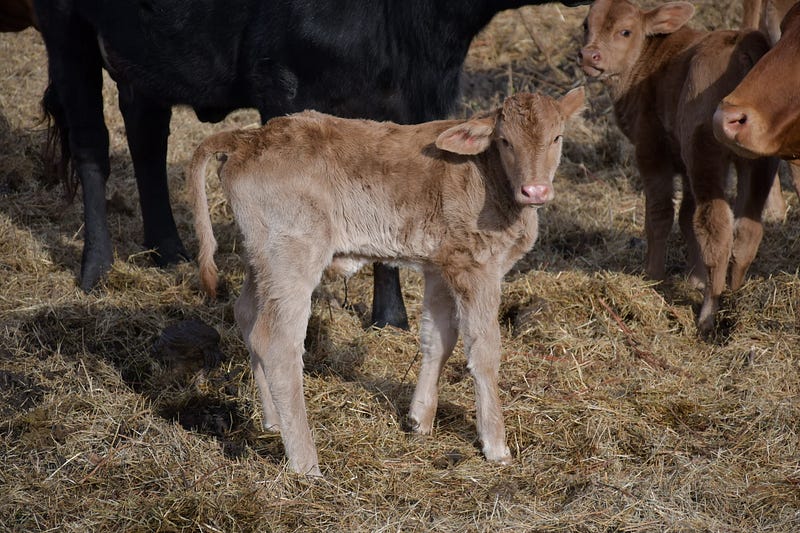
A cow’s pregnancy lasts 283 days compared to a human’s 280 days. When I was pregnant, it felt like an accomplishment to pop out a wrinkly little 8 pound baby. When a cow has her calf, it can weigh upwards of 80 pounds.
Once the cow delivers the baby, the placenta soon follows. Making a baby is tough work and the cow loses a lot of blood during calving. To help make up for those losses, she will immediately chow down on her placenta. Nature doesn’t waste.
Once outside the womb, baby calves, like baby humans, have an insatiable instinct to suck. The first milk that the cow produces is called colostrum and it is loaded with helpful bacteria that protect the calf from the wide and varied germs looking to infect it once it has left the safety of the womb.
There are scarier things than germs though. Cows are prey animals, and as a result, their babies have evolved to be almost immediately mobile. Within an hour or birth, a healthy calf will be up on its feet, toddling around drunkenly towards it’s future, which, if it’s lucky, will include lots of sex.
That’s how it happens. Day after day, year after year, calf after calf.
And maybe you didn’t really need to know all this. But don’t you feel a little better now that you do?