
How deadline-driven behavior sends your Scrum Teams spinning out of control
And 17 things to try instead. #11: Improve your team’s learning velocity.

If you want to hear the deafening sound of utter silence, say these words to a software delivery manager:
“To increase the odds of hitting your goals, don’t push your teams to deliver by a deadline.”
Having the slightest disdain for deadlines and plans is the ultimate form of bad manners in a corporate world. The corporate engine happily hums along by trying to deliver ideas by promised dates. Employees get hired and promoted based on their prowess at this game.
And yet, driving a set scope to a fixed date within a certain budget is the worst way to build a product. These days, we call this an output focus. We used to call it the iron triangle of project management. Regardless of the name, it does not play well with complex, uncertain product work.
I coach on Agile ways of building software products — mainly using a framework called Scrum. This is all a fancy way of saying I build the culture you need to create better software products. And moving folks from an output to an outcome focus is my most consistent, thorny challenge.
Deadline-driven behavior hits me fast when I start coaching an organization unfamiliar with Agile. And in an instant, every fiber of my being recoils at it. It spawns this reaction in me because I’ve seen it reverse and even destroy Agile journeys.
When I am confronted with this behavior, I’m often at a loss of words to describe its heinous effects. My spur-of-the-moment response is, “You will achieve your goals better if you focus on outcomes, not outputs.” Or I say, “Innovative teams need a purpose, not a constraint.” These statements are as convincing as trying to get a dog to trade a steak for a piece of bread.
I need something richer than a one-liner to paint the tapestry of problems caused by deadline-driven behavior. The compelling story from my experiences needs telling. I need to paint a complete picture.
The perilous domino effect of deadline-driven behavior: a pictorial representation
As I pondered how to tell the story on deadline-driven behavior, I recalled a system effects map crafted by John Cutler. His map painted the complex downstream, undesirable impacts of having high work-in-progress¹.
This representation is exactly what I needed. It inspired me to create a similar map for deadline-driven behavior. Figure 1 shows the result of my effort.
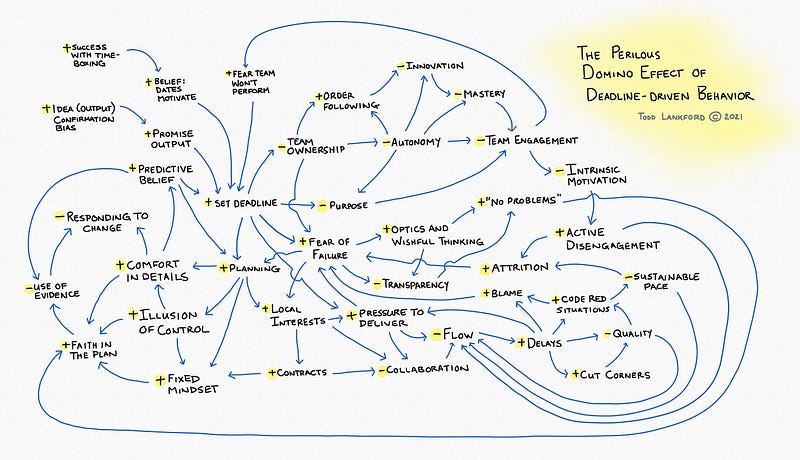
A picture does tell a thousand words after all. This map simplifies the story of the ill effects of deadline-driven behavior. It shows how driving teams to a fixed date triggers a chain reaction like when dominos fall.
Finally, I had a guide for a deeper discussion on how due dates don’t drive the results — the outcomes — we desire. Let’s walk through the key aspects of the diagram.
How it all starts
We don’t set due dates with malicious intent. It all starts with innocent, good intentions.
Business needs emerge, customers desire solutions, and stakeholders generate ideas. Ideas get traction, budgets require an end date, and dates get promised. This is the pattern for setting deadlines. And no team consultation occurs.
From an early age, we learn the importance of deadlines and delivering against them. We have to turn our assignments in on time in school. Our butts have to be in our seats when class starts. All our exams occur on set dates. If we miss any of these deadlines, we get a lower grade.
This pattern continues as we enter the workforce, and it amplifies. Our careers and compensation depend on us setting dates up front and then delivering on time. So the ability to predict and deliver to our guesses permeates our inner beliefs and outward behaviors.
Many of us also believe deadlines can be a motivational tool. Perhaps we’ve seen time-boxing produce phenomenal results in the past. Maybe we have a demotivated team, and we are afraid they won’t perform without a tight delivery window. Whatever the reason, we make the mistake of using a deadline to motivate a team to deliver.
These are some of the reasons setting a due date and planning to meet it gets baked into our nature. We do these things in an attempt to gain control and ensure a successful result. But in the uncertain, complex product development world, change is the only constant. Our plans grow stale fast.
We are desperate to find stability amidst the change swirling around us. A due date is the mirage of something stationary. So we try to grab hold to a fixed date, but its roots are shallow.
Once a deadline gets set, all the problems creep in and rob our teams of success.
The planning theater
Now you have a deadline, and the planning games begin.
Management needs to verify the date is achievable. Scrum Teams have to prove they can think of every detail necessary to deliver on time. It is a frenzied flurry of activity. Risks get mitigated, details fan out in every direction, and options get vetted and chosen.
Many believe details increase the ability to predict the future. We become more confident the more details we add to our plan.
And managers gain comfort when they see detail. It’s often the only way they release the reins and trust their teams. Ten years ago, I have a distinct memory of a manager telling me this about a plan: “Details inspire confidence.”
But the one thing that would help chart our successful delivery is missing — evidence. No amount of planning or detail will give us any proof of the reality on the ground. The only way we can gain evidence is to stop staring at a plan, put our feet on the path, and start walking.
Instead, we fall in love with the plan and become fixated on it. The plan and hitting the date becomes the goal. We apply optics, rationalize away problems, and stick to the plan. Output is our focus, and our ability to accept and respond to change plummets.
We tend to stay wrapped up tight in the comfort of our detailed plan like a warm blanket.
The drowning out of engagement
If a team’s engagement improves, its intrinsic motivation to perform increases. High intrinsic motivation is a reliable predictor of future performance. And you can gauge engagement based on a team’s level of autonomy, mastery, and purpose².
“When the reward is the activity itself — deepening learning, delighting customers, doing one’s best — there are no shortcuts.” — Daniel Pink, Drive
But setting a date as a goal does not create the inner drive to motivate a team. As a purpose, dates are about as inspiring as reading an accounting ledger.
When dates and scope are set for a team to meet, autonomy vanishes. I often find those in charge don’t consult the team on solution ideas or the effort to deliver them.
Teams in this situation don’t get to master the craft of using their collective minds to achieve a purpose. The result: a team’s mastery gets relegated to how well they can follow orders.
As a team’s level of engagement suffers, intrinsic motivation plummets. This spawns a downward spiral of morale, ending in the full-dark place of active disengagement. And the only place to go for those with active disengagement is to another company. They will leave for greener pastures.
And those that stay get to deliver ideas they did not generate by a date they had no say in setting. They follow a plan and do as they’re told as these are the only things they can control. Teams in this situation have a real fear of criticism—or worse—if they miss the date.
If you are lucky enough to have seen it, Scrum Teams with high engagement are like birds taking flight. Caging teams with a fixed scope and an imposed due date robs them of flight.
The viscous fear cycle
Fear of failure is like cancer for Scrum Teams. It grows and chokes out autonomy and transparency. Pressure to meet a fixed date fuels the growth of this tumor.
The pressure to deliver destroys collaboration and increases local interests. The result is every team looks out for itself. Team members begin to perform only work in their control and pass the hot potato off to others to do their part. Teamwork and helping each other get work done is no longer a focus. It’s a time of every team and team member focusing on survival.
When collaboration suffers, flow time elongates. And the propagation of active disengagement from those already disillusioned extends flow time further. In no time, delays start to pile up. Teams cut corners on quality in a desperate attempt to reduce the delays to the timeline.
The inevitable result is a code red situation where teams are out of time and money and the due date is looming. This is where optics take over, and the blame game begins.
The only transparency going on during this time is blaming those at fault, often by name. The blame and pressure are intense. Many can’t take it and leave. Those who stay have an ever-growing fear tumor, restricting and dictating their every move.
Pressure to deliver to a promise made up front in an uncertain, complex environment is a recipe for fear. And fear leads to disaster for Scrum Teams.

What can we do if we can’t set deadlines?
I have a starter list of ideas for you to avoid the deadline trap. You need to move from prediction to favor a learning culture, and embrace uncertainty. Here are seventeen ideas to get you started on this path.
- Make experimentation safe even when the experiment fails.
- Focus on achieving value instead of meeting deadlines.
- Test ideas with your customers before, during, and after delivery.
- Commit to goals (Product Goals and Sprint Goals) and keep dates, scope, and plans negotiable.
- Remove waste in your process so you can reduce your lead time.
- Try something simple to learn instead of creating a detailed plan.
- Co-create short-term and long-term goals with your teams.
- Involve stakeholders in building your product instead of promising a date.
- Involve your team in brainstorming ideas to meet goals.
- Have teams own the creation of their estimates and delivery forecasts.
- Improve your team’s learning velocity (the build, measure, and learn loop frequency).
- Engage teams with customers and stakeholders to learn what they need (no intermediaries).
- Coach teams to use evidence gained by recent delivery to refine remaining backlog delivery forecasts.
- Build goal-oriented product roadmaps instead of feature and deadline-driven roadmaps.
- Allow teams to prove they can speed up by self-improving the way they work; don’t ask them to set stretch goals.
- Aim to reduce and simplify output and maximize outcomes.
- Create delivery forecasts with date ranges to reflect uncertainty.
Taking it forward
As a coach, I now have a picture to help me explain the widespread, undesireable effects of deadline-driven behavior. Setting a due date up front seems natural, harmless, and like a good thing to do. But the far-reaching, negative impacts to a Scrum Team can be disastrous.
At its worst, deadline-driven behavior leads nowhere good. It propagates fear, saps team engagement, and drives people to leave.
But we can choose to move away from using dates to motivate Scrum Teams to deliver. I’ve worked with a large, 400+ person division to do this at scale with a no-deadline policy. When a customer or stakeholder would ask anyone in this group for a due date, the response would be:
“We don’t set deadlines. We focus on solving your need. Can we involve you in how to do that?”
Instead of setting deadlines, we can set meaningful goals and use evidence to chart our path towards them. We can look to reduce and simplify what we deliver to maximize outcomes. We can pull our customers and stakeholders closer and involve them in delivery. This beats making an empty promise to deliver a fixed scope by a fixed date any day.
“I think people get satisfaction from living for a cause that’s greater than themselves. They want to leave an imprint.”
— Daniel Pink
Will you take steps to move away from deadline-driven behavior? You too can remove the shackles of deadlines and free your Scrum Teams to take flight.
For more content like this on my pursuit of Lean Leverage, delivered to your inbox, you can just join my email list. Or see my other related posts below to dive even deeper.
Related posts
You can find other related posts from the author below:
References
- WIP It Real Good, John Cutler, Hackernoon on Medium
- Drive — The Surprising Truth About What Motivates Us, Daniel H. Pink, 2011



