
The Lord Takes Delight in His People
How Dare You: The One Way Christians Empty Their Church
Peter Kreeft: “There’s one big thing wrong with the Christian religion”
Christianity has only one flaw: Christians. Even our worst critics expect us to be “holier than thou,’’ but too often, we’re prideful, thoughtless or cruel.
Emotions were raw after two months of lock-down, but my parish’s first public Mass came on the 100th birthday of St. John Paul the Great, so I was excited.
We had to sign up online for that first post-pandemic Mass. We could only be filled to 5 percent capacity (45 people in the largest parish in our diocese).
We had new rules, including the wearing of masks, complying with Michigan Gov. Gretchen Whitmer’s order to wear some form of face-covering indoors.
The Catholic Church is a microcosm of the bigger world: all sorts of very different people with different feelings, fears, and views. Yet, all of us are family. All broken, hurting sinners.
Field hospital re-opens — after two months of Invisible War
“The thing the Church needs most today is the ability to heal wounds and to warm the hearts of the faithful; it needs nearness, proximity,’’ Pope Francis said in 2013.
“I see the Church as a field hospital after battle. It is useless to ask a seriously injured person if he has high cholesterol and about the level of his blood sugars!” You have to heal his wounds. Then we can talk about everything else. Heal the wounds, heal the wounds.’’
All the wounded lonely people. During every crisis in our lives, we’ve been able to escape the outside world by going to Church.
Not this time: churches closed from Rome to home. When they re-opened, we had to wear masks, visible physical reminders that dangers surround us, that we all carry germs and need to protect ourselves from harming each other.
We consider Church sacred — masks remind us Church is dangerous, filled with the same panic, pain, and pandemic of the outside world.
Our normally welcoming talkative parish was the quietest I’d ever heard it, like all were in mourning.
Just 13 hours earlier, I’d been at a joyous outdoor Mass at nearby Orchard Lake, Michigan but now closer to home, on its first Mass, my normally welcoming Brighton parish felt sad and quiet in comparison: no music. Just silence. Smiles hid behind masks.
All covered our faces to get in. Our priest said he was so happy to see us but noted he couldn’t see our faces or reactions.
As the Mass began, Father and the seminarian lector removed their masks. I sat in a corner, as far apart from everyone else as I could sit. Sitting in my isolation, I felt I, too, could let the red wool scarf around my face fall to my shoulders. The scarf was very close so I could quickly cover my face again (if I got near anyone else). But far enough to breathe.
We began reciting the Lord’s Prayer, the all-important prayer Jesus taught the first Christians:
“Our Father, who art in Heaven, hallowed be Thy Name. Thy Kingdom come, Thy will be done…’’
Then a woman decided to interrupt the Lord’s Prayer
Suddenly, a Church staffer, a classic “church lady” grandmother, was hovering at my side, standing in my physical space.
She interrupted the Lord’s Prayer, acting as if she were my mother scolding a misbehaving naughty boy. It was like I was somehow publicly humiliating her with my errant ways. She shouted over the prayer:
“Joe! You know you’re supposed to be wearing a mask!’’
Stunned that she would interrupt the Lord’s Prayer, I kept looking toward our Altar and simply took the scarf draped on my shoulder and re-covered my face, refusing to look her way.
She backed away, allowing us to continue our prayer to our Lord. I didn’t want to see her face. I wouldn’t let her see mine.
Stifling my anger, I fell on my knees and added another prayer, combining the words of Jesus with my own:
“Father, forgive them, they know not what they do. Father forgive me. I know not what I do either.’’
How dare you: How we quit churches, how families are torn apart
One well-meaning comment from a religious lady made me lose my desire to be inside my Church (at least temporarily). We all make or are wounded by this same mistake:
We see something we feel certain is wrong, point to another, and pridefully think or say, “How dare you!’’ Just like the Swedish teenager disgusted with world rulers.
We allow ourselves to think of the Church as the people who run the parish or religious organization.
We allow ourselves to forget God is really in charge, that His children are just doing their best (or less). When we convince ourselves people are out of line, we find another church or stay isolated in a one-person religion of our own rules, emotions, and loneliness.
The desire to start a new church of our own making began when our mother, Eve, agreed with the serpent that God’s first rule was too strict. It continued with every church schism, with the creation of more than 37,000 branches of Protestantism. Each founder of a new church decided their founder had “a better way’’ than the one holy Catholic and Apostolic Church founded by Jesus and His Disciples 2,000 years ago.
Every single person who left their faith (or one parish for another) knows one line of Scripture by heart: “Judge not lest you be judged” (Matthew 7:1). But we do all judge and we ourselves hate being judged. So we bolt. We long to discover our own Catholic Way Home.
Encounter: How one lousy experience breaks, scars and divides
Jesus unites. The devil divides. The Archdiocese of Detroit, in the heart of one of the pandemic’s deadliest hot spots, advised people who care for the sick, performing acts of mercy, to stay away from Mass until the disease subsides.
St. Bonaventure in Detroit, home to Blessed Solanus Casey, told these hurting people in need to stay away in a May 20 email: “Those older than 65 years old with a compromised health condition, those who are ill, those who care for the sick and those who are immunocompromised or at risk of complications from COVID-19 are strongly encouraged to stay home for your own safety and as an act of justice to the whole community.’’
Humans can’t keep a Church together, united in community, without Holy intervention. We expect our church leaders to be holy, and when they show their obvious human flaws, we feel a sense of betrayal.
Clericalism is the widespread mistake of confusing the priest or religious leader with the God they represent. They are humans, as messed up as we are or maybe even more, but we allow ourselves to forget that. When they sin, we wrongly blame God and His Church for the sins of his children. In his “Letter to a Suffering Church,’’ Bishop Robert Barron explains:
“The Spanish word for ‘priest’ catches this nicely: sacerdote (holy one)… the smile of a priest is, for many Catholic people, the smile of God himself… I would sense both a deep love for the Church and a practically bottomless disillusionment…
In the early 1970s, roughly 5 percent of Americans identified as having no religion. By the early 1990s, that figure had slightly risen to 6 percent… But today the percentage of religiously unaffiliated in our country is 25 percent. The percentage of “nones’’ under the age of 30 rises to 40 percent and among Catholic youth, the figure is an incredible 50 percent…’’
Everything God creates is good so His Church is good. But people bring the germs and viruses of the world to their Church and people are harmed.
Why would God make bad people? He doesn’t. Look at any new-born baby, and you know we are all born good but we quickly lose our way. Sin is an archery term meaning “missing the mark.’’ We aim for greatness but fail spectacularly.
Barron, in his beautiful “Letter to a Suffering Church,” explains how Christians sin, mess up and miss the mark. We need this “field hospital’’ because we need healing, but in our brokenness, we also disappoint or hurt others:
“The Church, from the very beginning and at every point in its development, has been marked to varying degrees by sin, scandal, stupidity, misbehavior, misfortune and wickedness. John Henry Newman observed: ‘The whole course of Christianity… is but one series of troubles and disorders.’
“Every century is like every other, and to those who live in it, seems worse than all times before it. The Church is ever ailing… Religion seems ever expiring, schism, dominant, the light of truth dim, its adherents scattered, The cause of Christ is ever in its last agony.’’…
The Emperor Napoleon, trying to destroy the Church, confronted Cardinal Consalvi, who responded: ‘Oh my little man you think you’re going to succeed in accomplishing what centuries of priests and bishops have tried and failed to do?’’’
Conclusion: Why we stay and why we go — will we find our way?
One harsh sentence from one Church lady trying to “help’’ me (but simultaneously judging me) washed away all my desire to be inside my Church. One sentence snapped six years of desiring to go to Mass daily.
St. Teresa of Calcutta called a sudden painful emptiness a “spiritual dryness.” She proved you can lose your desire yet still find your way home.
For centuries, Catholics attended Mass because of a religious obligation to participate on Sundays and special feast days. Once people are “on fire’’ for their faith, they come because they choose to come, because they feel called.
Then one person rubs us the wrong way (or worse), and we divide over theological questions and (now) public health questions. We read of the churches that opened and then had to close when others were infected. We read articles about choirs being dangerous. We know little — but need to feel we know.
We hear conflicting messages from our own governments over whether masks or treatments help or hurt more. And we judge.
We judge and feel judged for doing something or not doing something. And as we judge, we see the speck in our brother’s eye without recalling the log in our own.
I went online after my painful moment with the church lady. I looked for a mask that would “feel right” to wear to Church: no easy thing because masking your true identity during Mass is dangerous.
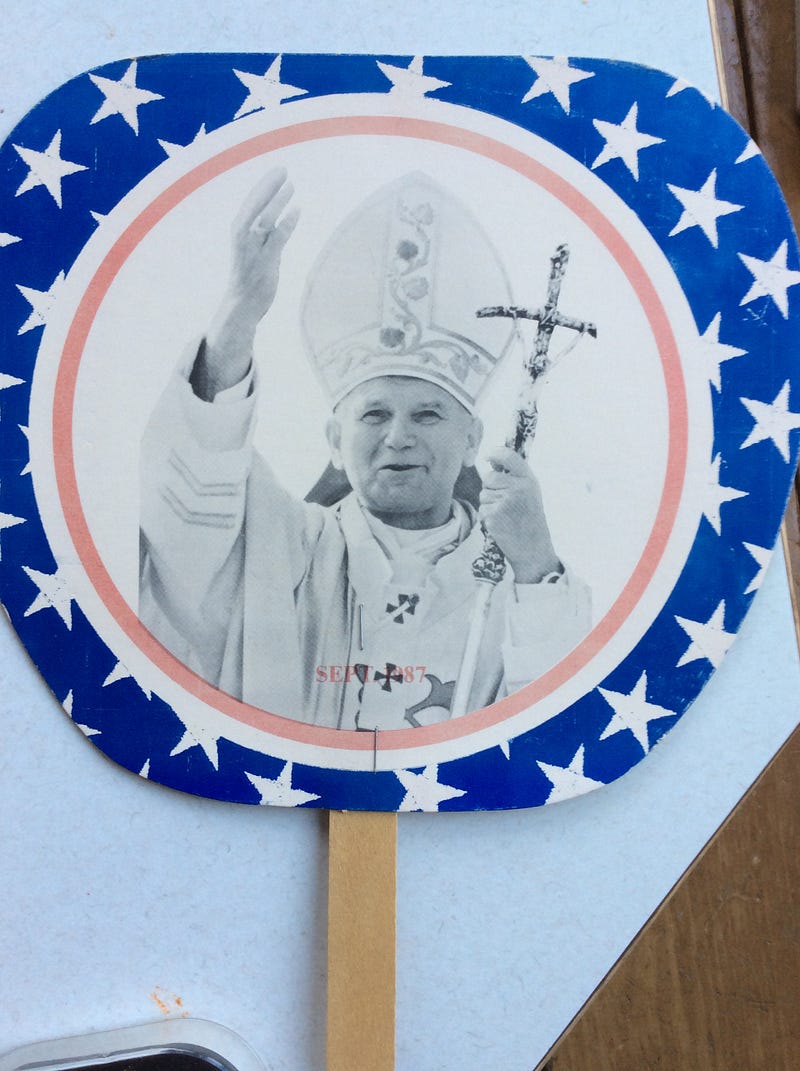
Some masks already for sale have religious messages. While praying at that May 18 Mass, I recalled hand fans (made for hot outdoor Masses) depicting St. John Paul and imagined covering my nose and hands with the face of my favorite saint. Maybe something like that would work? A way to feel faithful and obey changing public health rules at once?
Or maybe I should just avoid the crowds, pray on my own and wait until the masks are optional or gone?
Community is always challenging, but spiritual communion becomes even harder when we are busy judging each other’s actions. Bishop Barron adds:
“We do indeed have to look hard at the wickedness in the Church today; but we also have to be clear-eyed about the beauty and veracity and holiness on offer in the same Church.
“The vessels are all fragile and many of them are downright broken; but we don’t stay because of the vessels. We stay because of the treasure… there is simply never a good reason to leave the Church. Never.
“Good reasons to criticize Church people? Plenty. Legitimate reasons to be angry with corruption, stupidity, careerism, cruelty, greed, and sexual misconduct on the part of leaders of the Church? You bet. But grounds for turning away from the grace of Christ in which eternal life is found? No. Never, under any circumstances.’’


