
How Could We Sing About Anything Else?
Pantheism, atheism, and the restorative power of nature.
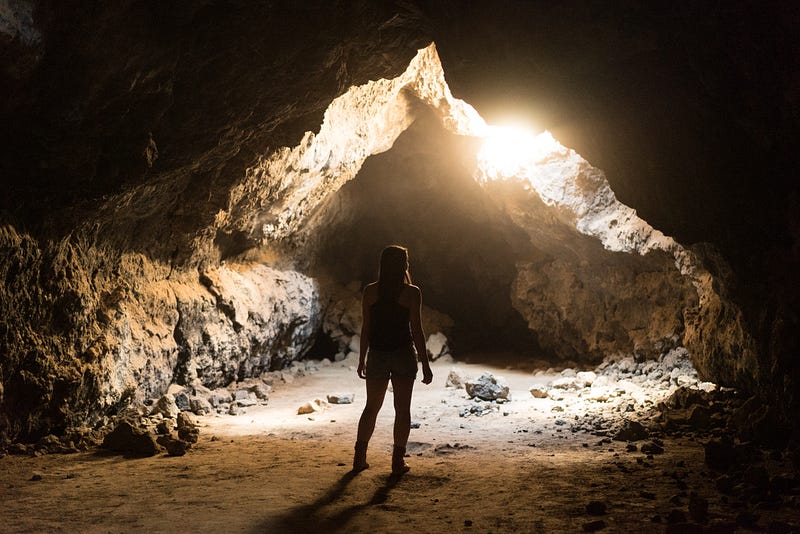
We are separate from the world.
This is what we’re taught, from the moment our soft and malleable heads grow big enough to hear it. Everything around us is either friend or enemy. Everything is either useful or useless.
But the more of the world you see, the more limited this utilitarian view begins to seem. We didn’t come into this world; we grew out of it. And there’s a lot the quiet places of the earth still have to teach us.
I used to cross continents.
Remember? The two of us finding something unnameable under a foreign sun. The fast-fleeing gleam of the real seen in the momentary flash of a passing bus window.
Or the halting, haunting glimmer on a waveless patch of sea. That’s what it’s always been. A door I’ve been banging on for decades. It’s never opened. But sometimes, I swear I hear the bolt slide back.
The pullouts were full of cars and cops.
Bullies in blue breaking up unlawful gatherings under a hot and early sun. But when I pulled up at the gate I was looking for, I was all alone.
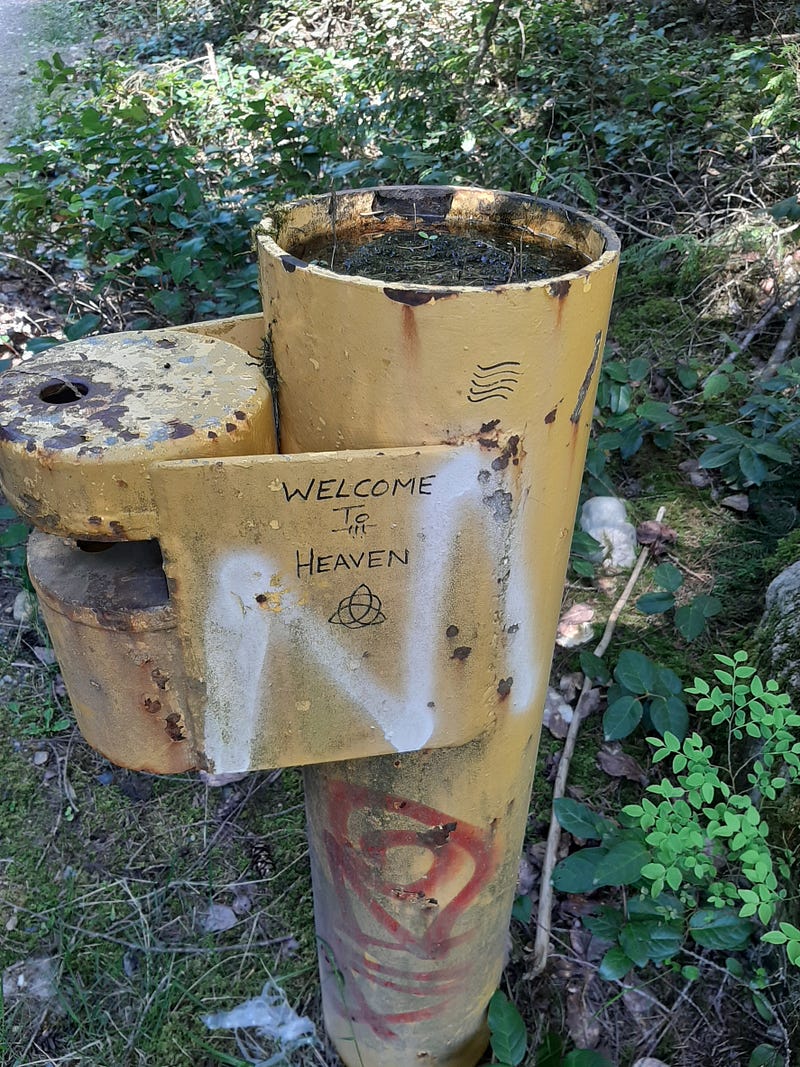
Welcome to Heaven, someone had written on the gate post in permanent marker. But Paradise is perilous. I picked up a stick. It’s May, and the empty forests are filled with predators. As full as the prison the map told me sat just out of sight, on the other side of a screen of tall trees.
At the end of the trail, a roaring river rushed by. No filters are needed here. The green water glows like it’s lit from beneath, greener than spring, greener than envy, a green so bright and brilliant that it almost hurts to look at.
Take a left. The trail gets narrow, overgrown each year by the endless advance of plants. Patches of mud cling on under the sun, their rust-colored skins wrinkled by the passage of biting flies. You weren’t there. There was no one to talk to, so I talked to myself. The human voice is anathema to predators. Despite what we feel, we are not defenseless. I narrated my journey like it was a story, and when I reached the cliff, I was almost finished.
The forest pushes back the light. But in needle-floored clearings, the sun clung to graffiti-tattooed tree trunks. Where the fires burned, weightless chunks of carbon still bear the pattern of growth of the trees they used to be. Insects buzzed in patches of syrupy light. Brambles clung to my clothes.
The forest swells each spring with an excess of life, burning with the green flame of nettles and berry bushes that can’t grow fast enough.
No axe ever fell here. These forests were ancient when my ancestors were pressing shaking hands to the damp walls of caves. But every season is the first one ever. There’s only one spring, repeated four and a half billion times.
And how can the birds be singing about anything other than love?
As children, we believe in fairytales. Until we learn the truth. But if you peer deeper into that chasm, you’ll start to see that early light all over again. Bird calls are offers of sex, solicitations, cries of hatred and rage, declarations of war.
Yes. That’s what love is.
In the philosophy of Spinoza, God and nature are the same thing.
If God is everywhere, then he must by necessity be in the rivers and the trees and the mountain and, crucially, in every one of us. This is the kind of thinking that gets you cursed and anathematized in 17th century Amsterdam. But Spinoza was hardly the first thinker to come to the same conclusion.
The ancient Hindu philosophy of Advaita, or non-dualism, teaches that the true self of a person, the Atman, is one and the same with the highest reality of the universe, Brahman — in other words, God.
Heraclitus of Ephesus, who reasoned that change is the one constant in the universe — an argument Buddhists would recognize — also taught that the world is a constant fire that has the exact same characteristics as God. You’ll find echoes of the same philosophy in the Gnostic gospels of Christianity.
If you believe in an infinite God — and why believe in one that isn’t? — it doesn’t seem like much of a stretch to believe that God is everywhere and in all things. And as the boundary of scientific knowledge has continued to advance into areas that used to be the province of religion, God has been forced to retreat into the gaps between current theories. Spinoza’s heretical view has become, if not mainstream, then at least far more acceptable.
Here the trail ends.
Here the cliff yawns open, cold even in the hot sun. A sandy-floored cave overlooks the river rushing river like a frozen scream. But it’s the river that tells the life of the mountain. You can read its guts in the stones that roll downstream.
Like the mountains, our heads get white in winter. Like the mountains, our stories trail out behind us, winding through the dangerous ground of the past on their way to the sea.
That perfect green shade of the water will never be repeated after today. Not precisely. Not exactly. As Heraclitus said, you can’t step into the same river twice.
A ladder built from logs rises from the edge of the water. Furred with moss, the irregular steps sag. At the top, a smaller cave breathes out cold air that streams down to the water.
Because in this forest, everything breathes and everything moves. And to stand on that rotting ladder and feel the cold air pouring out of the cave is to feel the breath of the world moving past you and through you, filling your lungs and colliding with isotopes from everywhere you’ve ever been. Every stray gust that ever moved through you and launched you toward the next.
In The God Delusion, Richard Dawkins calls pantheism “sexed-up atheism”. He has a point. To say that everything is God is ultimately the same as saying nothing is. Sooner or later, every mystically-minded lover of nature is going to have to confront the fact that pantheistic belief amounts to no belief at all.
We are made of elements formed in the big bang, the residue of swirling galaxies and supernova stars. We know we are made, ultimately, of the same things as the mountains and the trees and the singing birds swooping joyfully over the jewel-green river. What was philosophy for our ancestors is a demonstrated scientific fact for us.
And that only increases the wonder. The forest gods are dwindling, receding deeper into the caves, their voices forgotten like last year’s dead leaves. It turns out that the world is far grander and far more beautiful when looked at for what it really is.
These things — the mountains, the river, the forests, the wind — aren’t part of our story.
We are part of them. No words you could utter or song you could sing will shake these trees from their deep dream of a vanished world. The river rushes on, impatient to reach the sea and be reborn.
Sometimes, that’s all we need, isn’t it? The walls that hem us in start to recede the moment we get a glimpse of a world that doesn’t know us. The mountains don’t see you and me. They barely notice when we build our roads around them. They breathe slow and cold while we hurry past, as inconsequential as the swarming flies.
As I made my way back to the deserted parking lot, I swung my stick and talked to the listening dark. Cave swallows and kingfishers and starlings sparred in the air.
“Why shouldn’t we sing about love?” they cried, riding currents of air above the prison, above the mountains, above the beautiful indifferent world. “How could we sing about anything else?”


